
Ask a feed-mill operator about pellet quality and they will start talking about the conditioner. Ask a small wood pellet producer the same question and you often get a shrug — many compact lines run with no conditioner at all. Both answers are right for their own machines, and the gap between them is one of the most misunderstood topics buyers bring to us. This article explains what conditioning actually does, what steam adds in numbers, why wood and feed behave differently, and when a wood pellet line genuinely benefits from conditioning equipment.
What the conditioner actually does
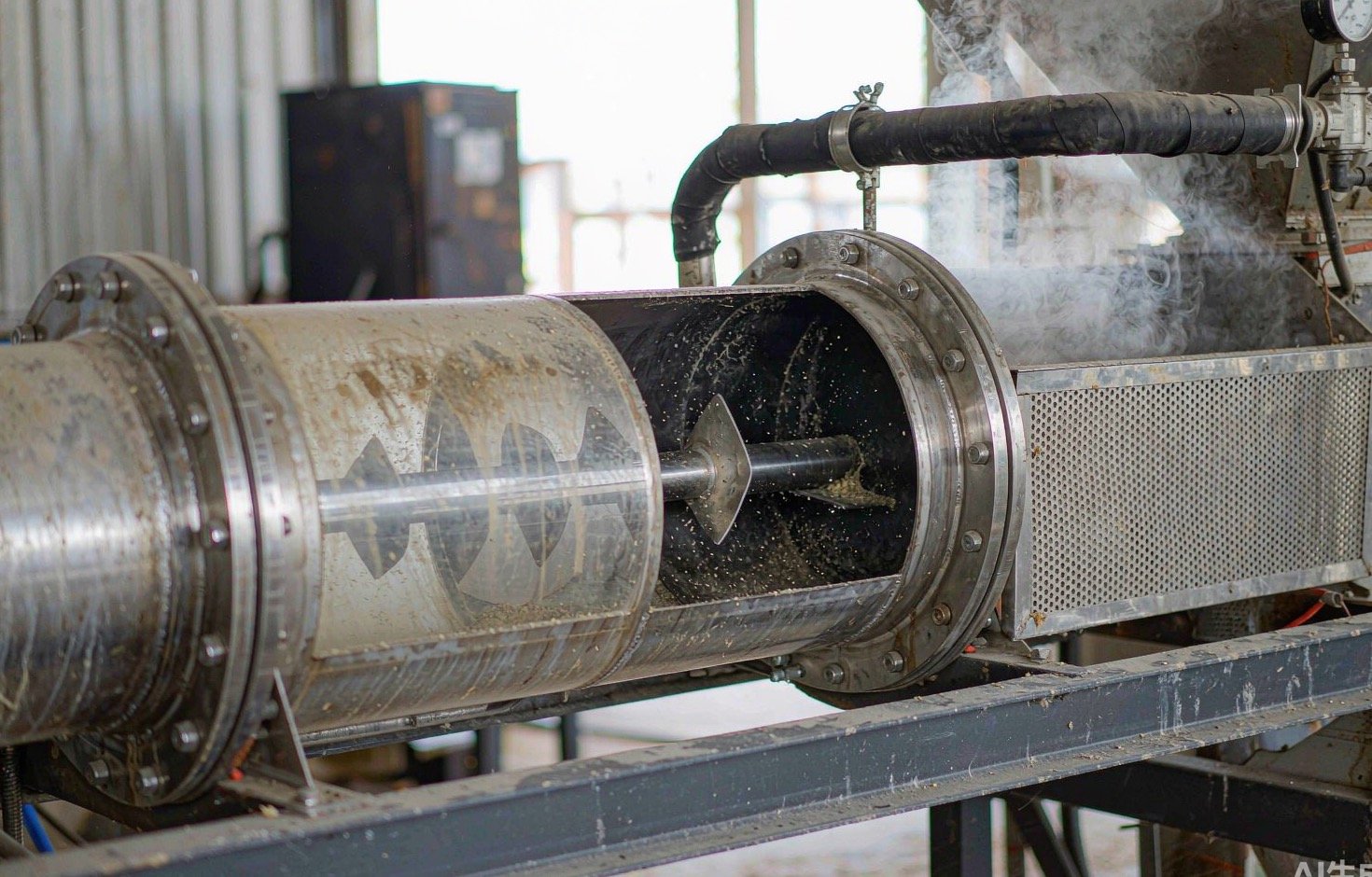
Conditioning is the step between grinding and the die. Ground material passes through a horizontal barrel with a rotating paddle shaft, where steam (sometimes water) is mixed into it. Three things happen in that barrel: the material heats up, its moisture rises, and the particles soften. Kansas State University’s feed manufacturing guide sums up the purpose plainly — steam conditioning increases die lubrication and softens feed particles to increase binding capacity (Kansas State University Quality Feed Manufacturing Guide).
The lubrication part matters more than newcomers expect. Hot, moist material slides through the die channels with less friction, so the mill draws less power for the same tonnage and the die wears slower. The binding part matters even more: heat and moisture activate the natural binders in the material, and pellet durability is decided in that activation.

The steam arithmetic, in real numbers
Steam conditioning follows a useful rule of thumb documented by Kansas State: for every 25°F (about 14°C) increase in conditioning temperature, roughly 1 percentage point of moisture is added to the feed (KSU guide). The same guide gives the operating targets for typical corn-soybean feed diets: 180-200°F (82-93°C) conditioning temperature and 17-18% total moisture at the die, with a retention time of about 30-45 seconds in the conditioner. Above roughly 18% total moisture, pellet mills start to plug — which is why the conditioner is a balancing act, not a “more steam is better” dial.
The effect on pellet quality is dramatic when measured. In a Kansas State trial, pellets made with no steam conditioning came out of the cooler with a pellet durability index of 3.3%; adding steam to reach a 190°F conditioning temperature raised PDI to 91.1%, with the steam adding 4.2 percentage points of moisture along the way (Wecker et al., Kansas Agricultural Experiment Station Research Reports, 2020). No other single change on a pellet line moves durability by that margin.
Industry references add the steam-side numbers: feed lines typically condition to 80-90°C and 14-18% moisture, consuming on the order of 60-63 kg of dry saturated steam per ton of feed, at steam pressure around 0.25-0.30 MPa (Univer Machinery). Steam quality is part of the equation too — wet steam dumps water on the particles without heating them through, and superheated steam does the opposite. One practical guide puts the optimal conditioning window at 70-85°C with retention times of 30-120 seconds depending on the formulation (Agrikima).
| Parameter | Typical feed pelleting | Typical wood pelleting |
|---|---|---|
| Conditioning temperature | 82-93°C (180-200°F) | No steam on small lines; large lines condition toward the die’s friction-heat zone |
| Moisture at the die | 17-18% (plug risk above ~18%) | 10-15% window |
| Retention time | 30-45 seconds | Not applicable on lines without a conditioner |
| Steam use | ~60-63 kg per ton of feed | Usually none; water addition on some lines |
| Main binding agent | Gelatinized starch | Softened lignin |
Feed figures: Kansas State University guide; steam figures: Univer Machinery; wood moisture window: Biomass Connect.
Why wood is not feed: the lignin route
Everything above describes feed pelleting, where starch is the binder and steam gelatinizes it. Wood works through a different binder: lignin. Lignin is a thermoplastic polymer — it stays rigid when cool and turns rubbery when hot. The softening temperature depends heavily on moisture: in dry wood lignin it sits near 195°C, but with enough water present it drops toward 90°C, and pelleting studies cite a softening range of roughly 110-135°C for wood materials in the 8-15% moisture range (diva-portal thesis collection on fuel pellet processing, citing Goring 1963 and Lehtikangas 2001).
Here is the practical consequence: a ring die running wood generates that temperature by friction. The material inside the die channels heats up under compression, the lignin softens and flows between fibers, and when the pellet cools and the lignin re-hardens, it acts as the glue. This is why so many wood pellet lines — especially compact vertical ring die lines — run with no steam conditioner at all. They buy their heat at the die face, not in a barrel upstream.
It also explains why wood tolerates less moisture than feed. The wood pelleting window sits around 10-15% moisture (Biomass Connect pelletisation guide), and the feed-mill habit of conditioning to 17-18% would push wood lines straight into die plugging and soft, deformed pellets. If you are coming to wood pelleting from a feed background, unlearn the moisture targets first. Our article on the ideal moisture content for wood pellets covers the wood window in depth.
So does a wood pellet line need a conditioner?
Our honest answer, after years of watching both configurations run: below roughly 2 t/h on clean sawdust, most plants do fine without steam conditioning, provided the dryer holds moisture steady and the die is matched to the material. The friction path works, and the capital saved goes further elsewhere in the line.
Conditioning starts paying for itself higher up the scale or on difficult materials. Large industrial wood pellet plants — the kind running horizontal ring die mills toward full-rated capacity — commonly use steam conditioning to preheat the material so the die reaches its binding-temperature zone sooner and with less friction loss. On fibrous, low-lignin materials the logic is even stronger: straw, for instance, carries roughly 12-18% lignin against softwood’s ~25-30%, which is why straw generally needs steam conditioning and/or a small starch addition to bind at all (TCPEL engineering guide — see also our comparison of vertical and horizontal mill designs).
The trade-offs to weigh are concrete. A conditioner adds a steam boiler or other heat source, piping, traps and insulation — capital and a maintenance surface. It adds a process variable that someone must control: the KSU guide recommends checking the conditioner weekly for buildup, monitoring temperature, retention time and conditioned moisture continuously, because a conditioner that drifts silently degrades quality two shifts later at the cooler. And it changes your drying target: material entering a conditioner should sit drier, since the conditioner will add moisture back. Over-drying ahead of a steam line wastes exactly the energy you spent in the dryer — a point our dryer buyer’s guide examines in detail.
Diagnosing conditioning problems
Conditioning failures announce themselves at the mill and at the cooler. Learning to read the symptoms saves die life and downtime.
Die slip. Rollers spin over material that will not feed into the holes. On a conditioned line, first suspect wet steam — surface-wetted particles slide instead of compress. Reduce steam, check the steam separator and trap.
Plugging at the die. Material packs the channels and the motor loads up. On a feed line, total moisture above ~18% is the classic cause (KSU). On a wood line, the same symptom usually points at dryer drift or a die matched to a different material — see our guide to crumbly pellets for the full diagnosis chain.
Fines that survive the cooler. If durability is low despite a healthy die, work backwards through the process: was the material hot and moist enough for its binder to activate? For feed, that is starch gelatinization; for wood, lignin softening. A mill running cold, dry material produces pellets that look fine for an hour and crumble in the bag.
Soft pellets leaving the cooler wet. Often a conditioning-plus-cooling interaction: the line added moisture the cooler cannot remove at its current airflow. Measure both ends — conditioned moisture going in, cooled moisture coming out — before touching any setting.
| Symptom | Likely conditioning cause | First action |
|---|---|---|
| Die slip, low output | Wet steam / surface wetting | Check steam quality, separator, reduce steam flow |
| Die plugging | Total moisture above the line’s window | Measure conditioned moisture; verify dryer output upstream |
| Low durability despite good die | Material too cold / too dry for binder activation | Raise conditioning temperature or retention time |
| Wet pellets, cooler overloaded | Steam added beyond cooler’s drying capacity | Balance steam addition against cooler airflow |
Conditioning mistakes that cost real money
Most conditioning problems trace back to a handful of habits. This table collects the ones we see most often, with the cost of each and the habit that prevents it.
| Mistake | What it costs | The habit instead |
|---|---|---|
| Copying feed-mill moisture targets onto a wood line | Die plugging, soft pellets, lost shifts | Hold wood at 10-15%; treat 17-18% as a feed-only figure |
| Chasing durability with steam alone | Wet steam, cooler overload, mold risk in bags | Adjust temperature, retention and moisture as one package |
| No conditioner monitoring between startups | Drift discovered days later as quality complaints | Weekly clean-out; log outlet temperature and moisture every shift |
| Over-drying feedstock “to be safe” | Wasted dryer fuel, then steam buys the water back | Set dryer target with the conditioner in the loop |
| Idle conditioner left with wet buildup | Corrosion and next-startup contamination | Run dry material through at shutdown; leave paddles clean |
Conditioning is not a mysterious upgrade or a mandatory ritual. It is a heat-and-moisture exchange whose value depends entirely on what your material binds with — starch through steam, or lignin through friction. Decide which binder your line relies on, size the equipment around it, and the rest of the pelleting process gets noticeably easier to hold steady.