
Every week, someone sends us an inquiry that reads like this: “We have logs / branches / palm trunks. Which machine do we need to make pellets — a chipper or a hammer mill?” It is a fair question, because both machines reduce size, both sit at the front of a pellet line, and both look like sheds full of steel noise from the outside. But they do fundamentally different jobs, and buying the wrong one (or only one of the two) is one of the most common — and most expensive — configuration mistakes in pellet projects.
Short version: a drum chipper cuts. A hammer mill smashes. If your raw material is logs, you almost certainly need both, in that order. If your raw material is already sawdust, you may need neither. The rest of this article explains the difference machine by machine, shows what each one costs you in energy and wear, and walks through real line configurations so you can place yourself on the map.
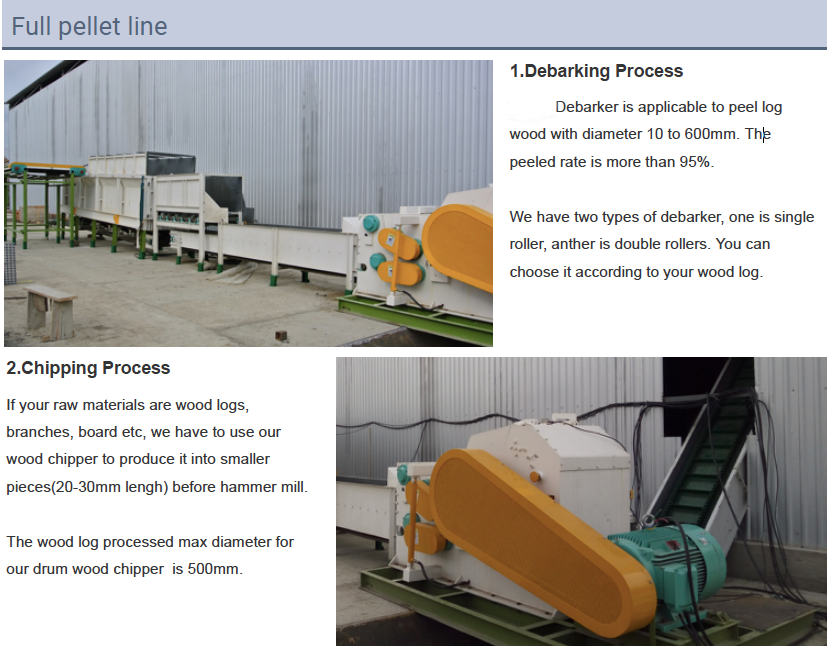
What a drum chipper actually does
A drum chipper is a cutting machine. A heavy rotor carries fixed, hardened knives that slice wood against a counter blade the way a guillotine cuts paper — once, cleanly, to a controlled size. Feed a log, a branch, or a slab into the chipper and what comes out is a stream of uniform chips, typically in the 20–80 mm range depending on knife and screen settings, with relatively low fines and low dust (published equipment guidance from one biomass machinery maker).
Because the machine cuts rather than beats, it handles wet, green, fibrous material without complaint. Freshly felled logs at 40% moisture are a normal day at the office for a chipper; the same material in a hammer mill will blind the screen within minutes.
What a chipper cannot do is produce pellet feed. Chips of 20–80 mm are a size class for boilers and for further processing — they are two orders of magnitude too big for a pellet die, and no die adjustment will change that.
What a hammer mill actually does
A hammer mill is an impact machine. Free-swinging hammers on a fast rotor strike the material repeatedly until the particles are small enough to pass through a screen — the screen, not the operator, defines the final particle size. Swap the screen and you change the output: a coarse screen might release 10 mm particles, a fine screen 3–5 mm or less.
This is exactly the fineness a pellet die needs. Pellet presses compress feed particles that are only a few millimeters across; the physics of compression ratio, steam conditioning, and lignin flow all assume a fine, homogeneous particle bed. Chips straight from a chipper cannot meet that spec — a hammer mill pass is what turns “biomass” into “pellet feed.”
The impact action has two costs. It generates dust and noise. And it is energy-hungry relative to cutting: every pass of the hammer adds specific grinding energy, and that energy rises steeply as the target particle size falls. Published experimental work on hammer milling measured specific energy of 27–36 kWh/t for maize grain and 136–181 kWh/t for the much tougher maize cob at the same 2.8 mm screen, with energy consumption rising further at higher rotor speeds (International Journal of Agricultural and Biological Engineering, 2020). The lesson scales directly to biomass: grind fine only when you must, and never grind finer than your die requires.
| Drum chipper | Hammer mill | |
|---|---|---|
| Working principle | Cutting — fixed knives slice once against a counter blade | Impact — free-swinging hammers strike repeatedly until the particle passes a screen |
| Output size | Coarse uniform chips, roughly 20–80 mm | Screen-controlled, typically 1–10 mm |
| Wet material tolerance | High — green logs and branches are normal feed | Low — wet fibers blind the screen; grind dry material |
| Dust and fines | Low | High — needs dust collection |
| Main wear parts | Knives and counter blades, regrindable | Hammers and screens, faster wear on abrasive feed |
| Role in a pellet line | Stage 1: logs and bulky residues into chips | Stage 2: chips into pellet-ready particles |
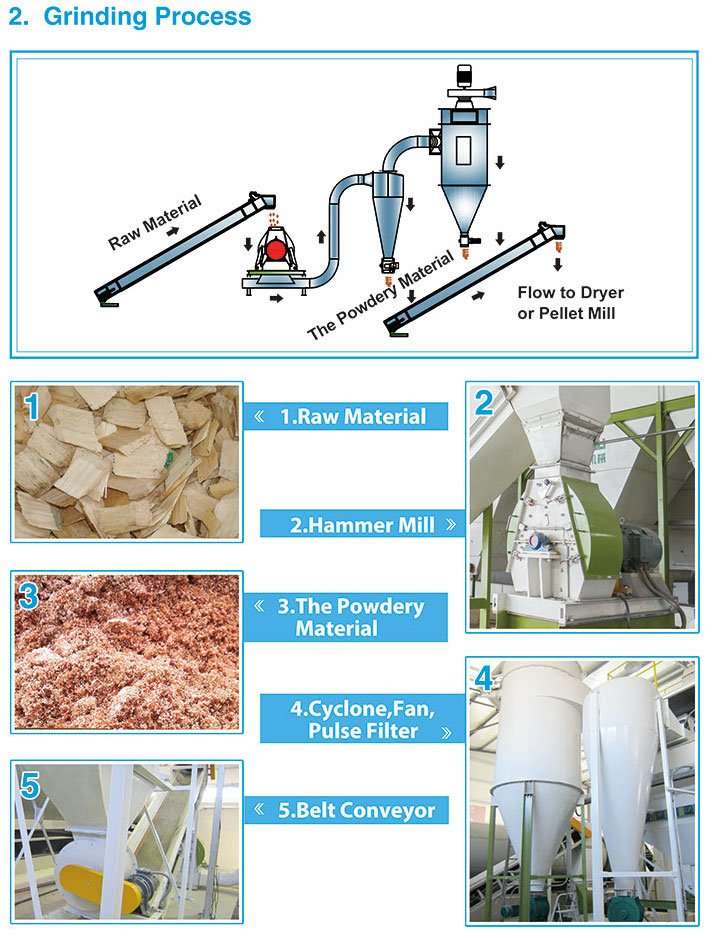
Why a pellet line usually needs both
Attempt the thought experiment: what happens if you feed a log directly into a hammer mill sized for a 2 t/h line? The answer is disappointment — slow throughput, shattered screens, a rotor that spends its energy on a few oversized pieces. Conversely, a chipper alone cannot make pellet feed no matter how you adjust it. The two machines are not substitutes; they are stages.
For wet-feed lines the sequence is deliberate: chip first, then a coarse grind, then drying, then a fine grind before the die. Grinding wet wood is energy-inefficient and blinds screens, but grinding bone-dry brittle wood throws fines and accelerates wear — so the line splits the grinding around the dryer. Biomass pelletisation guidance puts the ideal pelleting moisture at roughly 10–15% (Biomass Connect technical guide), and the size-reduction stages exist to deliver particles that can actually be conditioned into that window.
On the chipper side, our TCZL series drum chipper is built for exactly this stage-one duty, and its chipper knives are regrindable wear parts worth tracking like dies. On the grinding side, our YHM series hammer mill takes chips down to pelleting fineness with interchangeable screens for coarse and fine passes.
When you can skip one machine entirely
Both machines cost capital, floor space, power, and maintenance. Skipping the one you do not need is free money, and the deciding factor is always the feedstock as it actually arrives at your gate:
| Feedstock at the gate | Drum chipper | Hammer mill | Notes |
|---|---|---|---|
| Logs, stumps, palm trunks, large branches | Required | Required | Full two-stage size reduction plus drying in between |
| Purchased wood chips | Skip | Required | Buy chips to spec and put the capital into grinding instead |
| Sawmill sawdust and shavings | Skip | Usually required | Sawdust may pass one coarse screen pass; shavings need real grinding |
| Rice husk, PKS fragments, fine palm fiber | Skip | Required | Already small; needs crushing/grinding to uniform fineness, not cutting |
| Bark-rich mixed residues | Recommended | Required | Bulk reduction first keeps the hammer mill feed even |
One caution on “skip”: bought-in chips are only cheaper than chipping your own if the delivered price and quality are stable. Chips that arrive wet, long, or contaminated push the variability into your hammer mill, where it costs more per tonne than it saved.
Energy and wear: where the money actually goes
Size reduction is one of the quieter cost centers in pellet production, and the split between the two machines explains most budgets. Cutting is mechanically efficient — the chipper’s energy goes into a clean fracture, and its knives can be reversed and reground several times before replacement. Impact grinding is not: the hammer mill’s energy goes into repeated collisions, many of which do nothing but heat the air and the material, and the specific energy climbs as the screen tightens. The IJABE measurements cited above show the same machine consuming several times more energy per tonne on a tough feedstock at an identical screen size — which is why we always ask for a raw material sample before quoting a grinding stage, not after.
Wear follows the same logic. Chipper knives live on a regrind cycle measured in machine-hours between sharpenings; hammer parts and screens live on a replacement cycle that shortens sharply with abrasive feed such as rice husk or sandy residues. A plant that tracks both wear rates separately can price its size-reduction cost per tonne precisely — a plant that lumps them into “maintenance” discovers the truth only in the annual accounts.
Case review: sizing the size-reduction stage for a 2 t/h pellet line
To make the selection concrete, here is how we talk through a typical Southeast Asian inquiry: a customer with mixed plantation residues wants roughly 2 t/h of pellet output.
Step 1 — define the feed. The customer’s material is 60% rubberwood logs and branches, 40% purchased sawmill offcuts. Moisture on the logs runs high because harvest and delivery share the same rainy months as production.
Step 2 — place the machines. Logs go through a drum chipper sized so its output keeps pace with the line’s peak draw. Chips and offcuts then share a hammer mill sized for the fine-grind duty; a rotary dryer sits between the coarse and fine passes to bring moisture into the pelleting window. The pellet mill itself — for this throughput, a machine in the 2–3 t/h horizontal ring die class — takes the fine, dry feed.
Step 3 — sanity-check the balance. The classic mistake is matching each machine’s nameplate rating to the pellet mill’s nameplate instead of to the real material flow. Chipping and grinding stages must handle not only the throughput but also the moisture swings and contamination of real feedstock; a grinder that is adequate on dry sawdust stalls on wet chips. When we configure a complete production line, every stage is sized on the worst realistic week, not the best brochure number — which is also how the line in our 420 production line walkthrough was specified.

Step 4 — write the wear plan. Knife regrind intervals, hammer replacement criteria, screen stock, and die sets go into the operating budget at day one. Two hours of planning here saves the kind of downtime that only shows up as a missed shipment.
If you are unsure where your own feedstock falls in the table above, the cheapest next step is a sample in the mail. We run it, tell you which machines your material actually needs, and skip the ones it does not — that conversation has saved more than one buyer a machine they would never have used.