
Rice mills sit on mountains of husk. The shell comes off the paddy at the mill gate, it burns badly loose, it packs down into almost nothing per tonne of energy, and hauling it anywhere costs more than it is worth — so it piles up behind the plant. Sooner or later, every mill owner in Vietnam, Thailand, India, or Indonesia asks the same question: should I compress this into pellets and sell it as fuel?
Here is the honest answer up front: rice husk pellets are a legitimate industrial fuel, and rice husk pellets will never be ENplus certified. Not “difficult” — impossible. The numbers make that clear within one page of any standard, and pretending otherwise is how buyers end up with a product they cannot sell to the customer they had in mind. This article walks through what husk actually brings to a pellet mill, where it fails certification, what it does to your die, and which buyers genuinely pay for it.
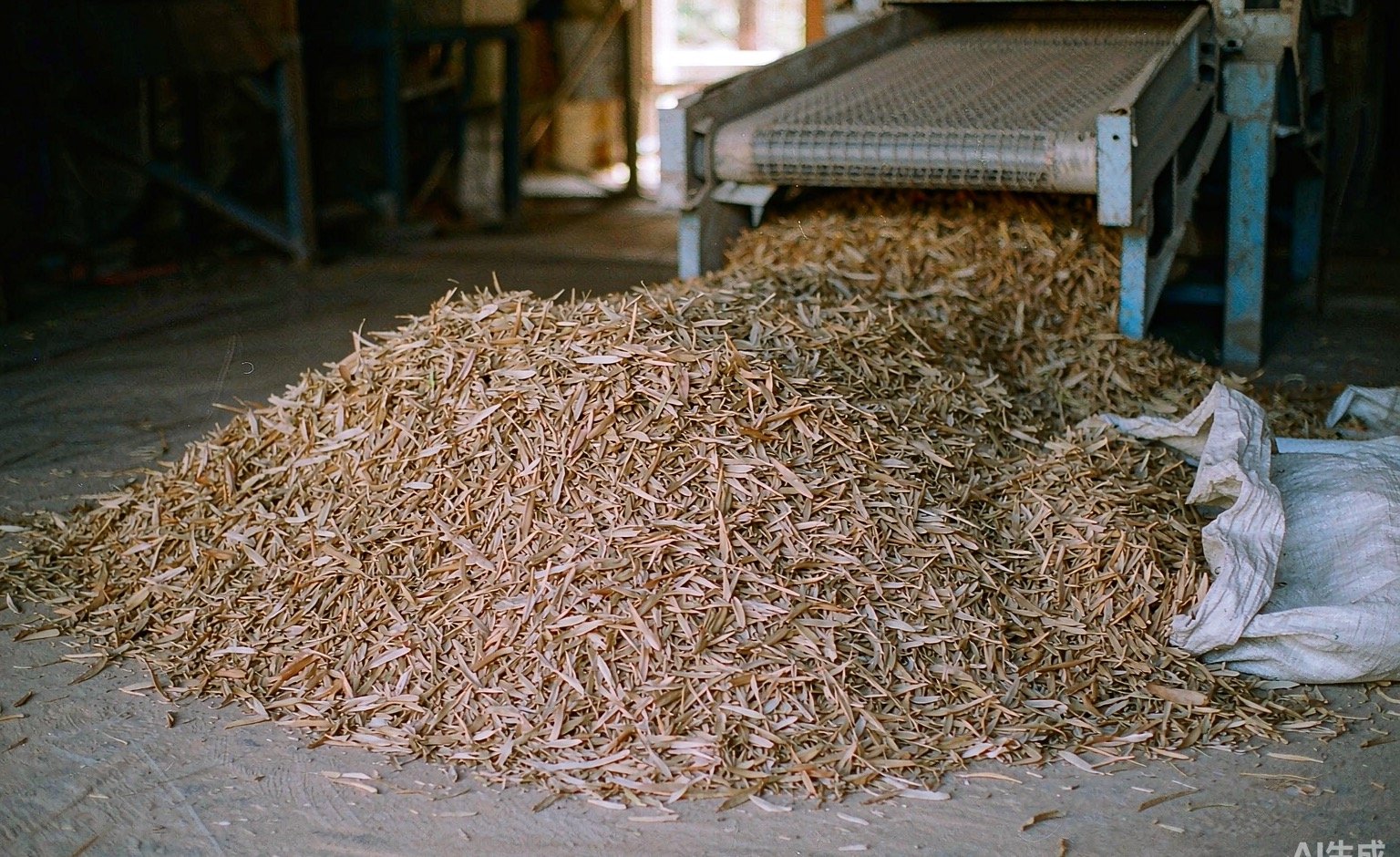
What rice husk brings to a pellet mill
Husk is not a bad fuel. It is a specific fuel. As a raw material it has three real advantages: it is often nearly free at the mill gate, its particle structure is already fine and fairly uniform compared with wood, and it flows into a pellet mill acceptably well once contaminants like stones and sack fragments are screened out.
The catch is chemistry. A comparative study published in the FUDMA Journal of Sciences pelleted eight tropical agricultural wastes under identical conditions and measured rice husk pellets at 15.3 MJ/kg gross calorific value with 18.5% ash — the lowest energy content and the highest ash of the entire set (FUDMA Journal of Sciences, comparative pellet study). For context, palm kernel shell pellets in the same study measured 20.1 MJ/kg and 2.4% ash.
Most of that ash is silica, the same mineral that makes sand abrasive. Two consequences follow from this single fact, and they shape everything else in this article: the ash volume is far beyond what any wood pellet standard allows, and the material grinds on your die and rollers every hour it runs.
The ENplus wall: why certification is off the table
ENplus is a wood pellet scheme, and its quality classes are built around wood’s naturally low ash. The ENplus Handbook v3.0, Part 3 sets the A1 ceiling at 0.7% ash, with a durability of at least 98.0% and moisture at or below 10%. Rice husk pellets measured at 18.5% ash exceed that limit by a factor of roughly twenty-six. No blending ratio short of a token handful of husk brings a husk-heavy pellet inside the limit.
And it is not just ENplus. The non-woody pellet standard ISO 17225-6 — the one that covers agricultural fuels — allows Class A pellets up to 6% ash and Class B up to 10% (ISO 17225-6:2021 summary). Rice husk pellets at 18.5% ash fail even the loosest industrial class of their own standard. That is worth pausing on, because it tells you exactly who your customer can and cannot be.
| Property | Rice husk pellets (measured) | ENplus A1 wood pellet limit | ISO 17225-6 Class B limit |
|---|---|---|---|
| Ash content | 18.5% | ≤0.7% | ≤10% |
| Gross calorific value | 15.3 MJ/kg | ≥4.6 kWh/kg net (≈16.6 MJ/kg) | declared per lot |
| Eligible for residential ENplus markets | No — fails on ash by a wide margin | Not applicable | |
Sources: rice husk pellet figures from the FUDMA Journal of Sciences study cited above; ENplus A1 limits from the ENplus Handbook v3.0 Part 3; ISO 17225-6 limits per the standard summary linked above.
The practical translation: a rice husk pellet is an industrial fuel for boilers engineered around high ash. It is not a wood pellet substitute, and any business plan that assumes residential or export heating demand is built on sand.
Slagging: the problem your buyer will hit first
Ash volume is only half the story; the other half is what silica ash does when it gets hot. Silica-rich ash softens and fuses at temperatures well inside the operating range of ordinary boilers, forming hard glassy deposits — clinker — on grates and heat surfaces. A boiler designed for wood will choke on it. A boiler with a rotating grate, moving bed, or fluidized-bed design that was specified for agricultural fuels handles it fine.
This is why the buyer conversation matters more with husk than with any other raw material we test. Before a rice husk pellet plant is built, the end user’s boiler type and ash-handling capacity should be confirmed in writing. Selling husk pellets to someone with a wood-spec boiler produces one shipment and a reputation problem.
What silica does to your die and rollers

Inside the mill, the same mineral that clinkers in the boiler grinds on your tooling. Dies and rollers wear noticeably faster on husk than on clean sawdust — this is consistent field experience across every husk line we have configured, and it is the reason die selection and compression ratio deserve specific attention on this raw material rather than a copy-paste from a wood project.
Two practices keep the wear economics tolerable. First, screen the husk before grinding: sand and field grit riding with loose husk accelerates wear out of all proportion to its weight. Second, track die life in tonnes per set from the first month — if you only discover your real wear cost at the end of the year, you have already priced the product wrong for eleven of them. Our troubleshooting guide includes the wear-tracking basics we give customers at commissioning.
Where rice husk pellets actually sell
With the residential route closed, the viable buyers are industrial, nearby, and boiler-matched:
Industrial boiler operators running multi-fuel or agricultural-fuel designs. These plants meter fuel automatically, handle continuous ash removal, and buy on price per unit of energy. For them, a dense, uniform, dosable pellet is genuinely easier to burn than loose husk.
Buyers at a transport distance. Loose husk carries so little energy per truckload that freight destroys its economics quickly. Pelleting raises the energy per truckload substantially, which extends the economic haul distance — and the shorter your haul, the less pelleting buys you.
Export markets with agricultural-fuel specs. Japanese and Korean industrial users buy agricultural pellets under their own import specs, not under ENplus. Those are contract negotiations, not spot markets — expect spec sheets, audits, and sustained volumes, in exchange for stability.
Preparing husk for the mill: screening first, grinding second
Husk arrives with passengers. Stones, rice grains, sack fragments, and field grit ride along from the paddy, and every one of them is harder than your die. Before any husk enters a grinding stage it should pass a screen or de-stoner — a cheap piece of equipment that pays for itself in extended tooling life. The husk’s own particle size is already fine, so the grinding task is lighter than with wood; the goal is uniformity, not major size reduction, and a single hammer mill pass with a matched screen usually delivers it.
Contamination control matters for the buyer, too. A husk pellet spec sheet with a visible sand fraction is a spec sheet that fails inspection, and silica contamination is exactly what a buyer’s lab will look for first. Clean feed is cheaper than arguments at the discharge port.
Drying: the quiet variable
Husk leaves the hulling process drier than most biomass, but storage practices vary wildly, and monsoon-season stockpiles absorb moisture. Pelleting works in a moisture window of roughly 10–15% (Biomass Connect pelletisation guide); outside it, pellets crack or crumble and the die gums up. A rotary drum dryer in the line is cheap insurance against a wet season — our own guide to moisture content covers the same physics, which applies to husk exactly as it does to sawdust.

The three routes for a mill sitting on husk
When the husk pile is the problem, pelleting is only one of three answers. Choosing among them honestly is where most projects save or waste their money.
| Route | Best when | Main trade-off |
|---|---|---|
| Sell raw husk locally | Boiler users within a short truck radius; husk price covers haulage | Lowest investment, but the market shrinks fast with distance |
| Pellet for industrial buyers | Confirmed buyer with high-ash boiler spec at a real transport distance | Requires a full line, die wear budget, and buyer spec discipline |
| Burn on-site | The mill itself consumes steam or power, or a captive user sits adjacent | No fuel sales, but converts waste into your own energy bill reduction |
Our recommendation, stated plainly: if you do not yet have a named buyer with a boiler spec in hand, do not order a pellet line. Start by mapping who burns fuel within 100 kilometers and what their boilers are rated for. If that map comes back empty, burning the husk in your own boiler beats owning idle equipment. If it comes back full, size the grinding stage and the pellet mill around your confirmed spec — and send us the husk sample before you sign anything, because a thirty-minute lab test has talked more than one buyer out of an expensive mistake.