
Most mills meet their durability figure on a certificate that arrives with a shipment, not on a test bench they own. The number is real, but it belongs to somebody else: a lab that received 2 kg of pellets from a batch you packed three weeks earlier, ran one test, and reported 98.2%. Then a customer runs the same test on arrival, gets 96.4%, and the argument starts.
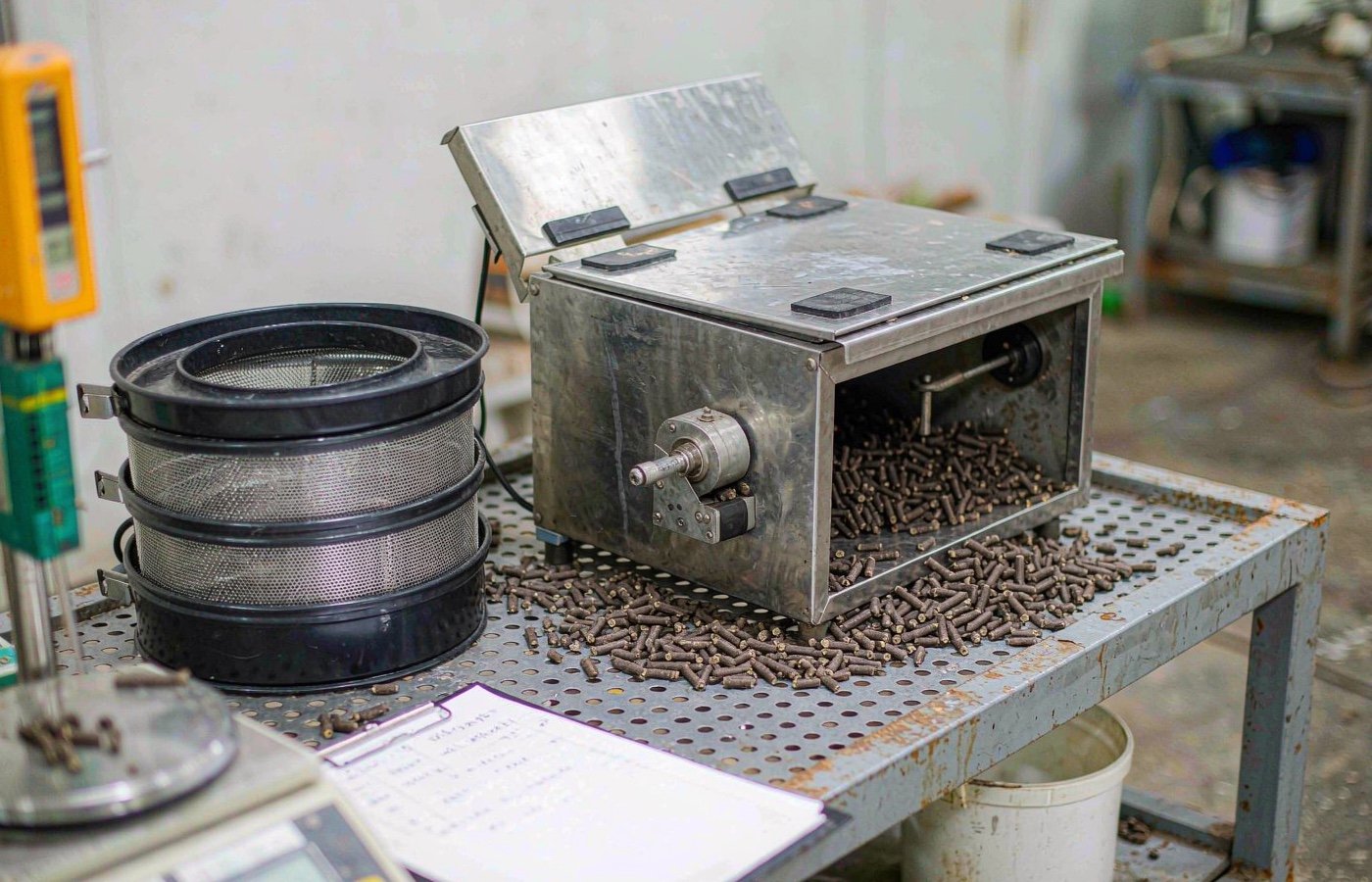
Running ISO 17831-1 in your own quality room changes that argument. Not because your result is more accurate than the lab’s, but because you can repeat it every shift, on the pellets you are actually shipping, and know what the line was doing when the number moved.
What a third-party durability result can and cannot tell you
A lab report answers one question: did this sample, at the moisture it happened to have when it arrived, survive 500 tumbles above 98%? That is a pass or fail. It is not a process control number.
Three things make a single external result a poor management tool. The sample is small relative to the batch it represents. The test is destructive, so you cannot re-run it on the same material later. And the result moves with storage, which means a pellet tested in a cool warehouse in March and the same pellet tested after a container sits on a quay in August are not the same object.
A study in Polymers tracked exactly this. Pellets received at 7.2% and 8.0% moisture started at 98.6% and 96.9% durability. After 30 days in controlled climate rooms the loss was modest — up to 1.2 points for the brown pellets, 2.0 for the white ones. But under freeze–thaw cycling the white pellets lost 4.3 points, and the higher heating value of stored pellets fell by 3.5% to 6.0% on average across 30 days (Polymers 2020, 12, 970). A single certificate cannot carry that information. A test you run yourself, on each lot, can.
What ISO 17831-1 actually asks you to do
The method is short. A sieved sample goes into a steel box with a baffle welded diagonally across one wall. The box turns at 50 rpm for 500 revolutions. The sample comes out, gets sieved again on the same 3.15 mm screen, and the mass retained is divided by the mass that went in.
What trips people up is the detail around those steps, because the standard fixes the sample mass, the sieve, the rotation count and the way the result is rounded — and every one of those choices shifts the answer by a few tenths of a point.
| Parameter | What ISO 17831-1 specifies | Why it matters on your bench |
|---|---|---|
| Pre-test sieving | 3.15 mm screen, sample already free of fines | Fines left in the sample are counted as broken pellets before the test starts |
| Test portion | 500 ± 10 g (500 ± 50 g for pellets over 12 mm) | Under-filling the box lowers the impact energy per pellet and flatters the result |
| Tumbler speed | 50 ± 2 rpm | A worn drive belt that drags speed to 45 rpm cuts the number of impacts |
| Duration | 500 revolutions, about 10 minutes | Counting time instead of revolutions is the most common shortcut |
| Post-test sieving | Same 3.15 mm screen, gentle handling | Vigorous shaking creates new fines and depresses the result |
| Replication | Two test portions, mean reported to 0.1% | One test is an anecdote; the pair is what the precision limits are built on |
| Calculation | DU = mass retained ÷ mass before × 100 | Weigh both portions to 0.1 g, not to the nearest gram |
A 2018 study in Materials describes the same procedure in its methods section — 500 ± 0.1 g, 50 ± 2 rpm, 500 rotations, manual sieving on a 3.15 mm screen, duplicate runs (Materials 2018, 11, 1329). If you are writing a work instruction for operators, that paragraph is a better model than most supplier manuals, because it lists the tolerances instead of just the steps.
Five items of equipment, and the one people get wrong
The bench itself is not expensive. A durability tumbler, a set of 3.15 mm sieves, a balance readable to 0.1 g, a sample divider, and a moisture meter will fit in a corner of the lab. Most mills already own the balance and the moisture meter.
The item that gets bought badly is the tumbler. Cheap units run fast, run slow, or have a timer that starts before the motor reaches speed. Test yours before you trust it: put a mark on the drum, run it for exactly 60 seconds, and count revolutions. You want 50, give or take 2. If you get 56, the drive pulley is wrong and every result you produce will read low.
The second item people underestimate is the sieve. A 3.15 mm woven screen that has been used for three years on the bagging line is not a test sieve. It is stretched, and it passes pellets that should have been retained. Buy a dedicated test sieve, store it flat, and replace it when the mesh sags.
Two more details on the balance side. You need a moisture reference you trust — a small drying oven at 105 °C is slower than a handheld meter but it is the number you can defend in a dispute, and running both for a month tells you how far your meter drifts. And you need to weigh to 0.1 g, which sounds obvious until you watch somebody tare a 500 g sample on a bathroom-style scale and record 98%.
Sampling is where most mills lose the argument
You can run the tumbler perfectly and still publish a number that means nothing, because the test portion came from the top of a bag that was filled an hour ago.
Pellets segregate. Fines migrate down and to the outside of a silo or a bulk bag. A scoop from the surface is the cleanest material in the lot, and it will test two or three points above the average. Sample from the bagging spout across a full minute of production, or take a vertical core from a bulk bag with a probe, and then split the sample down with a divider rather than by eye. The standard’s own sampling guidance is the place to start; the practical version is that the material in the tumbler should look like the material in the customer’s hopper, fines included.
Write the sampling method into the record. When a buyer disputes a result, the first question is always how the sample was taken, and “from the pile” is not an answer that survives a claim.
Reading the result: thresholds, tolerances and what 97.9% costs
Two numbers matter commercially. ENplus A1 requires durability of at least 98.0% and A2 at least 97.5%, with fines capped at 1.0% for bulk and 0.5% for bagged pellets (ENplus Handbook v3.0, Part 3). Industrial buyers who never ask for the label still write those thresholds into purchase orders, because they are the only common language for “will this survive a conveyor”.
Then there is the repeatability question. ISO 17831-1 sets the within-lab repeatability limit at 0.3 percentage points and the between-lab reproducibility limit at 0.6 points for pellets at or above 97.5%; below that level the limits widen to 2.0 and 3.0 points. In practice this means a 97.9% result and a 98.1% result are the same pellet. Anybody quoting a 0.2-point difference as a quality improvement, in either direction, is quoting noise.
| Result on your bench | What it usually means | First thing to check |
|---|---|---|
| 98.5% and above | Comfortably inside A1; the process is stable | Nothing — record and keep running |
| 98.0–98.4% | Passing, but with no margin for storage loss | Die temperature and feed moisture drift over the shift |
| 97.5–97.9% | A2 territory; A1 claims are exposed | Fines in the feed, worn die, cooling air too cold |
| 96.0–97.4% | Real quality failure; expect complaints on long routes | Moisture below the binding window, oversized particles |
| Below 96% | Product is crumbling in handling, not in the die | Check the cooler and the conveyors before blaming the press |
How often to run it
Daily is the right frequency for any line running continuously, with one test at the start of each shift and one after any change of raw material lot. Mills running a single shift can drop to three tests a week and still see a trend. What matters is that the test sits on the same schedule as the moisture check, so the two records can be read against each other.
Add one test per export lot, taken after bagging, and keep that result with the shipping documents. That single record does more for a claim conversation than a year of press-side numbers, because it describes the product at the point where your responsibility ends.
The variable the standard does not fix: pellet length
Here is a gap that catches exporters. The standard controls the sample mass, not the length distribution inside it. A 500 g portion of pellets cut at 10 mm has far more ends per gram than the same mass of 30 mm pellets, and ends are where breakage starts. A 2020 study in Energies tested exactly this and found the measured durability changes with the length mix of the sample, along with the tumbling conditions themselves (Energies 2020, 13, 3000).
The practical consequence: if your knife setting drifts and pellets get shorter, your durability number can fall without anything changing in the die. Check knife clearance and pellet length on the same schedule as the durability test, and write the average length on the same record. Otherwise you will spend a week adjusting steam to fix a problem that lives in the cutter.

Diameter interacts with the same effect. A smaller die hole produces a pellet with more surface per unit of mass, so there is more area for a crack to start and less material holding it together. That is one reason 6 mm pellets often read a point or two below 8 mm pellets made from the same feed — not because the press is working worse, but because the geometry is harder.
Test the pellet the customer receives, not the pellet off the die
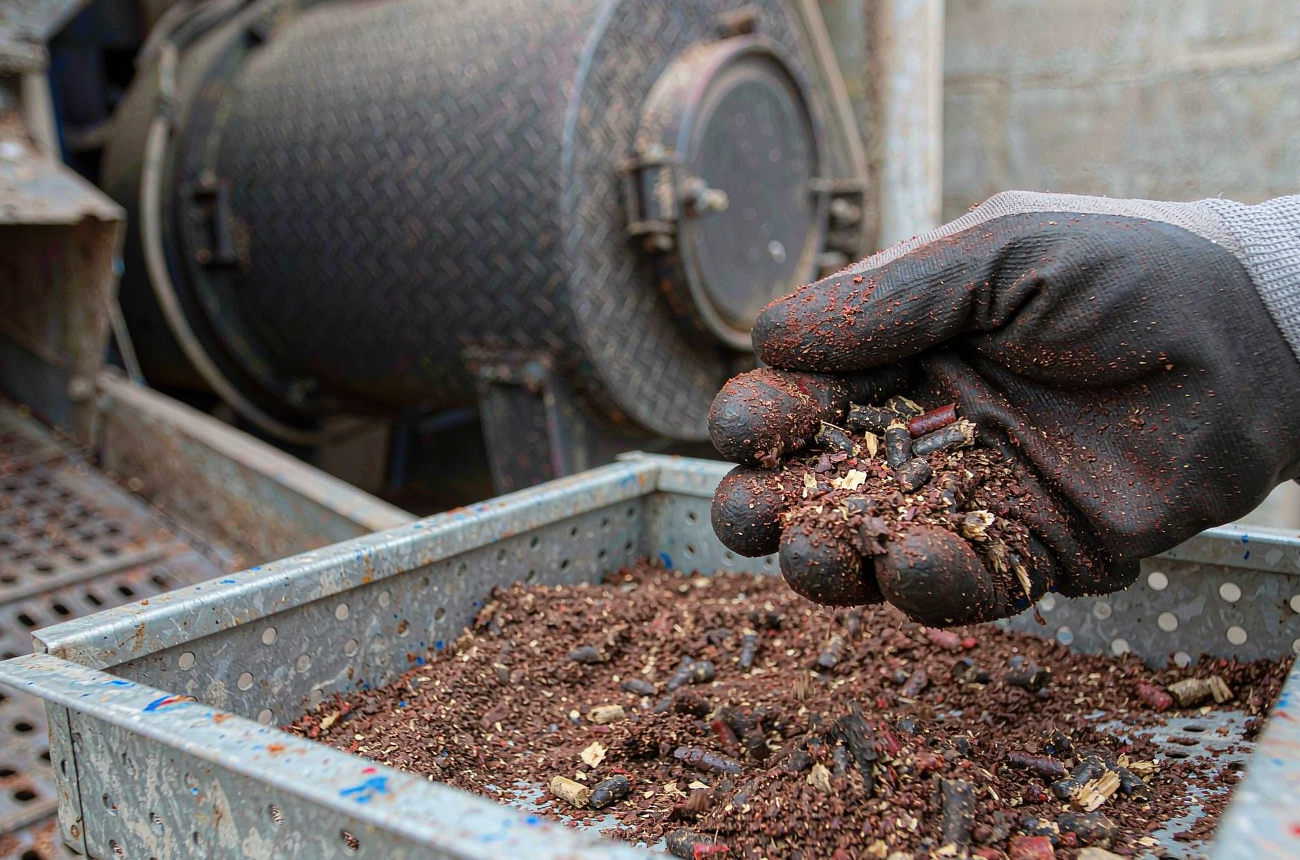
The most misleading sample in any mill is the one grabbed at the cooler outlet. It is hot, it is at its softest, and it has not yet been through a conveyor, a silo, a truck and a bagging line.
Sample after cooling, after screening, and — for export lots — after the material has sat in the bag for at least a day. Moisture at test time needs to be recorded too, because durability is moisture-dependent: the pelleting window for wood sits around 10–15% moisture on a wet basis, and pellets that have picked up surface moisture in a humid bag test differently from pellets at 8%.
If your numbers are good at the press and poor in the warehouse, the press is not the problem. Look at the cooler discharge temperature, the condition of the bucket elevator, the number of drop points between screening and bagging, and the free-fall height into the bulk bag. Every hard transfer is a small durability test that runs for free, all day, on your product.
The process levers that actually move the number
Once the test is trustworthy, the interesting work starts: finding which of five levers moves durability in your plant. In most mills the order of influence is roughly this, though the ranking shifts with raw material.
Moisture at the die
Too dry and the lignin does not soften enough to form bridges between particles; the pellet forms, then fails at the first impact. Too wet and the die slips, the pellet steams and cracks as it leaves the die, and the cooler has to remove water it was never sized for. Ten to fifteen percent is the usual working window for wood, and inside that window the optimum is narrower than most operators assume. Conditioning practice at the press — steam versus sprayed water, and where the nozzles sit — is described in practical terms by one pelleting equipment maker’s technical notes, and it is worth reading next to your own moisture log.
Particle size and preparation
Fine, uniform material packs into a denser pellet with fewer internal voids. Oversized chips create weak spots that behave like pre-cracks. If durability dropped after a hammer mill screen change, the screen is your answer before the die is.
Die specification and condition
A die that has been polished out, or one drilled with the wrong compression ratio for the material, will not build enough pressure. The same feed through a softer die gives a softer pellet. This is why die specification deserves its own purchasing discipline rather than being treated as a consumable ordered by price — the L/D difference between two “identical” dies is worth several points of durability.
Die temperature and steam
Heat is what plasticises the lignin, and most of that heat comes from friction inside the die, not from the conditioner. Adding steam raises the starting temperature and the moisture together, which is why a small steam change can move durability in the wrong direction if the feed was already wet.
Cooling and handling after the die
Pellets leave the die soft and hot. Cool them too fast with cold air at high volume and you get surface cracks that only show up as fines two days later. Cool them too slowly and the moisture does not come down. The cooler is part of the durability system, not a separate department.
When the number comes back low: a 90-minute check order
The temptation after a bad result is to open the die. Do the free checks first, in this order, and most low results resolve before anybody touches a wrench.
Minutes 0–10: re-test the same sample. Split the retained material and run a second pair. If the two pairs disagree by more than a point, the bench has a problem — likely speed or sieving — and the process may be fine.
Minutes 10–25: weigh the fines. Sieve a fresh 1 kg sample and weigh what passes 3.15 mm. High fines at the bagging spout with good durability at the press points at handling, not at the die.
Minutes 25–40: check the cutter. Measure 20 pellets. If the average length has dropped below what you ran last month, the knife clearance has opened up and the test is measuring short pellets, not weak pellets.
Minutes 40–55: read the moisture log. A shift that ran at 9% instead of 12% will show lower durability with no other symptom. Look for a dryer control change, a wetter raw material lot, or a steam valve that was throttled.
Minutes 55–75: look at the die. Check die hours against your replacement point, check that the rollers are tracking the full die width, and look at the pellet surface. A shiny, glazed pellet that breaks cleanly is a different failure from a dull pellet that crumbles.
Minutes 75–90: check the cooler. Discharge temperature and air volume. Pellets that leave the cooler above ambient plus 5 °C are still soft, and the elevator is finishing the job the die started.
If all six checks come back normal and the number is still low, then the die, the feed or the steam is genuinely the cause — and you have a record showing which of them you already ruled out, which is what a supplier needs in order to help you rather than guess.
Six ways an in-house test quietly becomes useless
- Single runs. One test portion, one result, no duplicate. You cannot separate process change from test noise.
- Time instead of revolutions. Ten minutes on a tumbler that runs at 47 rpm is 470 revolutions, not 500.
- Reused sieves. A stretched screen passes whole pellets into the fines tray and inflates the result.
- Warm samples. Testing straight off the cooler gives a soft pellet and a low number that says nothing about the shipped product.
- Undocumented sampling. No record of where the sample came from means no way to trace a bad result back to a shift.
- No moisture record. A durability number without the moisture at test time cannot be compared with last month’s number.
Turn the number into a record a buyer will accept
The test only earns its keep when it produces a document. A one-page batch record, filled in by the operator and filed with the shipping papers, ends most quality arguments before they start — and it gives you something to send when a buyer asks why this container reads differently from the last one.
| Field | What to record | Example |
|---|---|---|
| Batch and shift | Production date, line, operator | 2026-11-12 / Line 2 / A. Nguyen |
| Raw material | Species mix and supplier lot | Acacia 70% / rubberwood 30%, lot RW-118 |
| Feed moisture at press | Meter reading, three points across the shift | 12.4 / 12.1 / 12.6% |
| Die and hours | Die ID, compression ratio, hours run | D-630-1:7, 412 h |
| Pellet length | Average of 20 pellets | 22 mm |
| Sample point | Where and when taken | Bagging spout, 14:20, 60 s composite |
| Moisture at test | Oven or meter, before tumbling | 8.3% |
| Durability | Two portions, mean to 0.1% | 98.4 / 98.1 → 98.3% |
| Fines after screening | Percent below 3.15 mm at bagging | 0.4% |
Nine fields, one page, two tests per shift. A 2 t/h line can hold that discipline with one trained operator and about 40 minutes a day. The payoff is not the certificate on the wall — it is being able to say, with a document in hand, that the pellets left the plant at 98.3% and 8.3% moisture, and that whatever happened afterwards happened in transit.
If durability is already below target and you need the process side rather than the testing side, the failure patterns are covered in why wood pellets crumble, and the die half of the equation in die compression ratio and the ring die buying guide. For the cooling step that decides whether a good pellet survives the bag, see pellet cooler problems. And if you are specifying a new press and want the durability question written into the contract, the die and roller specification belongs in the same RFQ as the ring die and spare parts list.
One last thing worth saying plainly: buy the tumbler before you buy the second press. A mill that can measure durability can negotiate with a buyer from evidence. A mill that cannot is negotiating from the buyer’s lab report, and that is a weaker position every time.