
Two quotes land on the same desk. One die is quoted at 1:8. The other is 1:6. Both suppliers say their number is the right one for pine sawdust on a 6 mm die, and both will tell you the other guy’s die will either choke the mill or make crumbly pellets.
They are not necessarily lying. The compression ratio is a real, measurable number. What it is not is a universal one, and the way it gets printed on a quotation differs between workshops, between machine types and between the lab bench and the factory floor. Buyers who compare the number alone are comparing two different measurements that happen to share a name.
This guide covers what L/D actually measures, why published recommendations for the same feedstock can differ by a factor of two, which dimensions decide whether a die works on your material, and how to write a die specification a supplier can be held to.
What L/D measures, and what the number leaves out
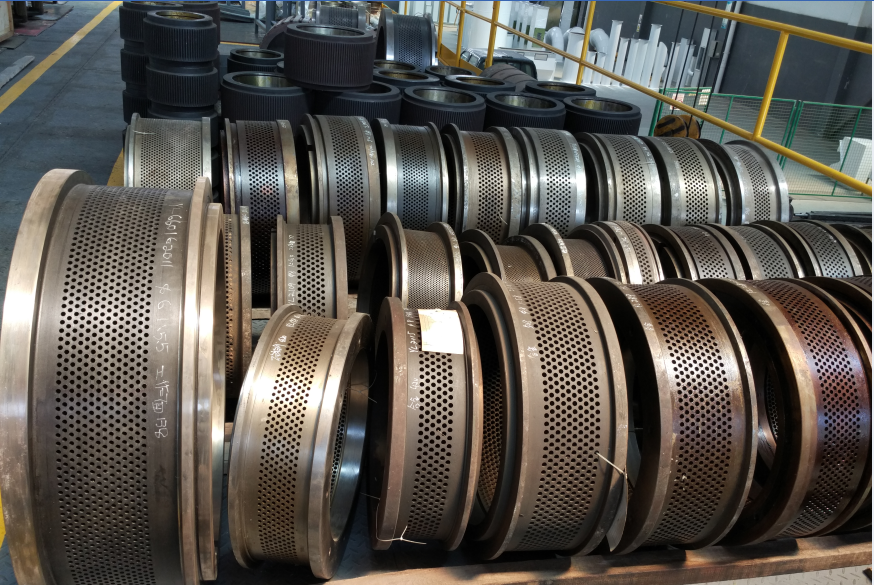
The compression ratio is the effective working length of the die hole divided by the hole diameter. Written as L/D, or as 1:8 in the trade, where the second number is the length in multiples of the hole diameter. A 6 mm hole with a 48 mm compression land is 1:8.
The APEC Secretariat’s report on bio-pellet heating applications describes the ring die version of the same idea: the ratio between a die hole’s effective length and the hole’s minimum diameter, used as an index of compression strength, with higher ratios producing denser pellets. The same report gives working ranges of L/D 4–5 for wood materials and 6–9 for high-fibre herbaceous material and rice straw, and notes that die surface roughness of 0.8–1.6 is the useful band, since rougher holes raise extrusion resistance at the same nominal ratio (APEC, Heating Applications of Bio-pellet).
Note the word effective. A die hole is rarely a straight cylinder from the inside face to the outside face. It usually has an entry taper or countersink, a straight compression land, then a relief bore that opens out so the formed pellet can exit without dragging on the full wall thickness. When a supplier says “1:8”, the 8 could be the compression land alone, or it could be the whole wall thickness. Those are not the same die, and on a thick die with a deep relief bore the difference can be 30% or more of the real working length.
Four other things change behaviour at the same nominal ratio, and none of them appear in the ratio:
- Countersink angle and depth. A wide, shallow entry gathers material differently from a steep one. The layer structure of the pellet forms in the first few millimetres of the channel.
- Open area. Total hole area as a share of the die surface sets how much material the die can swallow per revolution, independent of how hard it squeezes.
- Hole finish. Polished bores and rough bores are different tools. Roughness sits inside the ratio’s name but outside its arithmetic.
- Die metallurgy and hardness. A harder die holds its bore dimensions longer, so the ratio you bought is the ratio you still have after 800 hours.
So the ratio is a shorthand for “how much resistance does this hole present”, not a specification of the hole. That distinction explains most of the confusion in the next section.
Why the same feedstock gets recommended 1:6, 1:10 and 2.6
Published guidance is all over the map. That is not a scandal. The sources are describing different machines, different targets and different ways of measuring length.
| Source | Stated ratio | What it actually describes |
|---|---|---|
| APEC bio-pellet report | L/D 4–5 wood; 6–9 herbaceous | Industrial ring dies, effective length, general screening guidance |
| US lab work on high-moisture pelleting (INL, published in JoVE) | L/D 2.6 held constant | Flat die, 1–2 t/h pilot scale, corn stover plus starch binder |
| Chinese die and mill suppliers (typical quotation language) | 1:5 to 1:12 depending on material | Often wall thickness rather than effective land; wood at the low end |
| Feed milling practice (same machines, different product) | 1:6 to 1:12 | Starch gelatinisation with steam conditioning, not lignin softening |
The lab number is the most misunderstood. A 2.6 ratio on a small flat die with a starch binder is not evidence that industrial wood dies are over-engineered. The Instituto Nacional de Energia work behind that figure shows why: adding a starch binder let the researchers hold a low L/D and still reach over 92% durability after cooling, while cutting specific pelleting energy by roughly 20–40% (Tumuluru et al., JoVE protocol, PMC). The binder did the work that compression length would otherwise have to do. Take the binder away and the same die makes weaker pellets.
Flip it around and the supplier number makes sense too. A die quoted at 1:10 for hardwood is not trying to punish you. Hardwood with low extractive content and dense fibre needs a longer pressurized path to reach ENplus-level durability, because there is less natural resin to do the sticking. A softwood die at the same ratio will often run hot, drift toward the motor’s current limit, and darken the pellet surface.
The practical conclusion: a ratio is only comparable inside one supplier’s drawing system. Across suppliers, it is marketing until you see dimensions.
The four variables that move the right number for your plant
Species and extractives. Pine and spruce carry resin and fatty acids that turn plastic under pressure and heat. Oak, beech, rubberwood and mixed furniture waste carry less and are denser. The same 6 mm hole wants different land lengths. Blended feedstock is the hard case, because the mix ratio drifts week to week and the die cannot.
Moisture at the die. Water is a lubricant and a heat sink. Material at 15% behaves like a lower ratio; material at 8% behaves like a higher one and can scorch. This is why two plants with identical dies and identical species report opposite results: one is feeding 12% and the other 9%. If your incoming material swings 6 points across the week, no single die ratio will be optimal every day, and you should be tuning the dryer, not the die.
Grind and particle size distribution. A die compresses a plug, not individual particles. Fine, uniform grind builds a stable plug and lets the land do its job. Oversize chips and long splinters bridge in the entry, produce uneven density along the pellet, and create the surface cracks that later show up as fines in a silo.
Target durability and the standard behind it. ENplus A1 requires mechanical durability of at least 98.0%, A2 at least 97.5%, with ash at or below 0.7% for A1 and moisture at or below 10% (ENplus Handbook v3.0, Part 3). If you sell into the residential bag market, that 98% is not negotiable and it justifies a longer land. If you sell industrial pellets into a Japanese or Korean co-firing contract with a lower durability clause, a shorter land buys throughput. Two plants, same sawdust, different correct answers.
What a longer land buys, and what it costs
Compression is a purchase, and the currency is motor current. A longer land raises the pressure needed to push the plug through, which raises density and durability, and also raises the work done per tonne. The INL binder result is the cleanest illustration of the trade: when the binder took over part of the bonding job, specific energy fell by 20–40% because the die no longer had to supply all the pressure.
In day-to-day operation the trade shows up like this:
| What you change | Durability | Throughput | Motor load and heat | Die and roller life |
|---|---|---|---|---|
| Longer compression land at same hole size | Up | Down | Up, pellet exit temperature higher | Shorter, more abrasive load on the bore |
| Shorter land at same hole size | Down | Up | Down, cooler pellets | Longer, unless pellets crumble and recirculate |
| Bigger relief bore, same land | Neutral | Slightly up | Down, less exit friction | Longer, fewer blocked holes |
| More open area, same land | Neutral | Up | Higher total amps, same amps per tonne | Thinner webs between holes, more cracking |
Two notes from the workshop floor. First, the throughput you lose to a longer land is partly recovered by fewer recirculation passes, because fewer crumbly pellets come back to the die as fines. A mill running 12 t/h of soft pellets with 15% recirculation is not producing 12 t/h. Second, a die that is too long for the material does not gently underperform. It trips the motor, and on some mills it shears the safety pin, which is a much more expensive way to learn the lesson.
Hole size, ratio and the pellet your boiler actually wants
Buyers often fix the ratio question by fixing the hole size first, then wonder why the die still disappoints. The two are connected.
A 6 mm die and an 8 mm die with the same land length are not the same compression. The 6 mm hole has a longer land relative to its diameter, so it squeezes harder per unit of material, which is part of why 6 mm pellets come out denser and why the same die specification can feel “too hot” when a plant switches from 8 mm to 6 mm for a residential order. When you change hole size, re-open the ratio question.
Hole size is driven by the burner, not by the die shop. Small residential stoves and small boilers want 6 mm because the fuel must ignite quickly and burn out inside a short grate. Large industrial grates and co-firing systems often prefer 8 mm because it handles better, generates fewer fines in pneumatic conveying and packs a silo with less dust. If your offtake contract specifies 6 mm ±1 mm and a fines ceiling, both the hole and the land are already constrained, and the only free variable left is which supplier can hit the tolerance.
Published supplier guidance diverges here as well, which is worth seeing with your own eyes. One Jiangsu mill’s technical note puts hardwood at L/D 5–7 and agricultural residues at 4–5, with die bore tolerance at ±0.1 mm (Kingwood technical note on pellet diameter). Set that next to the APEC range of 4–5 for wood and the spread is obvious. Both can be right for their own die design, steel and machine geometry. Neither is a standard.
The die cannot fix a line that is wrong upstream
This is the part buyers skip, and it costs more than any die decision. A die compresses what arrives at the chamber. If what arrives is inconsistent, the die inherits the inconsistency and gets blamed for it.
Moisture is the biggest offender. A dryer that holds ±1% gives the die a stable job. A dryer that swings 4 points across a shift forces the operator to chase the mill with the feed gate, and the die sees alternating soft and scorched conditions. If your moisture is unstable, spending money on die tooling is spending in the wrong place. The dryer sizing and control guide covers the mass balance and why the outlet moisture target should be a band, not a single number.
Grind is second. A hammer mill with worn hammers produces a wide particle spread, and a wide spread produces pellets with hard and soft zones that break in the cooler. Third is the cooler and the fines screen: pellets that leave the cooler above ambient temperature go into the silo still relaxing, and pellets that carry fines into storage arrive at the customer already below the fines limit.
One rule of thumb worth adopting: before you change a die, prove the line is stable for 72 hours. Stable means moisture within band, throughput within band, and motor current within band. A die chosen on an unstable line is a guess with a purchase order attached.
How to read a die drawing before you approve it
Ask for a dimensioned drawing, not a ratio. On a proper drawing you should be able to find these, and if any is missing, the supplier has not finished the job:
- Hole diameter with tolerance, typically stated to ±0.1 mm on a quality die
- Effective compression land length, measured separately from total wall thickness
- Total die thickness
- Relief bore diameter and depth
- Countersink angle and depth at the entry
- Number of hole rows, holes per row, and the resulting open area percentage
- Die outside and inside diameter, and the clamping geometry
- Bore surface finish and hardness, plus the steel grade
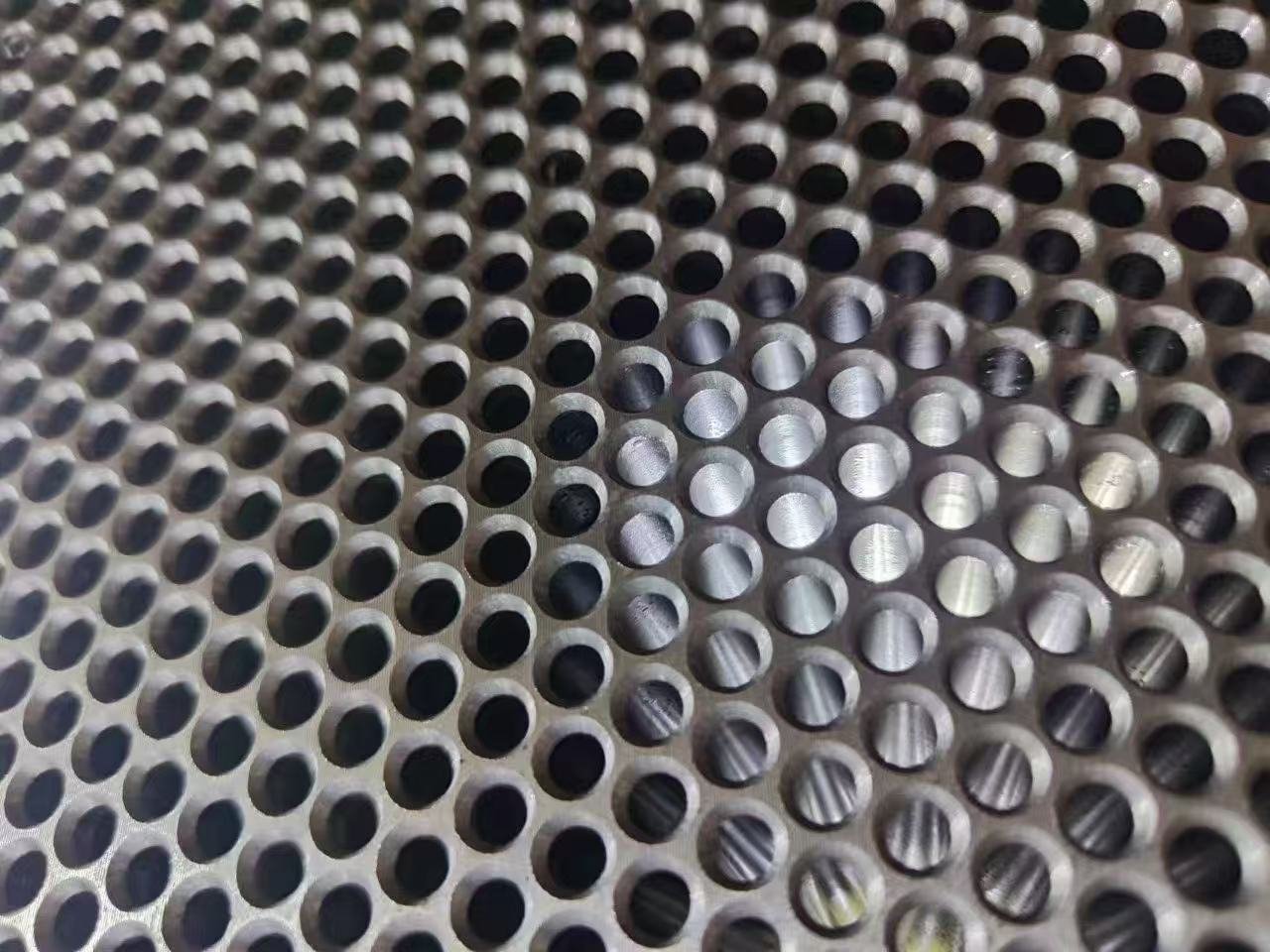
With those numbers you can compute a true L/D yourself and compare it with the next quotation. You can also spot the trick that shows up in cheap dies: a quoted “1:9” that turns out to be a 45 mm wall with a 20 mm relief bore, which behaves like a 1:5 on the material and will make soft pellets at any moisture.
If the supplier cannot produce the drawing, treat the ratio as unverified. This is the same discipline as buying ring dies as spare parts against a sample rather than against a catalogue photo.
A selection procedure that survives contact with production
Four steps, in this order. Skipping the first one is the most common and most expensive mistake.
1. Send the material, not the description. 50–100 kg of the actual feedstock, at the moisture it will really arrive at, with the species mix written on the bag. “Pine sawdust” from a trader is often pine plus rubberwood plus a little MDF dust, and MDF dust changes everything because of the resin and the mineral content.
2. Ask for a trial on a machine with the same die geometry, not a smaller one. A 30 kW trial machine will happily run a die that a 280 kW mill cannot push at production rate. The relevant comparison is the same hole diameter, same land, same die speed range.
3. Measure durability with a tester, not with your hand. Hand-squeeze tests catch only the worst failures. A pellet durability tester gives you a number you can put in a contract, and a number you can compare between candidate dies.
4. Log the run. Throughput in t/h, motor current, pellet exit temperature, moisture in and out, fines returned. Four columns on one sheet will tell you more about a die than a week of opinions.
When you change dies, change one thing at a time. A new die plus a new moisture setpoint plus a new grind size is three variables and zero information.
Is it the ratio, or is it something else?
Most “wrong die” complaints that arrive at a manufacturer’s service desk are moisture or grind problems wearing a die’s clothes. Use this to triage before you spend money on tooling.
| What you see | Check this first | Only then suspect the die |
|---|---|---|
| Soft pellets, heavy fines at the cooler | Feed moisture above target; grind too coarse; feed rate pushed past the motor’s comfortable band | Land too short for the species |
| Motor trips, dark or scorched pellet surface | Feed moisture too low; material surging; roller gap too tight | Land too long, or relief bore too small |
| Pellets curve or break on one side | Roller gap uneven; die not seated flat; distributor feeding one side | Hole pattern or open area badly matched to die width |
| Output falls away after a few hundred hours | Bore wear and polishing; abrasive ash in the feedstock | Die hardness or steel grade unsuited to abrasive material |
That last row matters for anyone running agricultural residue. Rice husk carries ash around 18.5% by weight in controlled pelleting tests, against roughly 0.5% for clean softwood, and that ash is largely silica (FUDMA Journal of Sciences, 2025). Silica grinds a die bore like sandpaper. A die that lasts a season on pine may be done in weeks on husk, whatever its ratio says. We covered the broader consequences of that material in the rice husk pellet article.
What we specify, and why we ask for a sample first
HENGMU builds ring dies in-house for the YPM series, including the YPM630 vertical ring die mill at 1–1.5 t/h and the YPM850 at 280 kW and 4–5 t/h. Die land length and hole pattern are set per order, because the same machine ships to a Vietnamese plant on acacia and to a Polish plant on pine and spruce.
Our default position for a new wood line: start at the shorter end of the range for the species, run a documented trial, and lengthen only if durability misses the contract. Starting long and backing off sounds safer and is not, because a blocked die costs production hours and a bored-out die costs a new die.
If you already run a mill and the pellets are variable, the die may be the third thing to check, not the first. Start with the fault-finding sequence, then look at tooling. And if you are still deciding between machine architectures, the ring versus flat comparison in this breakdown explains why flat dies tolerate much lower L/D values in the first place — the pressure geometry is different, so the numbers are not transferable.
A 30-minute die audit you can run this week
No new tooling, no supplier visit. Just measurement.
Minute 0–5. Pull the die drawing and find the effective land length. If the drawing only shows wall thickness, write down that you do not know your ratio and move on to the physical checks.
Minute 5–10. With the die off, measure a sample of bores with a pin gauge or a caliper at both ends of ten holes. Taper and wear show up as a difference between the inside and outside diameter. A bore that has opened 0.2 mm is no longer the die you bought.
Minute 10–15. Photograph the die face. Polished rings around the holes mean the rollers are tracking; bright patches mean uneven feed; dull, unpolished zones mean those holes are not being fed at all.
Minute 15–25. Take the last week’s production sheet and fill in four numbers per shift: tonnes, kWh, average feed moisture, fines returned. If kWh per tonne is climbing while moisture is flat, the die is wearing or the material has changed species.
Minute 25–30. Write one sentence in the maintenance log: current L/D, hours on the die, tonnes through it, and the durability result from the last lab test. Six months of those sentences turns die buying from a negotiation into a calculation. If you want the cost side of that calculation, the machine cost breakdown shows where tooling sits in the total.
The ratio on the quotation is the beginning of the conversation. The drawing, the sample trial and the durability number are the end of it.