
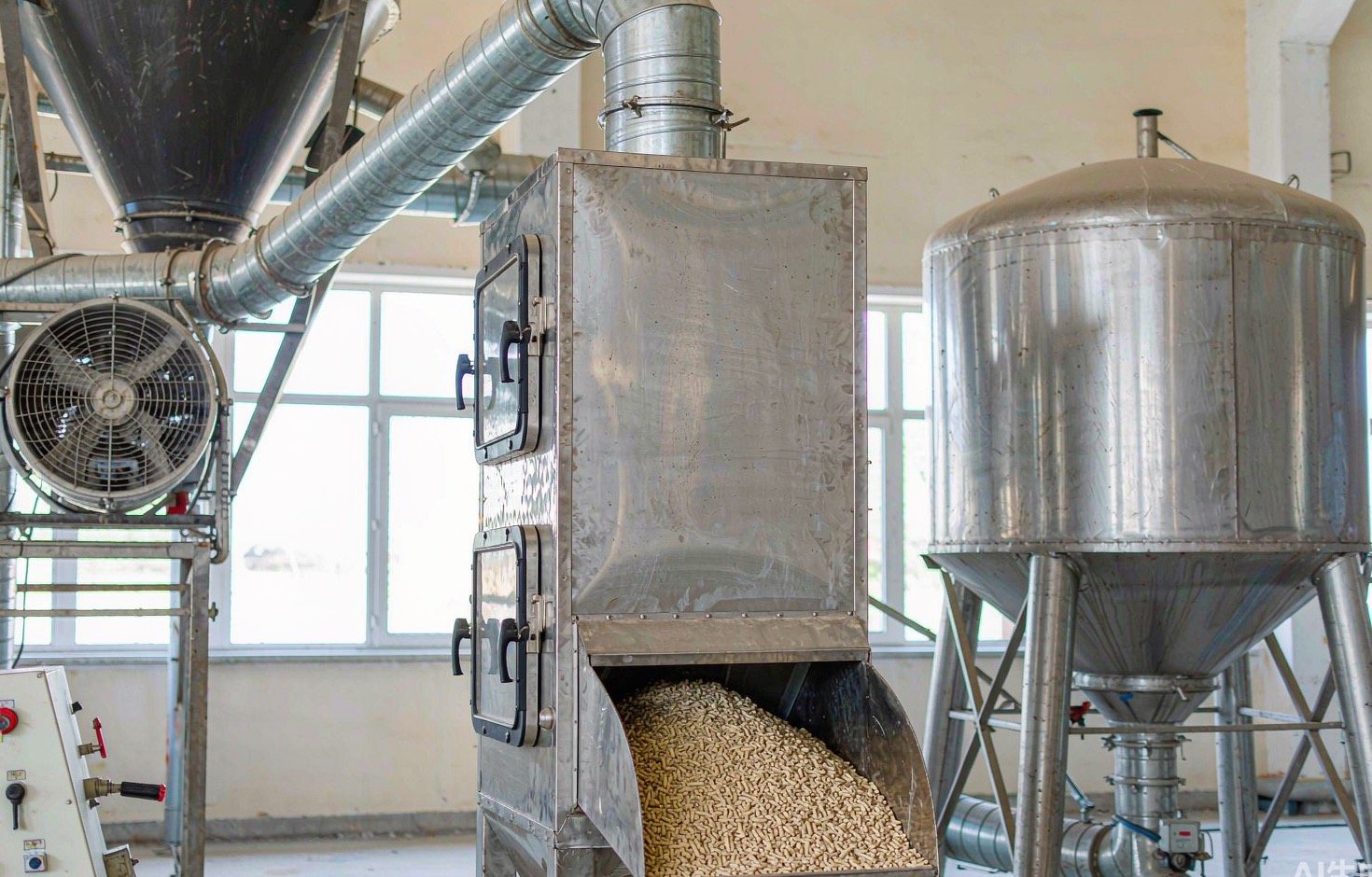
Cooling looks like the simplest box on the process flow diagram: hot pellets in, cold pellets out. Then the line runs a week, the bagging end starts complaining about dusty, cracked pellets, and someone asks how fast the cooler was running. The cooler choice — counterflow tower or horizontal belt — shapes that conversation before it starts, because the two designs treat the pellet bed in completely different ways.
Both designs do the same physics. Pellets leave the die at 70–90 °C and must come down to within roughly 5 °C of ambient before they touch storage or a bag, a duty documented in detail in a North Carolina State study on cooling air and pellet durability. Cooling also dries the product: expect 1–2% moisture loss across a well-run cooler. The difference between the two machines is how the air gets there — and that decides your fines rate, your floor plan and your capacity ceiling.
How the two designs move air
A counterflow cooler is a vertical tower. Hot pellets enter at the top through a rotary airlock, pile into a bed, and are discharged from the bottom in calibrated layers by a sliding or rotating grid. Air is drawn upward through the descending bed, so the coldest ambient air meets the coldest pellets at the bottom discharge and the warmest, most humid air leaves at the top in contact with the freshest hot pellets. Air speed through a modern counterflow bed sits between about 0.8 and 1.5 m/s (Share Precision Machinery’s cooler guide).
A belt cooler spreads pellets in a shallow layer on a horizontal mesh or steel belt. The belt carries the bed through one or more zones where air is blown or drawn through the layer. Because the bed is shallow and the pellets rest on a moving surface, air speed in conventional belt coolers stays below about 0.5 m/s — high enough to cool, slow enough to avoid fluidising light pellets out of the bed.
| Parameter | Counterflow cooler | Belt cooler |
|---|---|---|
| Working principle | Pellet column descends through rising air in a closed tower | Shallow bed travels on a belt through air zones |
| Air direction vs pellet flow | Counter-current: coldest air meets coldest pellets | Cross-flow: air passes sideways through the layer |
| Typical air speed | 0.8–1.5 m/s | Below ~0.5 m/s |
| Typical retention, wood pellets | 10–15 min | 15–20 min |
| Discharge temperature | Ambient +3–5 °C | Ambient +5 °C or better, zone-dependent |
| Capacity range seen in supplier catalogues | About 3–20 t/h | Commonly above 10 t/h on large lines |
| Footprint | Vertical tower; small floor area, needs headroom | Long, low; easy to fit under a pitched roof |
| Product-zone mechanics | Grid discharge, no belt in the product | Belt and its drive run through the product zone |
The retention figures in that table come from supplier sizing tables for wood pellets (15–20 minutes, Changsheng’s pellet line guide) and from counterflow cooler specifications (10–15 minutes, Share Precision). They are starting points for sizing, not laws of physics — 8 mm pellets need more time than 6 mm, which our article on pellet diameter choice covers from the die side.
Why air speed decides your fines rate
Cooling works by evaporation, and evaporation punishes impatience. Blow cold air too hard across hot pellets and the outer layer dries and shrinks while the core is still warm and moist — the surface cracks, and every crack becomes a fines factory at the next transfer point. The NC State study linked above documents exactly this relationship between cooling-air regime and durability. Starve the bed of air instead and the pellets leave warm and soft, then deform and break in the screen and the conveying.
Counterflow’s thermal logic helps here. Because the air leaves the tower near pellet inlet temperature, the temperature difference stays gentler across the whole bed — the hottest pellets meet the warmest air, the coldest pellets meet the coldest air. Suppliers of counterflow equipment claim 30–40% lower air volume than cross-flow belt coolers for the same duty, saving 2.5–3.5 kWh of fan power per tonne (LANE Machinery’s counterflow page). Treat those numbers as vendor claims to verify in commissioning, but the direction is consistent with the physics: counterflow extracts more heat per cubic metre of air.
Retention time and what it takes to hold it
Sizing a cooler is bed-holding arithmetic. The cooler must contain every pellet produced during the retention window. For a 5 t/h line with a 15-minute target:
- Pellets in the cooler at steady state: 5 t/h × (15 ÷ 60) h = 1.25 t
- Bed volume at 650 kg/m³ bulk density: 1.25 ÷ 0.65 ≈ 1.9 m³ (arithmetic)
Airflow has a supplier rule of thumb, too: around 120–160 m³/min of cooling air per tonne per hour of capacity for wood pellets (Changsheng sizing table). On the same 5 t/h line that is 600–800 m³/min — roughly 36,000–48,000 m³/h through the fan and cyclone. Cross-check any supplier figure against the heat-and-mass balance treatment in Watt’s cooling-process engineering guide before you sign a purchase contract; rule-of-thumb air numbers vary widely between vendors, and the balance sheet is what catches an undersized fan.
| Line capacity | Pellets held at 15 min (arithmetic) | Bed volume at 650 kg/m³ (arithmetic) | Airflow at 120–160 m³/min per t/h (supplier rule) |
|---|---|---|---|
| 2 t/h | 0.5 t | ≈0.8 m³ | 240–320 m³/min |
| 5 t/h | 1.25 t | ≈1.9 m³ | 600–800 m³/min |
| 10 t/h | 2.5 t | ≈3.8 m³ | 1,200–1,600 m³/min |
Notice what happens between 5 and 10 t/h: the airflow quadruples while the bed volume only doubles. Air handling — fan, cyclone, ducting — is where cooler money actually goes, and it is the first place an undersized specification shows up.
Where the counterflow wins
For most pellet lines under about 10 t/h, the counterflow tower is the safer buy. Its advantages stack up on small and mid-size plants:
- Floor space. The tower builds upward. Its maker claims up to 70% less floor area than an equivalent horizontal belt cooler (LANE), which matters in a steel building where every square metre competes with the bagging bay and the loadout.
- Smaller air plant. Lower air volume per tonne means a smaller fan and cyclone, and less fan power every running hour.
- No belt in the product. The pellet bed rests on a static column and discharges through a grid; there is no moving surface to abrade pellets or to clean.
- FIFO discharge. Calibrated layer discharge sends first-in pellets out first, so nothing sits at the bottom of the tower going stale — a genuine advantage for traceability on certified lots.
- No dead zones. The octagonal tower geometry keeps corners from trapping stagnant material, which matters for a product that off-gasses.
The counterflow design does have a ceiling. As capacity rises, the pellet bed must grow deeper to hold the retention time, and bed-depth limits in the counterflow design are why belt coolers become more common above roughly 10 t/h (Changsheng). Deep beds also cool unevenly once the spreader stops doing its job — which is the counterflow’s main maintenance dependency, not a design flaw, but a real one.
Two maintenance points keep a counterflow tower honest over the years. The rotary airlock at the top is the seal that makes counter-current cooling work at all; when its blades wear, false air leaks in around the feed, the fan loses suction on the bed, and cooling time stretches without anyone noticing a single dramatic symptom. Check the airlock clearance on the same schedule as the discharge grid. The grid itself — sliding or rotating — takes the full weight of the bed every cycle, and its drive and limit switches deserve a place on your weekly walk-down list alongside the fan bearings.
Where the belt wins
Belt coolers earn their place in three situations. The first is sheer capacity: on large industrial lines the belt’s zone-based design scales more easily than one very tall tower, and multiple belts can run in parallel under one roof. The second is fragile product: the shallow bed and low air speed handle weak or large-diameter pellets with less breakage, and each zone’s air can be tuned independently. The third is buildings with a height limit — a belt cooler needs length, not headroom, and some retrofits have no tower space to give.

The belt’s costs sit in the product zone itself: the belt surface, its drive and its cleaning all live where the pellets live, and a belt running 6,000 hours a year under abrasive product needs the inspection regime that implies.
What happens when cooling is skipped or rushed
It is worth stating what the cooler is actually preventing, because the failure modes are expensive and delayed. Pellets bagged hot sweat inside the bag: the residual heat drives moisture off the warm core, it condenses against the cool film, and the pellets at the bag wall reabsorb it. The result is soft pellets, surface mould in humid climates, and a fines number that climbs while the pallet sits in the warehouse. Bulk stored hot is worse — warm, moist pellets in a silo keep respiring, shed fines into the space above the bed, and feed the off-gassing behaviour that makes wood pellet storage a gas-hazard topic in its own right. Supplier guidance is blunt that hot pellets cannot be shipped or stored without damage, and that a side effect of proper cooling is the one or two points of moisture loss that bring the product into its storage-safe range (Share Precision).
Rushed cooling has a different signature: pellets that look fine on the way out of the tower and crack a week later. The NC State work linked above is the reference to hand anyone who doubts the physics — cooling regime and mechanical durability are linked, and the link runs through how gradually the pellet’s temperature gradient relaxes.
The mistakes that show up a month later
However you choose, four faults account for most cooler complaints we see:
- Undersized retention. The cooler that “just fits” the rated capacity forces the operator to slow the mill the first time the material runs heavy. Check the sizing against real throughput, not the nameplate — our article on rated versus actual capacity explains that gap.
- A lazy spreader. If incoming pellets pile to one side, air finds the thin path and the rest of the bed stays hot. Adjust the rotary spreader after every material change.
- A leaking airlock. False air through a worn rotary valve short-circuits the bed and the fan never sees the pellets. Listen for it at the airlock, not at the fan.
- Over-drying. Air that is too hot or retention that is too long pushes pellets below 6% moisture — cooled product has been measured as low as 6% in supply-chain research, rebalancing to 8–10% in storage (Lakehead University thesis data) — and they shrink and shed fines on the way. Our cooler troubleshooting guide has the full fault list with a scoring card.
Choosing in three steps
Make the decision in this order. First, capacity: up to about 10 t/h, default to counterflow; above it, get belt quotations seriously. Second, space: if your building is long and low, the belt fits; if floor area is scarce and headroom exists, the tower fits. Third, product: fragile or large-diameter pellets tip the balance toward the belt’s gentle shallow bed.
For the typical HENGMU buyer — a 1–5 t/h line producing ENplus-grade wood pellets for export — the counterflow tower wins in most quotes we see, and it is the cooler we match to our complete production lines as standard. The belt remains the right answer when the plant grows past the tower’s bed-depth comfort zone, and knowing that boundary before you buy is the whole point of the comparison.