
A buyer signs for a 2 t/h ring die mill. The quotation says 2 t/h, the brochure says 2 t/h, and the factory test in China produced 2 t/h on dry softwood sawdust with a 6 mm die and a 4 mm screen.
Four months later the plant in Vietnam runs 1.5 t/h on the day shift and 1.2 t/h when the sawdust comes in wet. Nothing is broken. The mill is doing exactly what its specification allows — the specification simply described a different plant than the one that was built.
This is the most expensive misunderstanding in the pellet business, and it is almost never a lie. It is a definition problem. Rated capacity is a conditional number, and the conditions live in the small print that nobody reads until the shortfall shows up in the monthly production report.

What the number on the quotation actually describes
When a Chinese mill builder writes “1.5–2 t/h” against a 160 kW machine, that figure is produced under a reference condition. The reference condition usually includes four things, whether or not they are printed:
- A named feedstock, most often softwood sawdust from a clean source.
- A moisture band, typically inside the 10–15% window that Biomass Connect recommends for pelletising.
- A particle size, usually what passes a 4–6 mm hammer mill screen.
- A pellet diameter and a die specification, often 6 mm or 8 mm with a compression length chosen for wood.
Change any one of those and the tonnage changes. Change three at once — hardwood offcuts, 18% moisture, and a 6 mm die — and a mill rated at 2 t/h will settle around 1.1–1.3 t/h and run there happily for years, at a higher energy per tonne and a lower margin than the financial model assumed.
The practical lesson is not that suppliers exaggerate. It is that a capacity figure without its conditions cannot be checked, tested or enforced. If your enquiry gets a single number back, ask what it was measured on. A supplier who cannot answer that has not measured it.
The arithmetic behind tons per hour
Capacity is not a property of the motor alone, and it is not a property of the die alone. It falls out of a division that any buyer can do before signing: available power at the shaft, divided by the energy the feedstock needs to become a pellet.
Take a 160 kW main motor running at 90% load. That is 144 kW at the shaft. If your feedstock needs 90 kWh per tonne, the mill can make 1.6 t/h. If it needs 110 kWh per tonne, the same motor makes 1.3 t/h. If it needs 130 kWh per tonne — wet hardwood, coarse grind, tight die — it makes 1.1 t/h and the amps sit at the relay all afternoon.
That single division explains most of the capacity arguments in the industry. The motor is fixed at the factory. The kWh per tonne is a property of your material, your grind and your die.
| Model | Main motor | Rated output | Implied kWh per tonne (kW ÷ t/h) |
|---|---|---|---|
| YPM250 | 18.5 kW | 0.1–0.2 t/h | 93–185 |
| YPM420 | 90 kW | 0.9–1.2 t/h | 75–100 |
| YPM520 | 160 kW | 1.5–2.0 t/h | 80–107 |
| YPM600 | 185 kW | 2.5–3.0 t/h | 62–74 |
| YPM660 | 200 kW | 3–4 t/h | 50–67 |
| YPM800 | 315 kW | 5–6 t/h | 53–63 |
Read down the last column and a pattern appears that surprises most first-time buyers: bigger frames are more efficient per tonne, not less. A 315 kW mill making 5–6 t/h uses about half the electricity per tonne that an 18.5 kW mill does at the top of its range. Die area, motor efficiency and the fixed losses all scale in the same direction.
Two cautions on that table. First, the numbers are nameplate divided by nameplate — they describe the machine under reference conditions, before your feedstock has had an opinion. Second, they explain why upgrading to a larger frame is sometimes the cheaper answer: if your material is genuinely hard to pelletise, a bigger motor at a lower percentage load can use less energy per tonne than a small motor running flat out at the relay.
For scale on the electricity bill: at 90 kWh/t and the U.S. industrial average of 9.64 cents per kWh reported by the EIA for August 2026, the main motor costs about $8.64 per tonne. At 110 kWh/t the same tonne costs $10.56. On 10,000 tonnes a year that gap is roughly $19,000 — usually more than the difference in price between two adjacent mill frames.
Derating 1: moisture, the biggest single lever
Water does two things to a pellet mill, and both cost capacity.
It lubricates. Wet material slides through the die instead of shearing under pressure, so the die runs cool and the pellet comes out soft. Operators respond by slowing the feeder to raise the die temperature, which is exactly the same as cutting capacity.
It takes energy to remove. Every kilogram of water that enters the mill either leaves as steam at the die — which is why die temperature sits near 100 °C in normal operation — or leaves in the pellet, where it fails the moisture spec. Either way, you paid to move water through the machine instead of fibre.
The workable band published by Biomass Connect is 10–15% moisture, with density and durability falling above it. In practice, most wood lines target the lower half of that band because durability and ENplus compliance live there.
What buyers get wrong is where they measure. A meter on the dryer discharge is not a measurement of mill feed. The buffer bin, the return fines line, the conveyor from an open shed and the weather all change moisture between the dryer and the die. Sample by hand at the mill inlet, hourly during the wet season, and write the figure on the same sheet as the amps.
Derating 2: particle size and species
Grind is a trade-off that shows up in two places at once. Biomass Connect notes that decreasing particle size increases friction in the press channel, which raises pellet density. Denser pellets are usually stronger pellets, and stronger pellets clear the ENplus A1 durability bar more easily. The cost is throughput and energy: finer material resists compression more, so the mill makes fewer tonnes per hour at the same motor load.
Species matters for the same reason plus one more. Hardwood sawdust from furniture and flooring plants is denser and drier than softwood planer shavings, and it resists compression differently. One Chinese mill builder publishes field figures putting hardwood output at roughly 60–70% of the softwood rate on the same machine, and rice husk considerably lower again. Treat those as one supplier’s field observations rather than a standard, but the direction is right and every commissioning engineer will recognise it.
The practical answer is not to demand more from the die. It is to control the grind: a hammer mill with the correct screen, hammers that are not worn smooth, and a sieve that keeps oversize material out of the die. Coarse chips that cannot enter the holes pack on the die face, and the mill spends its energy polishing them.
Derating 3: pellet diameter and die open area
The die is a plate with thousands of holes, and the hole area is what limits flow. A 6 mm hole has an area of 28.3 mm²; an 8 mm hole has 50.3 mm². At the same strand speed and the same hole count, the 8 mm die passes about 78% more material.
Real dies are drilled differently, so the gap in practice is smaller than that ratio — but it never disappears. A mill sold as “2 t/h” is usually quoting the larger diameter. Sell bagged 6 mm fuel from that mill and you are running a different machine with a different output, and no amount of feeder adjustment closes the difference.
This is covered in more depth in 6 mm vs 8 mm wood pellets, including what to put in the RFQ so the capacity figure and the die match.

Derating 4: die wear, roller gap and the die you actually bought
A new die and a die at the end of its campaign are not the same machine. Holes wear oval, the bore polishes, and flow becomes uneven: the load surges instead of holding steady, output drops, and fines rise. Plants that track tonnage weekly see it coming; plants that track nothing discover it as a capacity crisis in month nine.
The roller gap is the other half. Too tight and the mill works metal against metal for every tonne. Too loose and the rollers skate, so the amps look healthy while output falls — the most misleading failure mode on the machine, because every gauge says the mill is fine.
Then there is the specification question that predates all of this: was the die ordered for your material? A die with the wrong compression length forces the operator to compensate with the roller gap or the feeder, and both compensations cost capacity. If the die drawing was never supplied, you do not know what you are running.
| Factor | What it does to capacity | What to measure |
|---|---|---|
| Feed moisture above the 10–15% band | Steam flashes, material smears, feeder has to be cut back | Hand sample at mill inlet, hourly in wet season |
| Coarse or inconsistent grind | Oversize particles pack the die face and cannot enter the holes | Hammer mill screen size, hammer wear, sieve condition |
| Hardwood or residue feedstock | Higher resistance per tonne, lower tonnes at the same amps | Species mix per delivery, not per year |
| Smaller pellet diameter | Less open area per revolution; 6 mm runs below 8 mm on the same frame | Die hole count and diameter on the drawing |
| Worn die or wrong roller gap | Surging load, falling output, rising fines | Weekly t/h, die hours, gap check at each die change |
| Motor at 100% of FLA all shift | No headroom for a wet patch; trips instead of throttling | Amps as % of FLA, logged per shift |
The line is the limit, not the mill
Here is a calculation worth doing before you order anything. Suppose you want 2 t/h of pellets at 10% moisture from sawdust arriving at 40%.
Two tonnes of pellets at 10% moisture contain 1.8 tonnes of dry matter. At 40% moisture, that dry matter arrives inside 3.0 tonnes of wet material. So the dryer must accept 3 t/h and evaporate about 1.2 t of water per hour — and the mill, the conveyor and the buffer bin all have to handle 3 t/h on the wet side, not 2.
Now look at the dryer quoted against “2 t/h”. If it was sized on a nominal tonnage rather than on water removal, it will be the bottleneck, and the mill will spend its life waiting. The same logic applies to the hammer mill, the cooler and the bucket elevators: the line runs at the speed of its slowest unit, and the mill is rarely that unit in a plant that was assembled from separate quotations. Buyer guides written on the supplier side of this market make the same point, if less bluntly: the weakest machine sets the line rate.
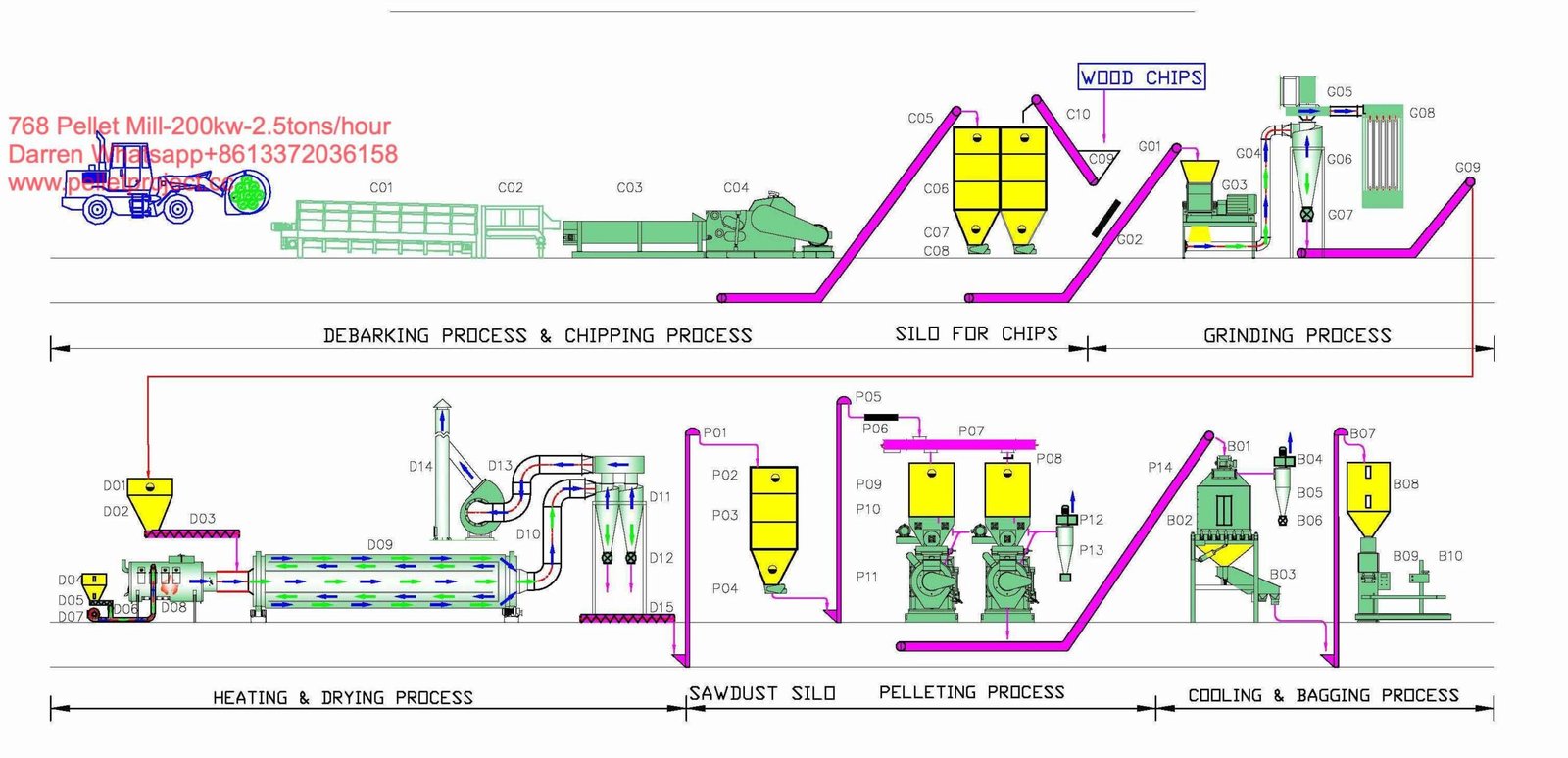
Three checks catch most of these mismatches:
- Ask the dryer supplier for water removal in kg per hour at your inlet and outlet moisture, not tonnage.
- Ask the hammer mill supplier for output at your screen size, not at the widest screen available.
- Ask the cooler supplier for capacity at your pellet diameter, because a 6 mm pellet carries more heat and more surface into the cooler than an 8 mm pellet at the same tonnage.
The plant layout decisions that follow from those numbers — buffer volumes, conveyor sizes, where the fines return — matter as much as the mill frame, and they are much cheaper to change on paper.
Uptime decides annual tonnes
Nobody buys a mill for its hourly rate. They buy it for tonnes per year, and tonnes per year is a three-factor product: hourly output, scheduled hours, and the share of those hours the line actually runs.
The third factor is where new plants lose the most. Die changes, cooler cleaning, blocked conveyors, waiting for the loader, a dryer that cannot keep up after rain, spare parts that arrive in three weeks instead of three days — none of them appear in a capacity quotation, and all of them appear in the annual total.
| Scenario | Scheduled hours | Availability | Annual output |
|---|---|---|---|
| New plant, single shift, learning curve | 4,000 h | 80% | 6,400 t |
| Established plant, two shifts, maintained | 6,000 h | 85% | 10,200 t |
| Well-run plant, three shifts, spares on shelf | 7,200 h | 90% | 12,960 t |
Same machine, double the output between the first row and the third. That is why a plant that buys a 4 t/h mill to cover a 2 t/h shortfall often ends up with the same annual tonnage as before, plus a larger electricity bill and a second set of problems. Availability is cheaper to buy than capacity: a spare die, a spare roller set, a moisture meter and a maintenance schedule cost a fraction of the next frame size.
A capacity test both sides can sign
If the number matters — and on a line above 1 t/h it always does — test it rather than accept it. A test that survives an argument has five elements:
- Duration. Run continuously long enough for the die to reach operating temperature and for the feed to stabilise. One Chinese builder’s published protocol uses a minimum of four continuous hours, which is a reasonable floor and a useful number to put in a contract.
- Material. Use the buyer’s feedstock, at a stated moisture, ground through a stated screen. Testing on the supplier’s dry softwood measures the machine, not the plant.
- Measurement. Weigh the finished pellets, bagged or in a checked hopper, over a timed interval. Do not read tonnage off a conveyor speed and a belt scale that has never been calibrated.
- Records. Moisture at the mill inlet every 30 minutes, amps as a percentage of FLA, die specification and roller gap, pellet diameter, and the kWh meter reading at start and end. The kWh reading is what tells you whether the tonnage was bought with electricity rather than with good material.
- Tolerance. Agree in advance what counts as a pass. A band of 5–10% below the quoted figure is the tolerance one supplier publishes for standardised material; anything wider is not a test, it is a demonstration.
Run the test twice if the first one lands near the tolerance limit. Dies need a few hours to settle, and a mill that is 8% short in hour one is often at the quoted figure by hour six.
What to write into the contract
Capacity guarantees fail for one reason: the conditions were never written down, so neither side can prove what was promised. Four clauses close that gap.
Performance clause. “Minimum X t/h, measured over four continuous hours, on [species] sawdust at [moisture]% ± 1, ground to pass a [size] mm screen, with a [diameter] mm die of [L/D] compression ratio, at [altitude/ambient] conditions.” Every bracket is a place where a dispute can start, so fill them all.
Measurement method. Who weighs, with what, and who signs the sheet. Name the kWh meter and the moisture instrument.
Remedy. What happens if the test fails: a replacement die at the supplier’s cost, a motor upgrade, or a price adjustment. A guarantee without a remedy is a conversation.
Spares and response. One spare die and one roller set with the machine, and a stated lead time for the second die. Die lead time is the number that decides whether a wear problem becomes a shutdown.
Buy the next frame up, or fix the process?
When a plant is short of capacity, there are two honest answers and one dishonest one. The dishonest one is to buy a bigger mill and keep the wet feedstock, the coarse grind and the worn die. The tonnage will rise for a month and settle back to where it was, because the constraint was never the motor.
Fix the process first when the shortfall is modest and the cause is identifiable: moisture outside the band, grind too coarse, die near the end of its life, roller gap wrong, dryer unable to keep up. All of those are cheaper than a new frame, and all of them are measurable within a week.
Buy the next frame up when the mill is running at 90–95% of FLA for full shifts, the material is inside spec, the die is new and the grind is right — and you still cannot make the tonnage. At that point the machine is genuinely the constraint, and running it at the relay every day is a slower way of buying a motor.
If you are specifying a new line, the safest approach is to size on your real feedstock at your real moisture, add the availability you can honestly maintain, and then decide whether the extra frame size is worth more than the spare die, the second silo and the moisture control that would have protected the tonnage you already had. Most plants under 3 t/h that ask us this question end up better served by a correctly specified YPM630 or YPM850 with two dies and a real dryer than by a larger mill with one.
Capacity worksheet: fill this in before you sign
Copy these seven lines into your project file and answer them in numbers. If a supplier cannot help you fill them, that is information too.
- Target annual tonnes = ______ t/year. Divide by your realistic running hours to get the hourly figure you actually need. 10,000 t over 6,000 hours is 1.67 t/h, not 2 t/h.
- Required hourly output = annual tonnes ÷ hours ÷ availability. Use 0.85 if you have no history; use 0.8 in the first year.
- Specific energy of your material = ______ kWh/t. Start from the die you will run and a sample test; if you have nothing, use 90–110 kWh/t for wood and expect the upper end for hardwood and fine grind.
- Motor size implied = required t/h × kWh/t ÷ 0.9. A 1.67 t/h duty at 100 kWh/t needs about 185 kW at 90% load.
- Wet-side throughput = dry matter ÷ (1 − feed moisture). At 40% feed moisture and 2 t/h of 10% pellets, the front end handles 3 t/h.
- Water to evaporate = wet feed − pellets = ______ kg/h. Give that number to the dryer supplier and ask for it back in writing.
- Annual electricity cost of the main motor = tonnes × kWh/t × your tariff. At 100 kWh/t, 10,000 t and $0.096/kWh, that is $96,000 a year — worth checking against the quotation before you argue about the price of the mill.
Seven lines, one afternoon, and the conversation with any supplier changes completely. You stop asking how many tonnes a machine makes and start asking whether it makes your tonnes, from your material, in your plant. That is the only capacity figure that survives contact with a production report.