
Two mills run the same acacia sawdust through the same model of press. One injects saturated steam ahead of the die and reads 98.4% durability. The other sprays water into the mixer and reads 96.9%, with a die that needs polishing every few weeks. Both operators will tell you they are “conditioning the feed”.
They are doing different things. Steam adds heat and water together. Water adds only water, and if it arrives cold it removes heat at the same time. That difference decides how the lignin behaves in the die, and lignin behaviour is what a pellet is.
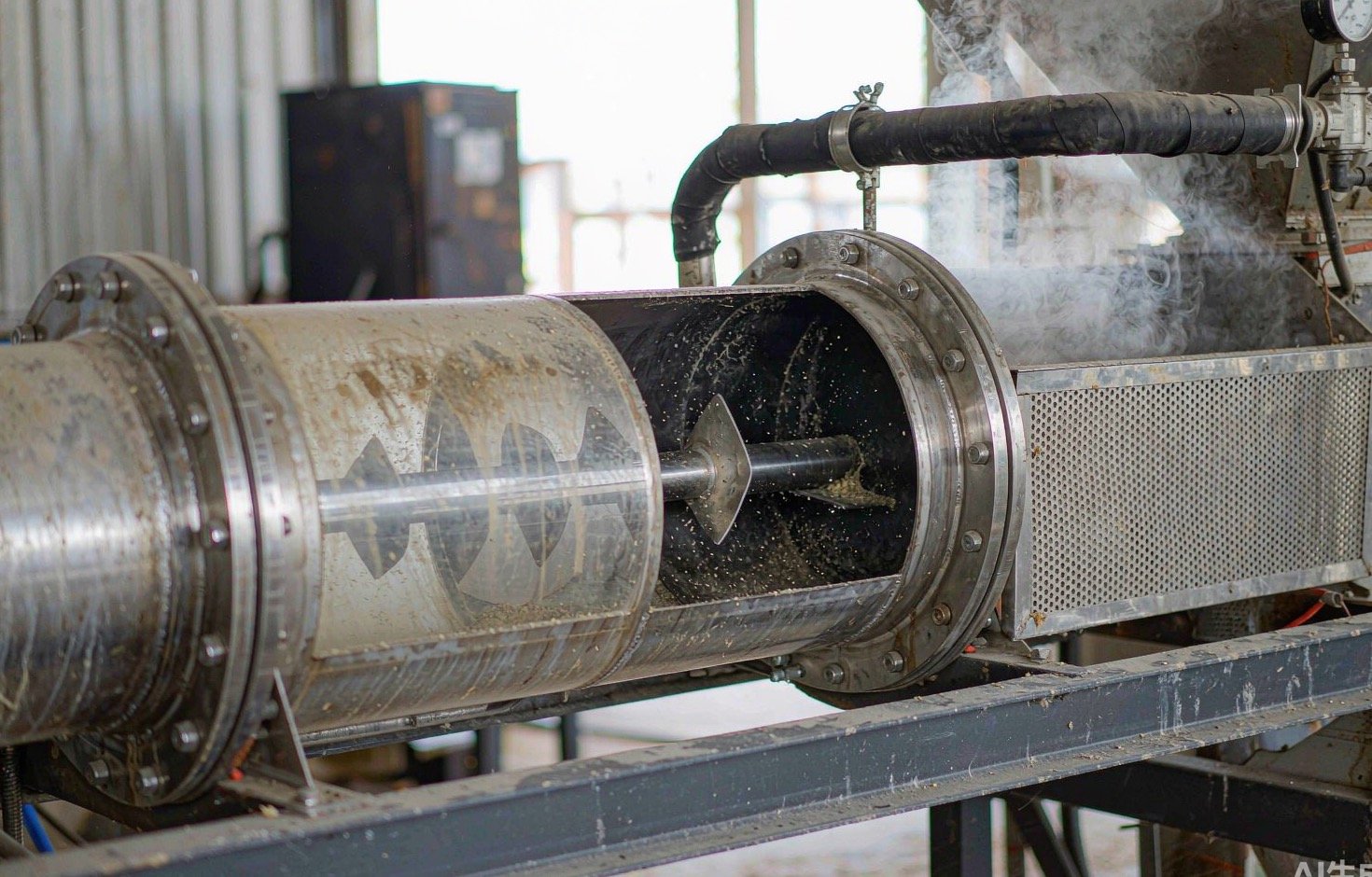
Heat and moisture do different jobs
Wood binds without any additive because lignin softens when it gets hot enough and wet enough, then re-solidifies as the pellet cools. Dry lignin softens somewhere around 195 °C, which no pellet die will reach. Add water and the softening point falls sharply — in the range of 110–135 °C for wood at 8–15% moisture (Karlstad University pelletising study).
That is still above what you can reach with water alone. The die supplies the rest through friction, and friction only builds when the material resists being pushed through the holes. So the conditioner’s job is to get the meal close enough to bonding temperature that die friction can finish the work — and to do it without pushing moisture past the point where the die slips.
Water by itself can lower the softening point, which is why some mills get away with it. What water cannot do is raise the temperature. A cold spray actually pulls heat out of material that just came out of a dryer, and the press then has to rebuild that heat from friction, which shows up as amps.
What steam actually delivers
Saturated steam carries latent heat, and when it condenses on a sawdust particle it releases that heat at the particle surface. The result is a fast, even temperature rise — the patent literature on the process describes particle temperature going to 80 °C and above, with a moisture gain of roughly 2–5% depending on how far the material is heated (CA 2467606 A1). The same document puts the bonding condition at a surface temperature above 90 °C with moisture above 5%, which is a fair summary of what you are trying to achieve at the die inlet.
Three practical consequences follow. First, the moisture is distributed as condensate on the surface of particles rather than as droplets in the mixer, so you get less of the wet-patch, dry-patch problem that shows up as fluctuating amps. Second, the meal arrives hot, so the die reaches working temperature sooner after a stop and the first tonnes after a restart are less likely to be soft. Third, steam displaces air from between particles, which slightly improves heat transfer and density.
The cost side is real, though: a boiler, water treatment, steam piping, traps and a licensed operator. For a 1 t/h line running one shift, that package can cost more than the press accessories it feeds.
What water actually delivers
Water is cheap, needs no boiler, and can be added with a nozzle manifold and a flowmeter. Mills use it for three reasons: the feed is too dry after the dryer, the local climate is arid, or the plant has no steam at all.
It works, with caveats. Sprayed water needs time to equalise through the meal, so the mixer has to be long enough and the retention time measured, not assumed. Nozzle pressure matters: equipment makers describe water injected at 2–3 bar through nozzles near the mixer inlet, and note that hot water at 80–90 °C distributes between particles better than cold because part of it evaporates after spraying (conditioning notes from a pelleting equipment maker). Cold water on dry meal produces surface-wet particles and a die that slips and surges.
The other caveat is biological. Water added at the mixer is not sterile, and a damp meal that sits in a bin over a weekend is a mould risk. Steam at temperature does not carry that problem to the same degree.
Steam or water: the comparison that matters
| Saturated steam | Hot water (80–90 °C) | Cold water | |
|---|---|---|---|
| Heat added to meal | Substantial — particles reach 80 °C and above | Some, but evaporative loss cancels part of it | Negative — cools material leaving the dryer |
| Moisture control | Linked to heat input; 2–5% gain typical | Direct and measurable by flowmeter | Direct and measurable by flowmeter |
| Distribution through meal | Condensate on particle surfaces, fast equalisation | Good if retention time is sufficient | Poor — surface wetting, local wet patches |
| Effect on die temperature | Raises it, shortening warm-up | Neutral to slightly positive | Lowers it; amps rise while the die recovers |
| Capital and running cost | Boiler, water treatment, piping, traps, operator | Heater or hot-water loop, nozzles, flowmeter | Nozzles and flowmeter only |
| Main risk | Over-moistening if feed is already wet; wet steam carrying droplets | Under-sized heater; temperature drop in long lines | Mould in bins, die slip, uneven pellet quality |
| Best fit | Lines above roughly 2 t/h with a boiler already on site, or high-fibre material | Dry feed and no boiler, warm climate | Emergency top-up only |
The ceiling nobody should cross
Feed mills publish a working target of 17–18% moisture at the conditioner, with a warning that total moisture above 18% makes the die plug (Kansas State University pelleting guidelines). Wood is not feed, and the useful window is lower: pelletising works best with wood around 10–15% moisture on a wet basis (Biomass Connect pelleting guide).
The same KSU document gives a rule of thumb worth taping to the conditioner: each 25 °F rise in meal temperature adds roughly 1% moisture. That cuts both ways. If your feed arrives at 13% and you want to stay under 15%, you have about 50 °F of heating headroom — enough to warm the meal, not enough to drown it. A mill that chases die temperature by opening the steam valve usually finds the ceiling before it finds the temperature.
Two measurements keep you honest: moisture of the meal entering the conditioner, and meal temperature at the conditioner outlet. Neither is expensive. Without both, every steam adjustment is a guess.
Where each approach wins
Steam earns its cost when the feed is dry, hard to bind, or high in fibre. Straw, rice husk and palm fibre need heat to plasticise, and a boiler is the cheapest way to deliver it. Steam also pays on lines with an existing dryer: the exhaust heat is already on site, and the marginal cost of a little more steam is low.
Water wins when the feed is too dry for the die but already at ambient temperature, and the plant has no boiler. In hot climates a 1–2% water addition through a properly sized nozzle can be enough to stop a die from slipping, at a fraction of the capital cost of a steam system.
The configuration that causes trouble is the half-measure: a boiler installed for a different process, piped to the conditioner without a separator, so wet steam carries droplets into the meal. The symptom is a die that runs fine for two hours and then chokes — moisture spikes, not a process trend.

Reading the symptoms: steam, water or neither
| Symptom at the press | Usual cause | Steam or water fix |
|---|---|---|
| Soft pellets, low durability, die cool to the touch | Meal too cold; friction never reaches bonding temperature | Add steam; check separator for wet steam first |
| Die slips and surges, amps swing ±15% | Moisture too high or unevenly distributed | Cut steam; if using water only, lengthen mixer retention |
| Pellets crack on the surface as they leave the die | Steam flashing inside the die; moisture above the window | Reduce steam; verify meal moisture at conditioner outlet |
| Hard, glossy pellets that crumble at the first drop | Over-pressed, too dry, die too long for the material | Small water or steam addition to soften; review die L/D |
| Fines climbing through the shift with no die change | Moisture drifting down as the raw material dries | Trim steam to hold outlet moisture; log every two hours |
| Wet patches in the meal, local die blockage | Droplets from wet steam or a single oversized nozzle | Fit a separator; replace nozzle tips as a set |
Most of these are measurement failures rather than equipment failures. A mill that logs inlet moisture, outlet temperature and amps every two hours can see a drift before it becomes a batch of crumbly pellets. That habit is also what makes the durability number meaningful — the test tells you the result, the log tells you why. If you have not set up the test yet, the method is in how to test pellet durability in-house.
Two configurations that work, and one that does not
A 2 t/h hardwood line in Vietnam, no boiler. The dryer brings sawdust to 12%, the mixer has a hot-water loop at 85 °C and two nozzles with a flowmeter. The operator adds 1% water in the dry season, nothing in the wet season, and the die runs at 88–92 °C from friction alone. Durability sits at 98.1–98.5%. No boiler, no steam traps, one less system to break.
A 5 t/h mixed hardwood and palm fibre line in Indonesia. Steam at 0.3 MPa through a separator, meal heated to about 75 °C before the die. The palm fraction needs the heat; water alone left it glossy on the outside and crumbly inside. Steam consumption is metered and tied to the shift log, because the boiler is shared with the dryer and an unmeasured steam line is a cost nobody owns.
The one that does not work: a 1 t/h line running dry sawdust at 8% with neither steam nor water, on the theory that “wood binds by itself”. It does bind, badly, and the mill spends its maintenance budget on dies and rollers instead of on the 200 kg/h of water that would have solved it.
If you are specifying a line now, decide the conditioning route before the layout, not after — the boiler room, water treatment and pipe runs are hard to add later, and the choice changes the electrical load and the building footprint. The process background sits in pellet conditioning, the upstream half in drying sawdust for pellets, and the die side in die compression ratio. When you are ready to size the press around a known feed, the YPM630 vertical ring die mill is the configuration most of our 1–1.5 t/h customers start from, with or without a conditioner depending on the answer to the question above.