
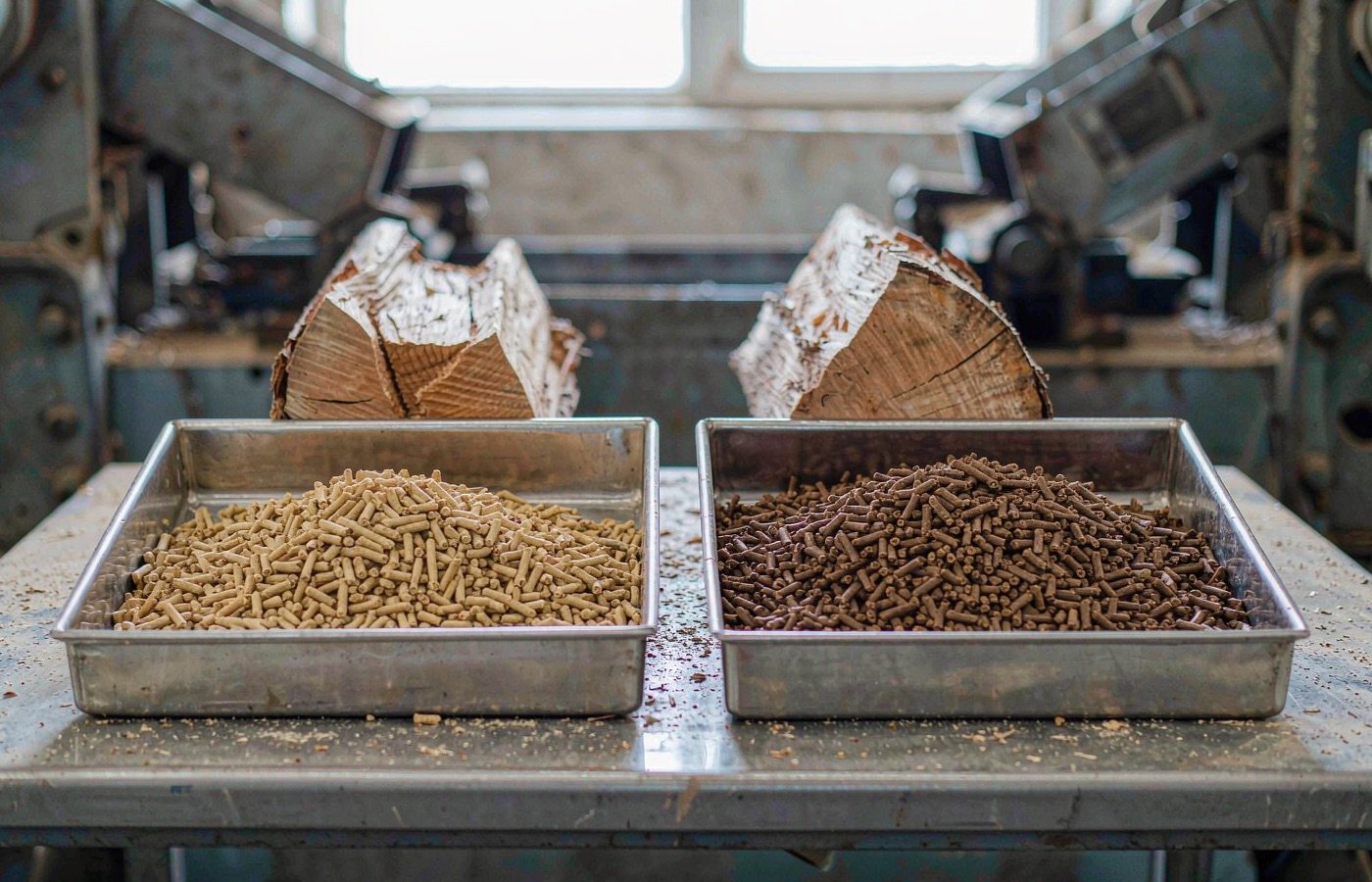
Ask three pellet traders whether softwood or hardwood makes the better pellet and you will get three answers, two of them wrong. The residential market in Europe still repeats the firewood logic — hardwood is premium, softwood is cheap filler. Meanwhile Vietnam, a country that runs almost entirely on plantation acacia and rubberwood (hardwoods, both), shipped 6.03 million tonnes of pellets in 2024 worth 805 million dollars, with 94% going to Japan and Korea (Vietnam Customs via Agrideco Vietnam). If hardwood pellets were a second-class fuel, Asia’s utility buyers did not get the memo.
This article is for producers deciding which species to build a line around, and for buyers trying to read a spec sheet that says “mixed hardwood” without further detail. What follows is what the species actually changes — chemistry, energy, mill behavior, die wear — and what it does not.
The chemistry: lignin, extractives and heat
Wood differs between species in three ways that matter to a pellet producer: lignin content, extractive content, and calorific value. The BISYPLAN bioenergy handbook, a European reference for biomass system planners, sums up the dry-basis composition of the two groups:
| Component (dry basis) | Hardwood | Softwood |
|---|---|---|
| Cellulose | 43 – 50% | 35 – 44% |
| Hemicellulose | 20 – 25% | 25 – 30% |
| Lignin | 16 – 25% | 27 – 33% |
| Extractives | 2 – 8% | 1 – 5% |
| Higher heating value | 18.5 – 19.5 MJ/kg | 19 – 20.5 MJ/kg |
(Source: BISYPLAN handbook, section 01-01)
Lignin is the natural binder. It softens under heat and pressure in the die, flows between particles, and sets again as the pellet cools — the reason a good wood pellet needs no added glue. Softwood carries more of it, roughly 27–30% against 20–25% for common hardwoods, and the same Finnish wood research paper notes that softwood’s higher lignin plus its resinous extractives are what push its heating value above hardwood’s (Wood Research, torrefied pellet pilot study).
The heating value gap is real but modest: roughly half a megajoule per kilogram at the band midpoints. A review of fuelwood data puts dry wood of all species between about 18 and 22 MJ/kg, “slightly higher in coniferous than in deciduous tree species,” because lignin itself carries 26–27 MJ/kg and resins sit higher still (Finnish MFA, fuelwood management guide).
Here is the nuance that surprises people: once pellets are compressed to the same bulk density spec, the species difference shrinks. ISO 17225-2 requires 16.5 MJ/kg net calorific value and 600–750 kg/m³ bulk density for every grade, residential and industrial alike. A well-made acacia pellet meets the same contract spec as a well-made pine pellet. What changes is how easily each one gets there — and that is where the mill story begins.
Throughput and die life: where hardwood bites
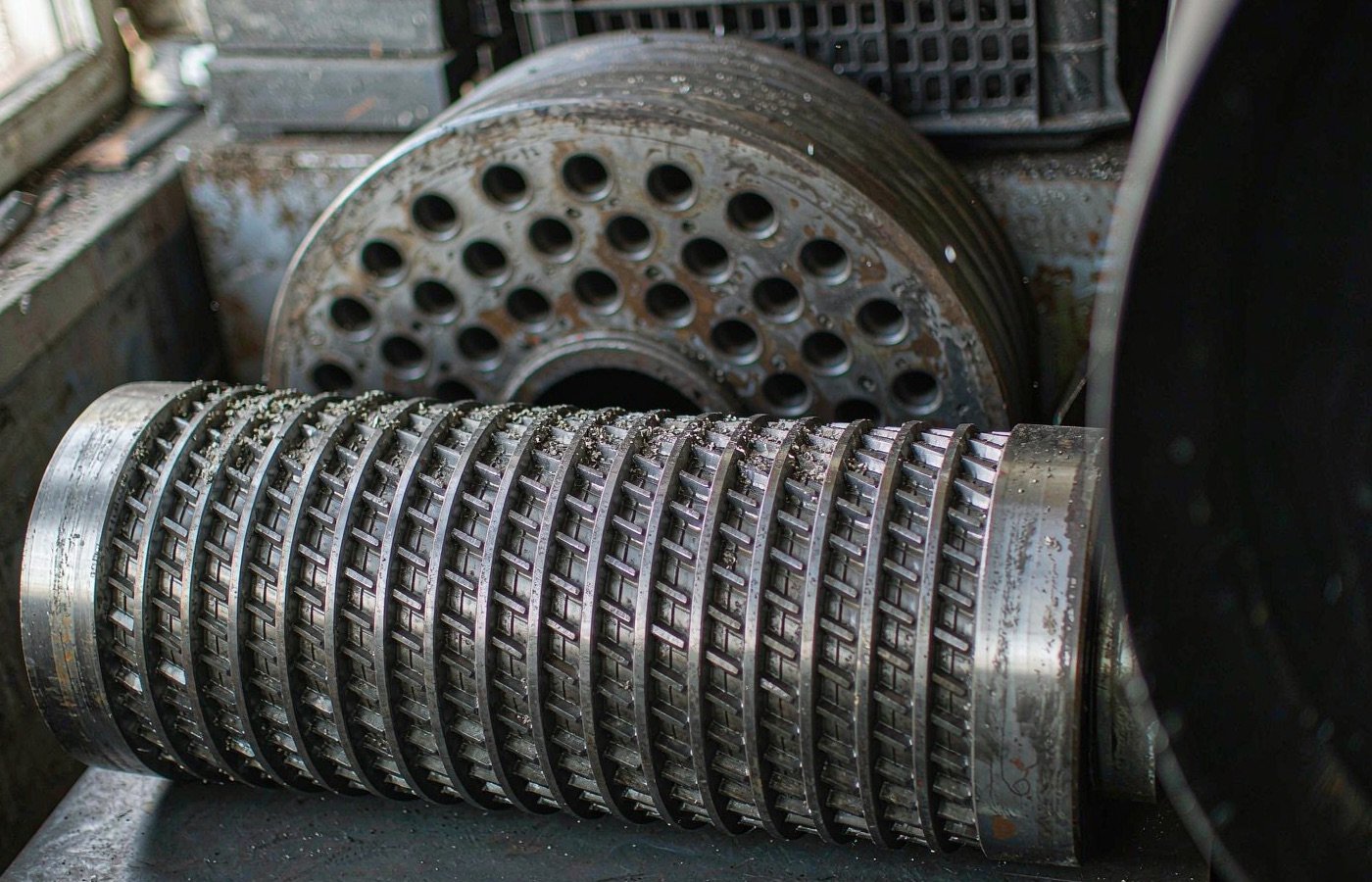
Ask any mill operator and they will tell you hardwood runs slower. Chinese machinery suppliers with large installed bases put hardwood throughput at roughly 60–70% of softwood on the same machine, with the same die, all else equal (Changsheng capacity notes). The reasons are mechanical, not mysterious: hardwood fibers are denser and stiffer, so they resist plastic flow through the die channel, and the press needs more specific energy per tonne to force the same mass through the same holes.
Die life follows the same logic. Supplier service data quotes roughly 1,200–2,000 hours on clean softwood against 800–1,400 hours on hardwood, with abrasive species and bark pushing the floor lower (Kingwood die life data). Harder feed also wears roller shells faster, and roller shells plus dies are your two recurring wear-part costs. We sized the trade-offs in our ring die buying guide — the short version: on hardwood you spec a slightly lower compression ratio and accept shorter die cycles, or you pay for more wear-resistant steel.
None of this makes hardwood uneconomic. It makes the arithmetic different: lower hourly output and higher wear-part cost per tonne, traded against raw material that plantation supply chains deliver year-round at a stable price. Vietnam’s mills run this math every day and it works — the same customs data shows their pellet export revenue crossing one billion US dollars in 2025.
Durability and ash: bark matters more than species
Conventional wisdom says softwood pellets are more durable because they carry more lignin. In practice, the durability number on your certificate is driven more by process than by species: feed moisture in the 10–15% window, adequate conditioning temperature, particle size, and die condition. A softwood mill running wet, cold and under-compressed makes crumbly pellets; a hardwood mill with tight moisture control and the right die makes pellets that survive three trans-shipment points.
Ash is the same story. Species sets the floor — clean stemwood of both groups sits around 0.3–0.8% minerals, per the BISYPLAN table above — but bark, sand and field dirt set the ceiling. Well-run Vietnamese acacia mills publish typical bands of 0.7–1.5% ash with net calorific value of 4,100–4,400 kcal/kg (17.2–18.4 MJ/kg) and durability of 97.5–98.5%, which spans ENplus A1 down to industrial I2 territory depending on bark content (Woodbase Vietnam).
That ash band is exactly why Japan-facing contracts so often settle on ISO 17225-2 I2 (ash ≤ 1.5%) rather than A1 (ash ≤ 0.7%): plantation hardwood supply chains include some bark, and buyers price for it. Japanese utility spec sheets from Vietnamese exporters mirror this — ash ≤ 1.5%, NCV ≥ 16.5 MJ/kg, durability ≥ 98% (DRD Biomass). If your feedstock is clean, debarked softwood sawdust, you can chase A1 premiums; if it is mixed plantation hardwood, I2 is where the volume lives.
Side by side: the honest comparison
| Factor | Softwood (pine, spruce) | Hardwood (acacia, rubberwood, oak) |
|---|---|---|
| Lignin (dry) | 27 – 33% | 16 – 25% |
| HHV (dry) | 19 – 20.5 MJ/kg | 18.5 – 19.5 MJ/kg |
| Pelleting ease | Higher — more binder lignin, lower friction | Lower — stiffer fiber, more specific energy |
| Throughput on same machine | 100% (reference) | Roughly 60 – 70% (supplier data) |
| Typical die life | 1,200 – 2,000 h | 800 – 1,400 h |
| Ash, clean debarked feed | 0.3 – 0.8% | 0.3 – 0.8% |
| Ash with plantation bark | Rises with bark share | Typically 0.7 – 1.5% |
| Natural export grade | ENplus A1 markets (EU heating) | ISO 17225-2 I1/I2 utility markets (Asia) |
Which one should your plant run?
Both species end up in the same specification envelope, so the decision is really about your raw material economics. Four things decide it:
What grows around you. A mill in central Vietnam does not choose softwood; acacia and rubberwood residue is the supply. A mill in the Baltic region or British Columbia has the opposite constraint. Species choice is usually made by geography before it is made by chemistry.
What the buyer pays for. European residential trade pays certification premiums that favor clean softwood. Asian utility trade buys volume on I2-shaped specs where hardwood dominates. Match your grade ambition to the market your port actually reaches — our ENplus A1 guide and our export shipping guide cover both ends.
What your machine needs. Hardwood wants a die with somewhat lower compression, a motor with headroom, and a conditioning setup that gets temperature and moisture right before the press. If you are spec’ing a line for mixed hardwood, size the mill for the hardwood throughput, not the softwood number on the brochure — the mismatch between rated and actual capacity is the most common complaint we hear, and we wrote a whole piece on why rated tons per hour don’t arrive.
What you can hold every month. A buyer would rather have a guaranteed 1.2% ash acacia pellet than an occasional 0.5% one. Quote the band your feedstock delivers.
One more production-level point that only shows up after the first month: hardwoods and softwoods dry differently on the way into the press. Plantation hardwood residue often arrives wetter and more variable than kiln-side softwood sawdust, which puts more load on your dryer and makes the moisture window — the 10–15% band the press actually likes — harder to hold hour by hour. When mills tell us their hardwood line “runs worse than the brochure promised,” the cause is more often a dryer chasing a moving target than the wood itself. If that sounds familiar, start with our sawdust drying guide before you blame the species.
The verdict, species by species
- Pine / spruce sawdust: the easiest pellet you will ever make. High lignin does half the bonding work; chase A1 premiums if your market pays for them. Die costs per tonne are the lowest in the industry.
- Acacia / rubberwood residue: the backbone of Asian exports. Slower through the die and harder on wear parts, but plantation supply is constant and I2 buyers take it at scale. Spec your line for hardwood throughput from day one.
- Eucalyptus: fast-growing plantation hardwood, similar profile to acacia — moderate lignin, clean ash when debarked. Widely used across Vietnam and South America.
- Oak / beech (furniture residue): dense, low-ash hardwood from kiln-dried stock. Bonds well once conditioned hot; watch residual coatings from panel or furniture processing, which move chlorine and nitrogen.
- Mixed sawmill residue (unknown bark share): the honest answer is “test it monthly.” Ash will wander with bark content; quote a band, not a point, and screen consistently before load-out.
The species debate ends where the specification begins: whatever grows near your mill, the contract is won or lost on moisture, ash, durability and density — and those are process numbers before they are wood numbers.