
A Korean utility buyer emails your trading desk and asks for pellets “to ISO 17225-2 I2”. Your sales team replies with the ENplus A1 spec sheet you use for European residential customers. Both sides go quiet, and the deal stalls. I have watched this exact loop play out more than once, and it always comes from the same gap: people treat ISO 17225-2 as a stricter version of ENplus, when in fact it is a different instrument written for a different buyer.
ISO 17225-2 is the ISO standard for graded wood pellets — both the residential classes (A1, A2, B) and the industrial classes (I1, I2, I3). The EN ISO 17225 series took the place of the older EN 14961 standard in May 2014, and Part 2 is the document most Asian utility tenders actually reference. If you sell into Japan or Korea, or plan to, you need to know the I-grades as well as you know A1.
One standard, two families of grades
The 17225 series covers solid biofuels. Part 2 deals with graded wood pellets from non-thermally treated woody biomass. Inside that single part sit two separate tables: one for non-industrial use — homes, small commercial boilers — with classes A1, A2 and B, and one for industrial use with classes I1, I2 and I3.
The industrial grades are not a copy of the residential ones with looser numbers. They were written around how a power station actually takes fuel: by ship, in bulk, screened at intake, milled before firing. That changes which parameters matter and how tight they are. A review published in Materials in 2023 tabulates the ISO 17225-2 requirements for both families (Materials 2023, 16, 4689), and the differences are easy to miss if you only skim it.
The core contrast, in five rows:
| Parameter | A1 / A2 / B (residential) | I1 / I2 / I3 (industrial) |
|---|---|---|
| Ash | ≤ 0.7 / 1.2 / 2.0% | ≤ 1.0 / 1.5 / 3.0% |
| Fines (< 3.15 mm) | ≤ 1% in all three classes | ≤ 4 / 5 / 6% |
| Additives | ≤ 2% | ≤ 3%, type and amount to be stated |
| Chlorine | ≤ 0.02 / 0.02 / 0.03% | ≤ 0.03 / 0.05 / 0.10% |
| Nitrogen | ≤ 0.3 / 0.5 / 1.0% | ≤ 0.3 / 0.3 / 0.6% |
Notice the nitrogen row: the industrial table is actually tighter than the residential one at I1 and I2, because large boilers report NOx to a regulator. Looser does not mean sloppier — it means the parameter set is rearranged around what a utility cares about.
The I1, I2 and I3 limits in one table
Here are the industrial-grade specifications as reproduced from ISO 17225-2 in a PhD thesis on pellets for suspension-fired power plants at the Technical University of Denmark (Masche, DTU):
| Parameter | Unit | I1 | I2 | I3 |
|---|---|---|---|---|
| Diameter | mm | 6 ± 1; 8 ± 1 | 6 ± 1; 8 ± 1; 10 ± 1 | 6 ± 1; 8 ± 1; 10 ± 1; 12 ± 1 |
| Length | mm | 3.15 – 40 | 3.15 – 40 | 3.15 – 40 |
| Moisture (as received) | wt-% | ≤ 10 | ≤ 10 | ≤ 10 |
| Ash (dry basis) | wt-% | ≤ 1.0 | ≤ 1.5 | ≤ 3.0 |
| Mechanical durability | wt-% | 97.5 – 99.0 | 97.0 – 99.0 | 96.5 – 99.0 |
| Additives | wt-% | < 3 | < 3 | < 3 |
| Bulk density | kg/m³ | 600 – 750 | 600 – 750 | 600 – 750 |
| Net calorific value | MJ/kg | ≥ 16.5 | ≥ 16.5 | ≥ 16.5 |
| Fines (< 3.15 mm) | wt-% | ≤ 4 | ≤ 5 | ≤ 6 |
Two things stand out. First, durability is written as a band, not a floor — 97.5–99.0% for I1. That surprises people who only know ENplus, where the number is a minimum. Second, the fines allowance at delivery runs up to 4–6% depending on grade, far above the 0.5–1.0% you live with under ENplus bagged trade. The fines values come from the Materials review’s reproduction of the standard; the DTU thesis omits them but agrees on everything else in the table.
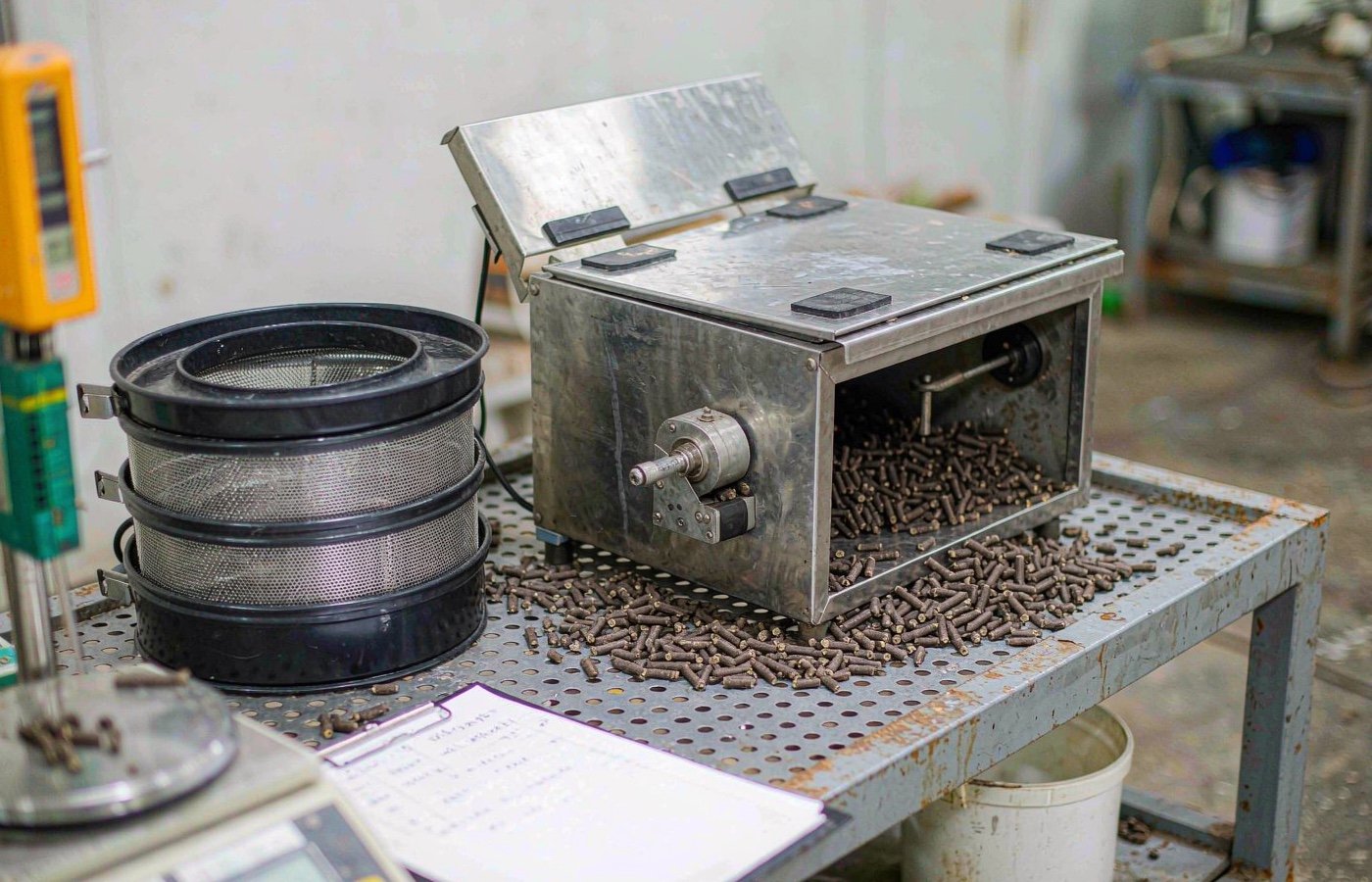
Each parameter maps to a specific ISO test method: moisture by oven drying to ISO 18134, ash by ISO 18122, net calorific value by bomb calorimeter to ISO 18125, mechanical durability by tumbler to ISO 17831-1, bulk density to ISO 17828, fines to ISO 18846 on a 3.15 mm sieve, diameter and length to ISO 17829, and the nitrogen, sulphur and chlorine values to ISO 16948 and 16994. Those method numbers appear on every serious spec sheet, and a laboratory that cannot tell you which method it used is not a laboratory you want deciding your contract.
The same Materials review lists the chemical limits, which barely move between I1 and I2 but widen at I3: sulphur ≤ 0.05% across all three grades, with trace-element ceilings for arsenic, cadmium, chromium, copper, lead, mercury and zinc roughly doubled versus the residential table.
Why industrial grades allow more fines and more ash
The residential classes protect a small boiler that has no fuel preparation system. If the auger delivers fines, the stove smokes and the homeowner complains. The industrial classes protect a plant that screens, stores and grinds fuel anyway.
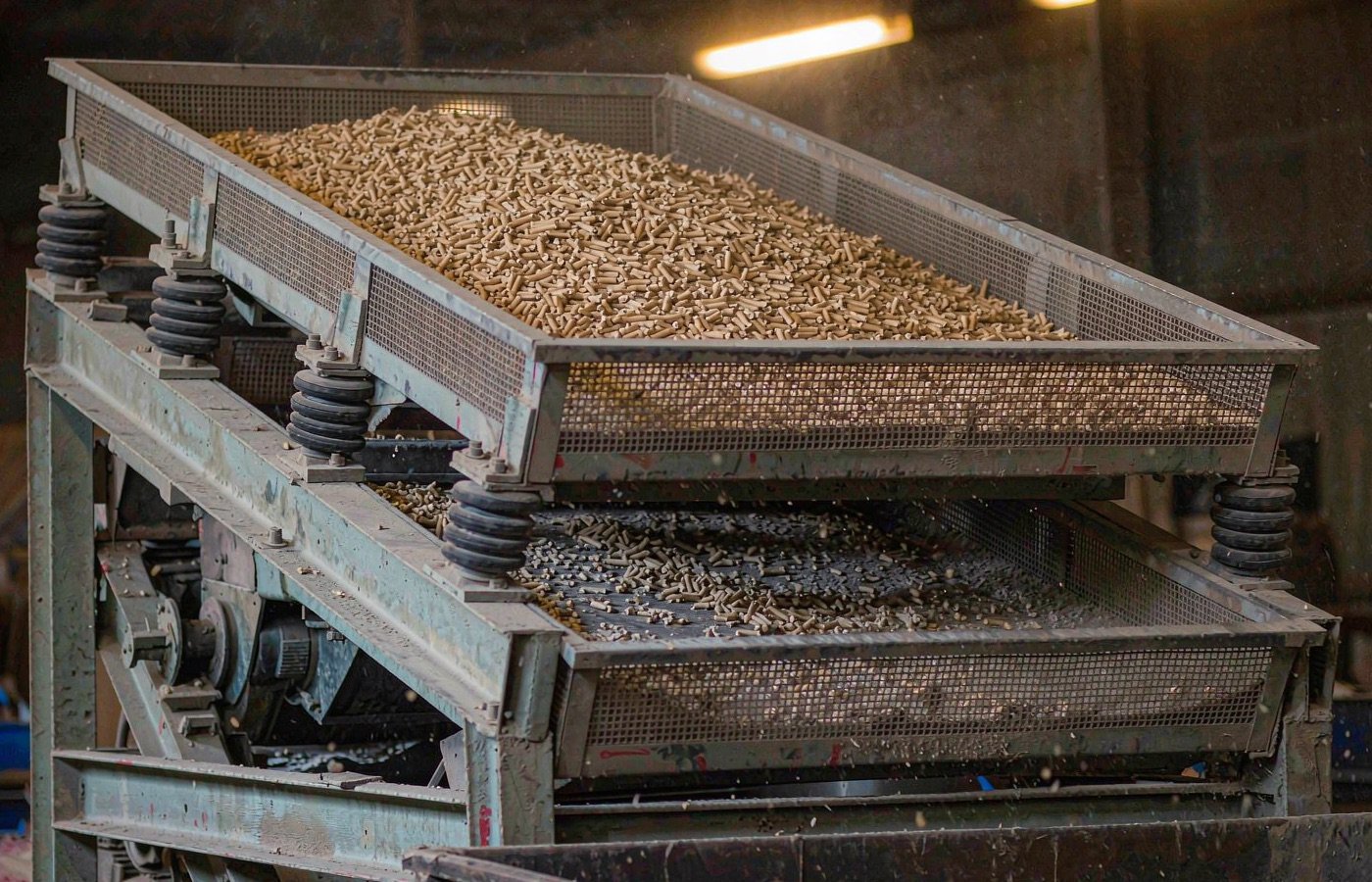
A utility receives pellets, screens out fines at intake, and mills the pellets to powder before firing. Fines that arrive in the cargo are not a burner problem — they are a dust-handling problem, and the plant’s equipment is built for them. That is why the standard tolerates 4–6% fines at delivery instead of 0.5%.
Ash works the same way. An I3 pellet may carry 3% ash because the boiler has continuous ash removal, while a residential stove would choke on it. What the utility actually worries about is ash chemistry — slagging and fouling — which is why tenders add ash melting behaviour tests on top of the ISO table even though melting temperature sits outside the graded parameters.
There is one more specification that exists only for industrial grades and almost nobody outside the sector talks about it: the particle size distribution of the milled pellets. The DTU thesis tabulates it directly:
| Share passing after disintegration | I1 | I2 | I3 |
|---|---|---|---|
| < 3.15 mm | ≥ 99% | ≥ 98% | ≥ 97% |
| < 2.0 mm | ≥ 95% | ≥ 90% | ≥ 85% |
| < 1.0 mm | ≥ 60% | ≥ 50% | ≥ 40% |
This “internal PSD” describes how the pellet breaks apart when milled. An I3 pellet may be built from coarser particles, which lowers its milling energy demand but also limits how finely it can be ground — relevant if the buyer fires in a pulverized-fuel boiler rather than a grate or fluidized bed. If your customer suspension-fires, ask which PSD values their mill design assumes before you promise a grade.
What each grade costs you at the pellet mill
Grades are written for buyers, but producers pay for them. Here is how the three industrial classes translate into mill-side work:
I1 (ash ≤ 1.0%). Clean sawmill residue territory. Debarked stemwood sawdust typically lands well under 1% ash; anything with bark mixed in drifts toward the limit, because bark raises ash, nitrogen and chlorine at the same time — the Materials review cites trials where bark additions lowered ash melting behaviour and pushed pellets out of tighter classes. Holding I1 month after month usually means owning the debarking step, not hoping the sawmill did it.
I2 (ash ≤ 1.5%). The workhorse grade for Asian exports. It tolerates a modest bark fraction, which matches what plantation hardwood supply chains actually deliver. Vietnamese mills shipping to Japanese and Korean utilities typically hold ash in the 0.7–1.5% band depending on how much bark and plantation residue enters the flow, which is why many quote I2 as their standing grade rather than promising I1 every month (Woodbase Vietnam spec guide). Durability of 97.5% and above is normal for a well-run line; the mills that struggle are the ones letting moisture wander.
I3 (ash ≤ 3.0%). Built for plants with heavy ash handling — grate boilers and fluidized beds that co-fire or take lower-cost fuel. Producing I3 is easy; selling it is the hard part, because only certain boiler designs accept it and utilities pay less for it. For most producers I3 is a fallback, not a strategy.
Notice what does not change: moisture ≤ 10%, NCV ≥ 16.5 MJ/kg, bulk density 600–750 kg/m³, durability still in the high nineties. Moving from I1 to I3 does not mean making a bad pellet. It means making a pellet from slightly dirtier wood.
The fines arithmetic you should run before quoting
Say you contract 5,000 tonnes of I2 at a delivery-point fines limit of 5%. At exactly 5%, the cargo contains 250 tonnes of fines (arithmetic). Under an ENplus bulk delivery you would be held to 1.0% — 50 tonnes. That 200-tonne spread is not free money; the buyer screens it out and deducts it. But it changes how you design your own load-out.
If your screener runs at a 3.15 mm cut point ahead of load-out and holds fines at 1.5% at the silo, handling and transport to port will add fines. Under ENplus you fight every percentage point at every transfer; under an I-grade contract you have real margin. This is one of the quiet cost advantages of industrial trade, and it is worth knowing before you over-invest in port-side screening. Our guide to pellet fines screening systems covers the equipment side.
A worked example: quoting a utility tender without embarrassing yourself
Suppose a tender lands for 10,000 tonnes over twelve months, I2, ash ≤ 1.5%, durability ≥ 97.5%, fines ≤ 5% at the load port, moisture ≤ 10% at the load port. Your mill runs acacia sawmill residue with a measured ash band of 0.7–1.5% over the last quarter. Walk it in this order:
Ash. Your band straddles the limit. Tighten bark control at intake, pull three weeks of daily lab data, and quote only once the new band sits clear of 1.5%. Quoting “≤ 1.5%” on a straddling band is how first-cargo claims happen.
Moisture and energy together. The NCV floor of 16.5 MJ/kg is judged on as-received fuel, so moisture is an energy parameter, not just a handling one. Every extra point of moisture adds weight that carries no heat; dryer setpoint discipline is a contract term here, not a lab nicety.
Durability. Build margin: aim to sit at 98.0% in your own ISO 17831-1 tumbler tests so one off-spec lab round does not put the cargo out of grade.
Fines. At 3% fines you ship 300 tonnes of fines inside a 10,000-tonne contract (arithmetic). The limit is 5%, so you are compliant — but the buyer’s intake screen still deducts that 300 tonnes from usable fuel. Price the contract with your realistic fines number, not the ceiling.
Four paragraphs of arithmetic, and you either price the job honestly or you pass. Both outcomes beat discovering the problems at discharge.
Moisture, containers and the discharge-port problem
Industrial cargoes move in containers and bulk vessels, and both environments expose pellets to humidity swings. Research on pellets stored at high humidity is unforgiving: samples held at 95% relative humidity climbed to about 14% moisture within four days in a University of Greenwich study (Deng, 2018), starting from 5.1–5.5% — and moisture uptake is reversible only down to the equilibrium point, not all the way back to spec.
This is why the measurement point matters more on I-grade contracts than the grade itself. If the tender judges moisture at discharge, you are accepting the risk of the ocean leg, which you do not control. Standard practice among exporters is to push for loading-port determination, or to negotiate a transit allowance; our piece on why pellets gain moisture in storage explains the physics you are negotiating against. The same logic applies to fines: handling at two ports adds fines, so again the contract should say where the number is read.
ISO 17225-2 is a specification, not a certificate
This is the point most often fumbled. You cannot “get ISO 17225-2 certified” the way you get ENplus certified. ISO 17225-2 defines the fuel classes; certification schemes sit on top of it. ENplus certifies residential pellets against the A1/A2 limits plus scheme rules for handling and bagging — we explain how that scheme works in our ENplus A1 guide. The Sustainable Biomass Program is the framework industrial buyers use for utility-scale wood pellets, with its own chain-of-custody and data reporting requirements; our SBP certification guide walks through what it takes.
So when a tender says “pellets conforming to ISO 17225-2 I2”, the buyer is specifying the fuel, and the certification question — SBP, FSC or PEFC chain of custody — usually appears in a separate clause. Answer both, in the right order, and you look like someone who has shipped before.
Who actually buys I-grades
The industrial grades exist because the utility trade is large and growing. Bioenergy Europe’s 2026 statistical report puts global wood pellet production at 53.5 million tonnes in 2025, up 10% year on year, with Asia the fastest-growing producing region (Bioenergy Europe, SR2026). On the demand side, Japan Customs data reported by ITTO show imports under HS 4401 — wood pellets and chips — at 9.6 million tonnes in the first half of 2025, up 17% year on year, with Vietnamese pellet shipments to Japan alone worth more than 400 million dollars in that half (ITTO Market Information Service).
Japanese and Korean utility specifications generally align with ISO 17225-2 industrial grades — an ash ceiling near 1.5%, NCV at or above 16.5 MJ/kg, durability at or above 97.5%, fines tolerance in the low single digits. Vietnamese producers openly design for this: export spec sheets from Vietnamese mills list Japan-facing parameters such as ash ≤ 1.5% and durability ≥ 98% against the ISO test methods (DRD Biomass spec sheet). That is the I2 shape, and it is why I2 has become the de facto contract grade across Southeast Asian exports.
Diameter and length: the parameters buyers never ask about until they do
The industrial table widens the physical envelope as the grade drops: I1 lists 6 and 8 mm diameters, I2 adds 10 mm, and I3 allows 12 mm. Length stays 3.15–40 mm across the board. That progression is not an accident — larger diameters belong to coarser fuels and heavier handling systems, and a plant that pneumatically conveys fuel over long distances has different opinions about pellet hardness than a plant that loads straight from the screener to the ship.
For a producer, two practical notes. First, if you make 6 mm today and a tender asks for 8 mm, that is usually a die change, not a process change — but bulk density tends to fall slightly at larger diameters, so re-run your density numbers before you commit. Second, long pellets survive handling worse than short ones; the length ceiling of 40 mm exists because long pellets snap into fines at every transfer point. Both topics are worked through in detail in our comparison of 6 mm and 8 mm pellet production.
Where each grade actually sells
Grade choice follows the boiler, and the boilers follow the market. European residential heating runs on A1 — the ENplus world — where ash and fines limits are tight and certification carries a price premium. European industrial co-firing and dedicated biomass plants buy under SBP-framework contracts, typically with I1/I2-shaped specs, driven by renewable energy targets rather than stove owners. Asian utility markets — Japan and Korea above all — buy I2-shaped fuel at scale, with sustainability paperwork attached and ash bands that plantation hardwood can hold.
Small industrial boilers — district heat, greenhouses, kilns — sit in between. They take I1 or I2 depending on ash handling, and they pay neither the A1 premium nor the utility volume. If your commercial plan says “we sell everywhere”, your spec sheet should say one grade, one band, held honestly — the mills that try to be all things on paper end up arguing about every cargo.
Four mistakes that show up in real contracts
Quoting the A1 sheet to a utility. A1 caps ash at 0.7% — a number you may not hold every month on plantation wood. If the buyer asked for I2, quote I2 with your real test history. You will price better and miss fewer cargoes.
Treating the durability band as “97.5% is fine”. The band has a ceiling too. A mill that pushes durability past 99% with heavy binder dosing or extreme compression is spending die life for nothing; a mill sitting at 96.8% is out of grade. Know your number from a proper tumbler test, not an ad-hoc shake test.
Assuming I3 is “worse” and I1 is “better” in every dimension. They are tuned for different boilers. An I3 pellet with 40% of milled particles under 1 mm may mill cheaper in a plant designed for it than an I1 pellet squeezed through a tighter PSD.
Ignoring the bulk density range. 600–750 kg/m³ is wide. If your cargo sits at 605, you are in grade but shipping 15% less energy per container than a mill at 715 (arithmetic). Buyers notice after two shipments, and a ten-minute density audit at load-out catches the drift early.
Before you sign: the tender cross-check
When an industrial enquiry lands, run it against this list before you quote:
| What the tender says | What to confirm |
|---|---|
| “ISO 17225-2 I2” | Confirm it is the fuel class, and ask for their full parameter sheet — buyers often tighten ash or durability beyond the standard |
| Ash limit stated (e.g. ≤ 1.2%) | Check your last three months of lab data; if you run 0.7–1.5%, either blend feedstock or quote the honest band |
| Fines at delivery ≤ 5% | Confirm the measurement point: load port or discharge; budget screening margin at load-out |
| Durability ≥ 97.5% | Verify your tumbler results against ISO 17831-1, not an ad-hoc shake test |
| “SBP compliant” | Separate workstream: SBP chain of custody and data reporting, not part of the fuel grade |
| FSC/PEFC requested | Chain-of-custody audit timeline — usually months, not weeks |
| Moisture ≤ 10% “at discharge” | Push for loading-port determination or a transit allowance; ocean freight will move the number |
| Ash melting temperature specified | Outside the ISO 17225-2 grades; book the ash fusion test with a lab early |
Grades are not marketing labels. They are the vocabulary your buyer’s fuel engineer thinks in. Learn the I-table as well as you know the A-table, quote the grade you can hold every month, and the tender conversation stops being a translation exercise.