
Ask a mill owner what stopped production last year and the answer is rarely the gearbox. It is a die that cracked on a Friday, roller shells worn past their grooves, a hammer mill screen split by a stone, or a thermocouple that lied about the cooler temperature until the pellets came out steaming. None of these parts is expensive. All of them are expensive when you have to order them, because a standard pellet machine already takes 25–45 days to build and ship (supplier procurement data), and air freight on a 60 kg ring die is a punishment, not a plan.
So here is the list we give customers before a line ships: the seven parts to have on the shelf from day one, why each one fails, and what the realistic service intervals look like. Supplier-reported figures vary — where they disagree, I say so — but the logic of stocking does not.
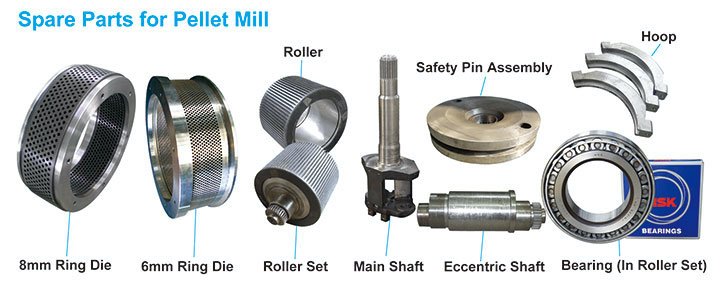
1. A spare ring die, of the right compression ratio
The die is the heart of the machine and the part with the widest spread of reported life. One supplier’s field data puts industrial biomass die life at roughly 500–2,000 operating hours depending on feedstock abrasivity, alloy and moisture control (Kingwood field data); another’s maintenance budget tables assume replacement every 1,000–3,000 hours (Changsheng maintenance guide). Both can be right. Clean, well-dried softwood at a sensible compression ratio lives at the top of the range; hardwood blends, rice husk or bamboo — anything with silica or high lignin variance — eats dies from the bottom up.
What matters for stocking: order the spare die with the machine, matched to the hole diameter and compression ratio you validated on your own feedstock, not the generic die that ships in the box — the ring die product page shows the specification details to confirm when ordering. Replacement dies for 2–5 t/h industrial mills typically run USD 800–3,000 depending on diameter and alloy (Kingwood budget figures). A spare die is also your quality insurance: as the die wears, pellet durability drifts, and ENplus A1 requires mechanical durability of at least 98.0% (ENplus Handbook, Part 3). We explain how to read the ratio itself in the die compression ratio article.

2. Roller shells — and the roller bearings behind them
Rollers press material into the die, and they wear at a comparable or faster rate. Supplier field data for Cr26 high-chromium shells: roughly 1,200–1,800 hours on softwood, 600–1,000 on hardwood, 400–700 on rice husk; tungsten carbide shells push those figures up 2–3× (Changsheng wear-parts FAQ). Kingwood’s field numbers for roller shells sit in a similar band, 600–1,200 hours, and their practical advice is worth repeating: replace dies and roller shells together, because a fresh die running against worn shells costs pellet quality within weeks.
Stock one set of shells per die, and while you are at it, the roller bearings and seals. Bearing failure behind a roller is one of the top mill faults we see in service calls — it usually announces itself as rising roller shaft temperature before it becomes a seizure. If your feedstock is abrasive, do the cost-per-tonne math on carbide shells rather than just the sticker price.
Supplier-reported service intervals vary by feedstock, which is exactly why a stocking plan built on someone else’s softwood numbers fails on rice husk. The bands below combine the two suppliers’ field data cited in this article; treat them as planning figures and validate against your own hours-and-tonnes log.
| Feedstock | Die life (supplier-reported) | Cr26 roller shell life (supplier-reported) |
|---|---|---|
| Clean, dry softwood | 1,200–2,000 h | 1,200–1,800 h |
| Hardwood blends | 800–1,500 h | 600–1,000 h |
| High-silica (rice husk, bamboo) | 500–800 h | 400–700 h |
3. Hammer mill screens and hammers
Every tonne of sawdust passes through the hammer mill before it reaches the die, which makes screens and hammers the highest-churn wear parts in the plant. Screens split on tramp metal — one stone or bolt is enough — and hammer corners wear until the grind coarsens and the die starts starving. Keep two full sets of screens in the common hole sizes you run (most wood pellet work sits around the sizes matched to your die hole), a crate of spare hammers, and the rotor pins to mount them. If your line is built around a YHM-class machine, the YHM hammer mill page lists the screen and hammer configurations per model.
The correct screen is not a detail: particle size feeds the die, and the relationship between grinding, moisture and pellet quality is laid out in the Biomass Connect pelletisation guide. A coarse grind from a tired screen shows up an hour later as uneven pellets and higher electricity per tonne — measured pelletizing energy spans 75–275 kWh/t in the INL data, and worn grinding equipment pushes you toward the top of it.
4. Main bearings and the right grease
Main shaft bearings on a ring die mill run under load, heat and fine dust. They rarely fail without warning, but the warning window is short, and a seized main bearing can take weeks to resolve with a shaft removal. Keep one full set of main bearings on site for mills above roughly 90 kW, plus the seals. Just as important: keep the specified grease in quantity. A surprising share of “bearing failures” in the field are lubrication failures — wrong grease, dirty grease, or intervals stretched to fit a production plan. Write the greasing interval on the mill, not in a folder.
5. Conveyor belts, chains and elevator buckets
The pellet mill gets the blame, but conveyors stop plants more often. Belt splices lift, chain elongates, and elevator buckets come loose after a foreign object jams a boot. Stock belting and splicing kits for each conveyor run, a length of chain and connecting links for drag conveyors, and spare buckets. None of it is costly; all of it is boring to source from abroad with a plant waiting. If your line uses screw conveyors for sawdust feed, add one spare flight section and the drive chain.
6. Cutter blades and the scraper assembly
Long pellets are a bagging problem before they are a quality problem: strands longer than spec bridge in the bagger and raise fines when they snap. Cutter blades at the die face dull with every die change, and the scraper that clears material from between the die and rollers is small, cheap and impossible to improvise. Stock a set of blades per die change and two scrapers. If you also run a drum chipper upstream, the same logic applies with bigger steel — we ship spare chipper knife sets with the machine for a reason, in the common sizes listed on the knife product page.
7. The small electrical kit
This is the part nobody stocks and everybody needs. Thermocouples for the dryer and cooler, pressure switches for the baghouse, proximity sensors on gates, a few contactors and thermal overload relays matching your motors, and fuses. A failed temperature sensor on a cooler is a quality incident; a failed contactor on the mill feeder is a stopped line. The sensors themselves cost tens of dollars; the stopped shift costs more than the whole kit.

Store the spares so they survive until you need them
Stocking fails in the storeroom as often as in the shopping list. Dies and roller shells must be coated with rust preventative oil and kept in a dry area — a ring die that rusts in its bores will drag on startup and shorten the next die’s life. Treat carbide shells as the fragile items they are: their weakness is brittleness, so they must never take an impact, and avoid thermal shock by warming them with the mill rather than pressing cold material at start-up (the wear-parts FAQ linked above covers both). Keep spare bearings sealed in their original packaging until installation, store screens flat so they do not warp, and label every shelf by machine and position — a spare part whose location nobody knows is not a spare.
What it all costs: budget bands by mill size
Order-of-magnitude figures help set the first-year budget. The bands below come from a Chinese wear-parts supplier’s published maintenance tables (Changsheng maintenance cost guide) and represent annual spend on wear parts, lubricants and routine labor — not the machine itself. Your feedstock abrasivity and running hours decide where you land inside the band.
| Mill class | Annual running hours | Die cost per year (USD) | Roller cost per year (USD) | Total maintenance per year (USD) |
|---|---|---|---|---|
| Small commercial ring die, ~55 kW | 2,000–3,000 | 3,000–6,000 | 1,000–2,000 | 5,000–15,000 |
| Medium ring die, ~90 kW | 4,000–5,000 | 5,000–10,000 | 2,000–4,000 | 10,000–25,000 |
| Large ring die, ~160 kW | 6,000–8,000 | 8,000–15,000 | 3,000–6,000 | 20,000–50,000 |
Two cautions about the table. First, wear parts are typically 50–70% of the maintenance total, which is why the stocking list above concentrates on them. Second, if your supplier quotes a maintenance number far below these bands, ask what replacement interval they assumed — a die that “never needs changing” is a die you will meet in month four, at production speed, on a weekend. Our troubleshooting article covers the five faults that actually stop lines, most of which trace back to worn or missing spares from this list.
First-year stocking list, condensed
If you only take one paragraph from this article: one matched spare ring die, two sets of roller shells, one set of roller and main bearings with seals, two sets of hammer mill screens plus a crate of hammers, conveyor belting and chain for every run, a set of cutter blades and scrapers per die, and the small electrical kit. Pack it in the same container as the machine — we do this routinely for export customers — and label it by machine and position, because the value of a spare part is a function of where it is when the line stops. For the commercial side of the purchase — payment structure, inspection, negotiation — see our article on the common mistakes when buying a pellet machine from China.