
A pellet mill will make pellets without a conditioner. Anyone who has run a small line knows this. But the pellets come out pale, short and dusty, the die wears faster, and the press pulls more amps for fewer tons. On wood fuel lines the argument is not whether to condition, it is how big to build the conditioner, how much steam it needs, and where the setup numbers actually come from.
This guide is written for buyers specifying a new line or retrofitting a press. It covers what the conditioner physically does to sawdust, the three designs you will be quoted, how much steam a wood line really consumes, and the sizing arithmetic we walk through with customers before they sign an RFQ. Every number in it has a source you can check; where a figure is our own arithmetic, the text says so.
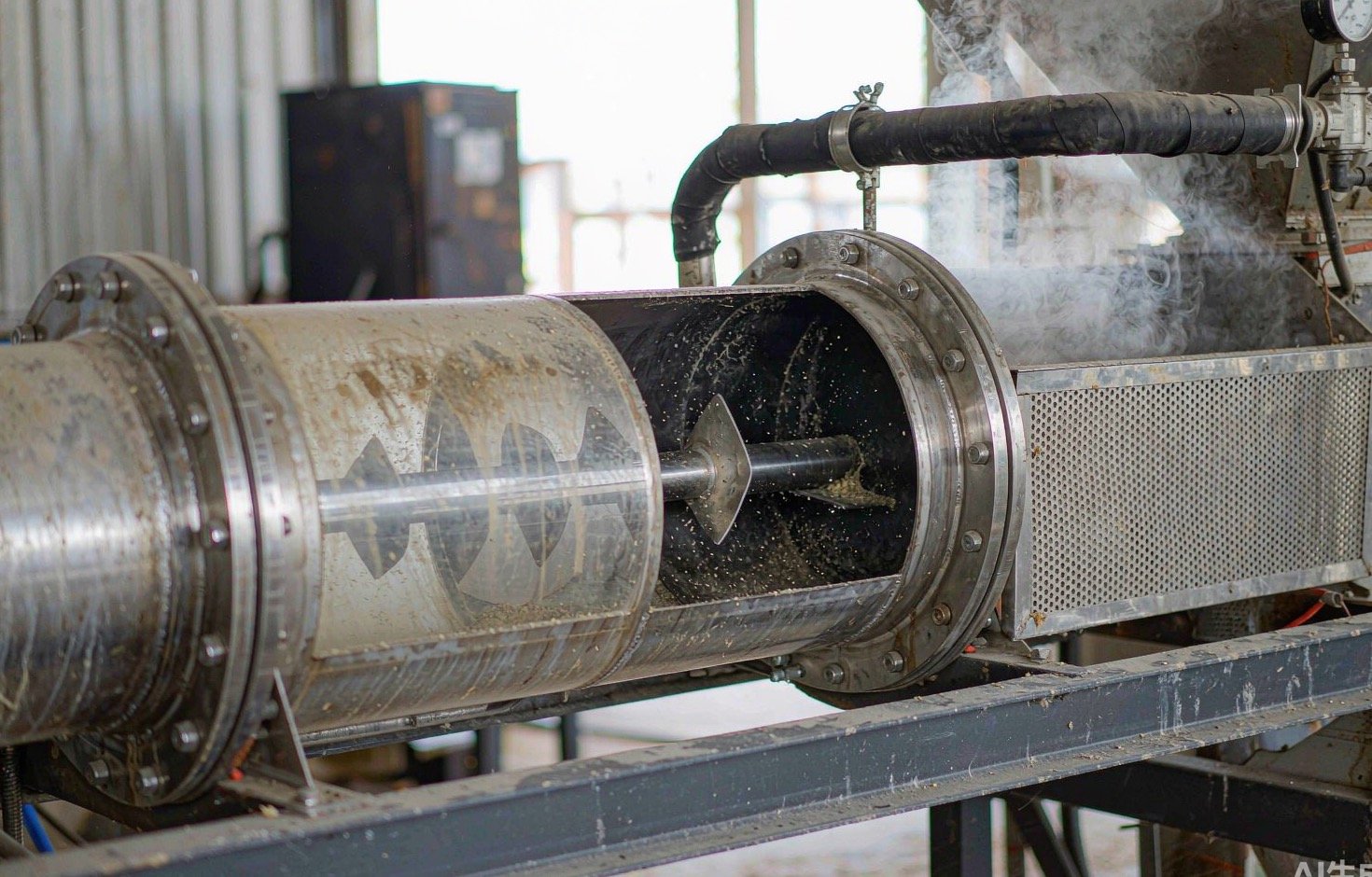
What a conditioner actually does to sawdust
Wood binds into pellets because of lignin. Dry lignin is glassy at around 195 °C, but with moisture present its softening point collapses: wood raw material at 8–15% moisture softens between roughly 110 and 135 °C, which is why press rolls and dies get hot enough to squeeze it into a glue (Lehtikangas, via the diva-portal thesis library). Steam conditioning does two jobs at once. It heats the mash toward that softening window, and it adds water so the lignin plasticises at a temperature the machine can actually reach.
The mechanism on a particle level is condensation. Live steam injected into the mash gives up its latent heat and deposits water on the surface of the particles. A Canadian pellet process patent describes the working window plainly: steam raises the mash above 80 °C and adds roughly 2–5 percentage points of moisture, and bonding develops once particle surfaces sit above about 90 °C with more than 5% surface moisture (patent CA 2467606). That is the physics your vendor is selling when they quote a conditioner.
The payback shows up in durability. In a Kansas State University trial, mash pelleted without steam measured a durability index of just 3.3%, while mash conditioned to 190 °F reached 91.1% in the same test — a difference between pellets that shatter in the bucket and pellets that survive trucking (Wecker, KSU Cattlemen’s Day 2020). The same trial recorded that conditioning added 4.2 percentage points of moisture to the mash. For a plant selling ENplus A1, where mechanical durability must test at 98.0% or better, skipping that step means gambling the whole premium on die friction alone.
There is a second, quieter payback: die life and specific energy. Soft mash flows and seals in the die holes with less shear. Hard, dry mash makes the rollers grind the layer before anything compresses. In our earlier piece on pellet conditioning we walked through the chemistry; here we stay on the equipment side.
The three designs you will be quoted
Conditioners for ring die presses come in three families. On wood fuel lines the choice is mostly about how many seconds of residence the mash needs and how much floor pressure your layout allows.
| Design | How it works | Typical residence | Best fit |
|---|---|---|---|
| Single conditioner | One trough with paddles or a screw, steam injected through nozzles along the trough | 30–45 s (feed-industry figure, KSU pelleting guide) | Sawdust lines up to ~2 t/h where space and budget are tight |
| Double (stacked) conditioner | Two troughs mounted one above the die, steam added in stages, longer wet time | Approaching 60 s+ total (two passes) | Harder, dryer or fibrous feed; larger presses |
| Long-retention / extender style | Larger diameter trough, slower paddle speed, holds mash far longer before the die | 1 min or more | Feed lines needing cook or expansion; rare on wood fuel |
The 30–45 second figure comes from the Kansas State feed pelleting guide and is the nearest published anchor for trough sizing; wood mash conditions acceptably in that band because the goal is lignin softening, not starch gelatinisation. What changes between designs is not the target temperature so much as the time available for steam to actually condense on the particles instead of blowing through to the press chamber.
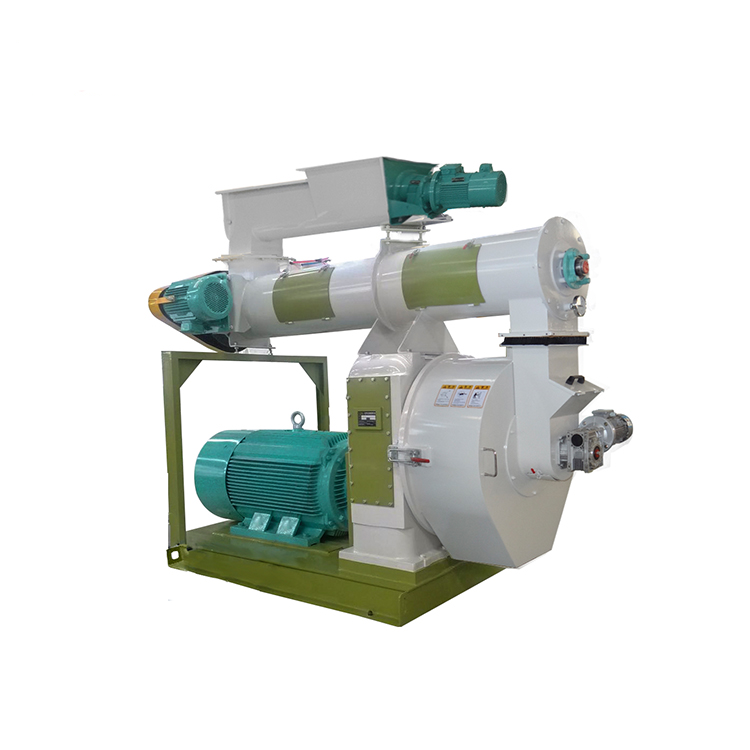
On a vertical ring die press, the conditioner usually sits above the press and feeds by gravity, which shortens the drop and keeps the layout compact — that is one reason the YPM630 vertical mill package suits small EN A1 lines. Horizontal ring die presses take the conditioner on the feed screw ahead of the force feeder. Either way, ask the vendor to state residence time and steam connection size in the datasheet, not just “with conditioner”.
How much steam a wood line consumes
Steam figures vary more between vendors than between standards, so anchor them carefully. The IEA Bioenergy review of wood pellet production cites Thek and Obernberger’s process data: conventional sawdust pelleting uses about 0.04 kg of steam per kg of feed — 40 kg of steam per tonne (IEA Bioenergy CS4 report). Supplier practice clusters lower: Chinese press makers commonly quote 20–30 kg per tonne at around 15% feed moisture with 3–8% steam injection at 2–6 bar (Changsheng’s biomass pelleting notes). Feed mills run higher because they push mash to 17–18% moisture: Univer’s feed conditioning figures are 60–63 kg of dry saturated steam per tonne at 0.25–0.30 MPa.
| Parameter | Wood fuel pellets | Feed pellets | Source |
|---|---|---|---|
| Steam per tonne | ~40 kg/t (process data); 20–30 kg/t (supplier quotes) | 60–63 kg/t | IEA CS4; Changsheng; Univer |
| Steam pressure | 2–6 bar | 0.25–0.30 MPa (2.5–3 bar) | Changsheng; Univer |
| Moisture added by steam | ~2–5 percentage points | up to ~4 points per pass | Patent CA 2467606; KSU |
| Mash moisture ceiling | Total above ~18% plugs the die | 17–18% target | KSU pelleting guide |
| Working moisture window (wood) | 10–15% going into the press | — | Biomass Connect pelletisation guide |
Why the wood numbers sit lower: sawdust already arrives from the dryer at 8–12%. Steam has to lift it into the 10–15% window, not to 17%. The Kansas State rule of thumb — roughly one point of moisture gained per 25 °F (about 14 °C) of temperature rise — is handy in either industry, because it converts a thermometer reading into a moisture budget. If your mash reads 12% at 60 °C and you want 14%, expect to add about 2 points of steam, and check that the resulting total stays under the 18% ceiling where dies flood (KSU).
A word of caution on over-conditioning. More steam is not linearly more quality. Push total moisture past roughly 18% and the die smears, production drops, and pellets emerge wet enough to swell in the cooler. If you keep wishing for a softer pellet, the fix is usually steam quality or residence time, not volume.
Sizing the conditioner and steam supply: a worked example
Here is the arithmetic we run for a 2 t/h sawdust line. None of it is exotic; it exists so the buyer can check the vendor’s boiler quote against the conditioner’s appetite.
Here is the arithmetic we run for a 2 t/h sawdust line. None of it is exotic; it exists so the buyer can check the vendor’s boiler quote against the conditioner’s appetite. Start with steam demand: 2 t/h at the supplier mid-point of 30 kg/t gives 60 kg/h. Add about 15% for startup and purge and the design figure is roughly 69 kg/h — a 0.1 t/h class boiler covers it with room to spare. Making that steam from 20 °C feed water takes about 2.7 GJ per tonne (hengxin boiler data), so 69 kg/h needs around 0.19 GJ/h, or 52 kW of boiler output. At 83% efficiency and 186 kg of pellet fuel per tonne of steam, the boiler burns about 12.8 kg/h — roughly 102 kg of fuel per 8-hour shift. These steps are our arithmetic from the cited unit figures, not a vendor quote.
The interesting line is the last one: the whole conditioning steam load on a 2 t/h line costs about a tenth of a tonne of pellets per shift, burned in the boiler. It is rarely the fuel that makes steam expensive; it is a badly matched boiler cycling on and off because someone sized a 0.5 t/h unit “to be safe”. Our steam boiler sizing guide covers that failure in detail, including the 65–85% load band where boilers actually run clean.
Steam quality: the half of the job nobody photographs
Conditioner specs talk about pressure and flow. They rarely talk about dryness, and that is where most steam-side disappointments start. The steam reaching the nozzles should be dry saturated. Wet steam carries condensate droplets that do not vaporise in the pipe, hit the mash as cold water, and produce lumpy, unevenly wetted mash with no temperature gain — the pellets then look like a water problem when it is really a pipe problem.
The standard cure is a separator plus a working steam trap close to the conditioner, and a short, insulated line. If the boiler sits forty metres away with no drop leg, the first cold snap of startup dumps a slug of condensate into your mash. Ask the vendor where the separator and traps go on their piping drawing; if there is no drawing, that answers another question about the vendor.
Spirax Sarco’s steam engineering reference puts the target at 95–98% dryness fraction for process steam — enough of a margin that nozzle performance stays predictable (Spirax Sarco, steam quality). You do not need laboratory instrumentation to police this: a thermometer at the conditioner inlet reading within a couple of degrees of saturated steam temperature at your gauge pressure is the everyday check. A reading well below it means the line is losing heat or flooding; a superheated reading means the steam will pass over the mash without condensing, and you gain temperature on the housing instead of moisture on the particles.
Water injection as a fallback — and where it falls short
Not every small plant has a boiler. Water conditioning exists: nozzles at 2–3 bar spraying hot water at 80–90 °C spread moisture more evenly than cold water, and the press still loses 3–5% of its mash moisture to evaporation through the hot die (technolog.online’s raw material moisture notes). Hot water softens something; it does not carry latent heat. Steam at 2 bar delivers roughly 2,200 kJ to every kilogram it condenses — that is the energy budget water injection simply does not have.
We spell out the trade-off, symptom by symptom, in steam versus water conditioning. The short version: on lines making pellets for sale under ENplus or ISO 17225-2 contracts, steam wins; on a farm-scale press making bedding or burning its own output, hot water is often the honest choice.
Reading a conditioner datasheet before you sign
Vendors’ quotations compress the conditioner into one line item. Make them expand it. The five fields that decide whether the unit works are:
- Residence time — a number in seconds, tied to trough volume and fill level, not “adjustable”.
- Steam connection and design pressure — matched to the boiler, with separator and trap positions marked.
- Paddle or screw geometry — adjustable paddles let you tune fill; a fixed screw does not.
- Drive and slope — mash must not pool in dead zones; wood fines are abrasive when dry and sticky when wet.
- Cleanout access — the trough needs drains and doors, because Saturday-morning stoppages happen.
If the plant is a turnkey package, cross-check these against the whole-line offer. Our complete pellet production line pages list the conditioning stage explicitly for that reason — a conditioner that exists only in the brochure photo is a common gap between quotation and commissioning.
Where conditioning fits in the moisture budget of the whole line
Finally, keep the conditioner in its place in the water balance. The dryer removes water; the conditioner adds a small, controlled amount back; the cooler takes it out again. A line drying sawdust to 8% and then steaming it to 12% is sensible. A line drying to 4% “to be safe” is paying the dryer to burn fuel the conditioner must spend again — and over-dry mash loses lignin plasticity, which is why the moisture window matters at both ends. We have seen plants chase durability with more steam when the actual fault was sawdust entering the conditioner at 6% moisture, too dry for lignin to soften even with the steam wide open. Keep the whole water balance on one sheet of paper when you review a line layout — dryer exit moisture, conditioner input, steam rate, cooler exit — because those four numbers decide whether each machine is helping or undoing the one before it.
That is the whole sizing conversation in one paragraph: dryer exit moisture, steam rate, residence time, and steam quality — four numbers, agreed on paper before the container ships, checked with a thermometer and a moisture meter in the first week of commissioning.
Two ways plants get this wrong
The failure modes repeat across plants so often they are worth naming, because both are invisible in the quotation and obvious three weeks after commissioning.
The oversized boiler. A buyer adds margin “to be safe” and buys a steam plant four times the conditioner’s appetite. The boiler reaches setpoint in minutes, shuts off, cools, and cycles again every few minutes for a demand it could hold at a steady crawl. Every startup pushes a slug of condensate down the line until the pipes heat through, and that slug lands in the mash as cold water. The tell-tale on the floor is a conditioner that runs fine for twenty minutes and then goes cold and sloppy for three. The cure costs a fraction of the boiler: a correctly set pressure, a working trap, and a supply sized off the kg/h arithmetic above instead of a catalogue default.
The bypassed conditioner. Presses ship with a bypass gate, and on a bad day an operator opens it. Dry mash at 8% moisture does press — slowly, loudly, and at a cost. The durability trial above shows what that costs in the test drum: 3.3% versus 91.1% (Wecker, KSU). The press feels it too, because dry mash refuses to shear evenly and the current climbs; sustained running in that state is how roller shells and dies age months early. If you inherit a plant where the bypass is worn smooth from use, you have inherited the margin leak.
Both mistakes trace back to the same document: the datasheet nobody made the vendor write. Make them write it.
Tuning the conditioner on the floor
Once the equipment is in, tuning is a sequence, not a mystery. This is the order we teach during commissioning, and it takes about one shift to walk through with a thermometer, a moisture meter and the mill’s ammeter.
Warm the line before any mash enters it. Open the steam supply to the empty conditioner for several minutes so the trough, paddles and housing reach temperature. Steam into a cold iron trough condenses on the walls, not the particles, and the first tonne of mash pays for that with wet, inconsistent conditioning.
Start the feed low and read the ammeter. Bring the mill up at reduced throughput and watch the main drive current. A steady draw with swings inside roughly 10–15% is a healthy press (the band we use when handing over lines, consistent with the commissioning practice described by technolog.online). Wide, rhythmic spikes usually mean the mash is surging — often a conditioner fill problem, sometimes a steam starvation problem, never something to chase with more feed rate.
Set steam against the thermometer, not against habit. Measure mash temperature at the conditioner outlet and convert using the KSU rule of about one point of moisture per 25 °F of temperature rise. Decide your target mash moisture first — inside the 10–15% wood window, and comfortably below the ~18% die-flooding ceiling (Biomass Connect; KSU) — then let the temperature reading tell you whether you are on it. Operators who tune by pellet feel alone tend to overshoot on cold mornings, exactly when wet steam makes overshoot likelier.
Check the exit pellets against the entry numbers. If mash moisture and temperature are right but pellets still crumble, the fault usually sits elsewhere: die compression ratio, roller shell fit, or fines circulating in the feed screw. Those are separate investigations — our in-house durability testing guide gives you the measurement side, so you are arguing from numbers rather than from impressions at the next shift meeting.
Then write it down. Whatever combination of feed rate, steam valve position and outlet temperature produced good pellets on your actual raw material — log it. Raw material changes with the seasons and with every new sawmill source, and a written baseline turns the next drift into a five-minute correction instead of a day of guessing.
Conditioner wording that protects you in the contract
A short list of phrases to insist on, because each one converts a vague promise into a testable claim:
- “Conditioner with a residence time of X seconds at nameplate throughput” — not “with conditioner”.
- “Steam consumption not exceeding Y kg per hour at Z% feed moisture” — the number your boiler sizing depends on.
- “Separator, steam trap and insulated line included and shown on the piping drawing” — steam quality is equipment, not an aspiration.
- “Acceptance test: mash temperature rise at the conditioner outlet consistent with the agreed moisture budget” — ties payment to a reading you can take with a $30 thermometer.
- “Bypass gate fitted but not required for normal operation” — so nobody quietly deletes the conditioning stage during a capacity dispute.
None of this adds cost to a serious supplier’s offer. It removes ambiguity from the offer you are about to pay for, and it gives the FAT and commissioning teams objective pass/fail lines instead of opinions.
Annualised steam cost: what conditioning actually costs per tonne
Buyers often ask what the steam side adds to cost per tonne over a year. The table below extends the worked example, using the hengxin boiler fuel figures (186 kg of pellet fuel per tonne of steam at 83% boiler efficiency) and an assumed boiler fuel cost equal to your own pellet production cost — substitute your number where the assumption sits.
| Item | Calculation | Result (arithmetic) |
|---|---|---|
| Design steam for 2 t/h line | 69 kg/h (from worked example) | — |
| Pellet fuel burned for steam | 12.8 kg/h | — |
| Annual fuel at 5,000 operating hours | 12.8 × 5,000 = 64 t pellets | ≈ 32 kg steam-fuel per 1,000 t product |
| Cost at $120/t internal fuel value | 64 t × $120 | ≈ $7,700/yr ≈ $0.77/t product |
Against a durability-driven premium of tens of dollars per tonne on A1 product, steam costs hundredths of the revenue it protects. That is the quiet argument for buying the proper trough, the separator and the trap — and for turning the boiler off when the press stops, because the one habit that doubles this bill is steaming an empty conditioner between shifts.