
Most wood pellet lines in Asia run with nothing more than a water drip above the press. A growing number of export-focused plants, though, are adding a steam boiler — and discovering that boiler sizing is where the project either gets quietly cheap and effective, or turns into an oversized fuel burner that never runs at its design point. This guide walks through the sizing arithmetic, the steam quality requirements, the fuel question, and the honest cases where you should skip steam altogether.
A confession up front: we sell pellet lines, and we still recommend many customers not buy a boiler. Steam pays in specific situations — hard species, low incoming moisture, durability problems, high-capacity lines. If none of those apply, water addition is cheaper in capital and simpler to operate.
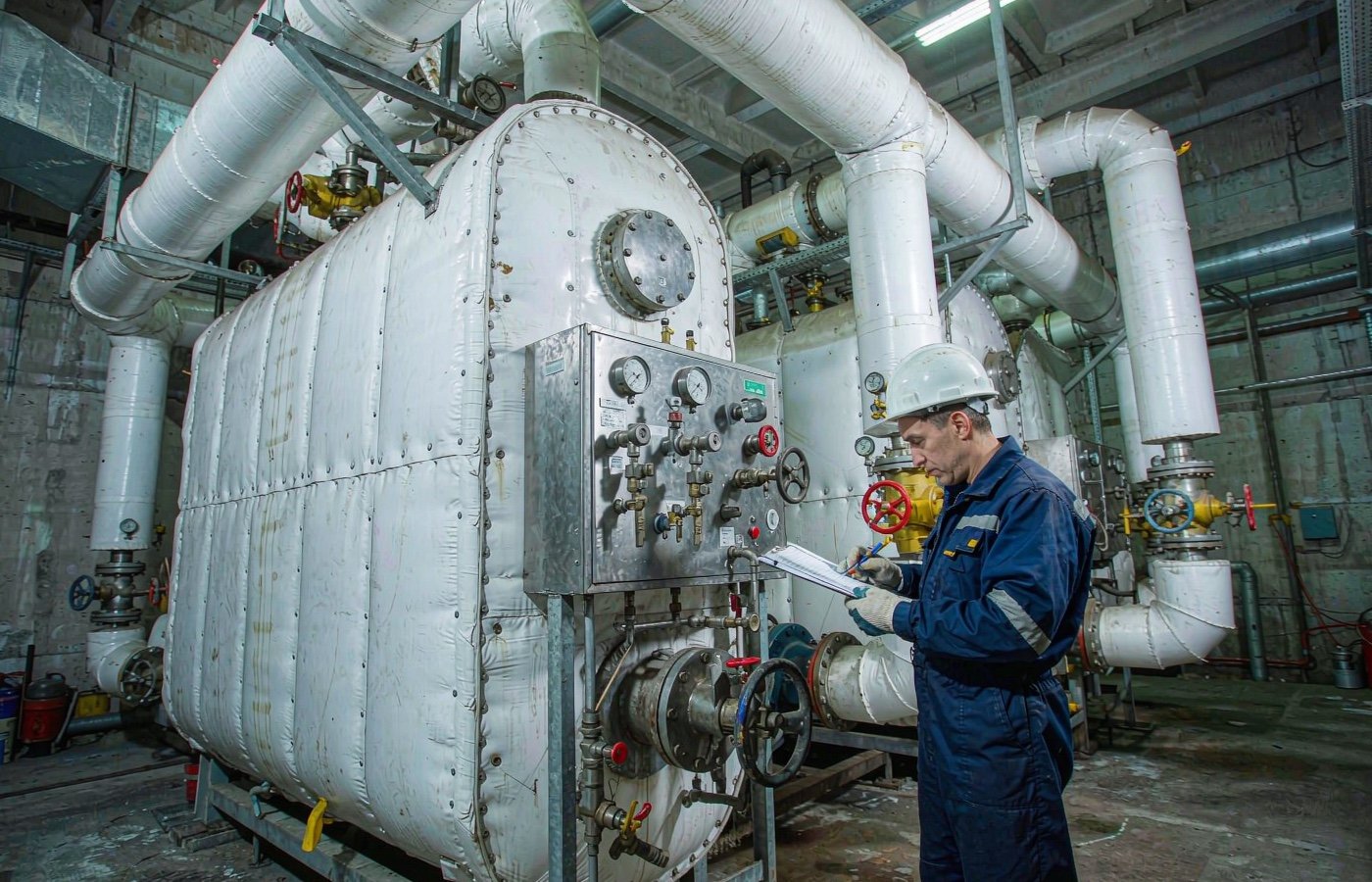
Does a wood pellet line need steam at all?
Wood is not feed. In feed milling, steam conditioning is standard because starch needs gelatinization at 70–95 °C; Kansas State University’s pelleting guide (KSU quality assurance guidelines) targets 180–200 °F (82–93 °C) and 17–18% mash moisture before the die. Wood pellets rely instead on lignin softening, which starts working around 110–135 °C at 8–15% moisture — temperatures the friction of the press itself can generate. That is why the classic wood process is “dry”: dry the sawdust to 10–15%, maybe drip a little water, and let the die do the heating.
Steam enters the picture when the wood won’t bind on its own. Adding dry saturated steam in the conditioner raises both temperature and moisture at once, softening lignin before the fiber reaches the die. Producers who run it report the effects our conditioning explainer summarised: better durability, fewer fines, lower press energy. The trade-off is that a steam system adds a boiler, water treatment, traps and an operator skill set that a water drip never needs.
The decision framework between the two routes is in our steam vs water comparison. This article assumes you have decided steam is worth evaluating — now let’s size it.
How much steam a pellet mill actually uses
Start with the literature number. An IEA Bioenergy case study of conventional wood pellet production (CS4: steam explosion process technology) uses 0.04 kg of steam per kg of material fed to the pelletizer, citing Thek & Obernberger (2004) — in line units, 40 kg of steam per tonne of feed. Supplier guidance for biomass lines at ~15% incoming moisture lands in the same neighbourhood, around 20–30 kg per tonne of feed (Changsheng operation guide), and biomass conditioning practice commonly injects 3–8% of mass as steam at 2–6 bar of dry saturated steam (Changsheng conditioning guide).
Two cautions before you multiply. First, steam adds mass: at 40 kg of steam per tonne, you are also adding 4 percentage points of moisture that the cooler must later remove — which is exactly why the KSU 18% total-moisture ceiling exists, and why wood lines hold the injected amount lower than feed mills do. Second, the steam demand varies with the raw material: dry-season sawdust at 10% moisture wants more steam than the same sawdust at 14%.
Sizing the boiler in five steps
Boiler sizing for a pellet line is straightforward arithmetic once the steam demand is fixed. Here is the sequence, with a worked example for a 2 t/h wood pellet line using 40 kg steam per tonne (arithmetic throughout, based on the sources above):
- Connected demand. 2 t/h × 40 kg/t = 80 kg/h of steam at full production. Add any other steam users (none in most pellet plants) to get the connected figure.
- Demand factor. Not every user runs at maximum simultaneously; a demand factor of 0.85–0.95 is typical practice for multi-press mills (Hengxin boiler sizing guide). With one conditioner, use 1.0 — your conditioner is either running or the line is down.
- Distribution margin. Add ~15% for pipe losses, blowdown and recipe changes: 80 × 1.15 ≈ 92 kg/h.
- Thermal check. Raising feedwater from ~20 °C to saturated steam takes roughly 2.7 GJ per tonne (Hengxin’s figure, consistent with the standard enthalpy arithmetic). 92 kg/h × 2.7 GJ/t ≈ 250 MJ/h ≈ 70 kW of boiler output at the load point.
- Efficiency and nameplate. At ~80% boiler efficiency the furnace must release ~3.3 GJ per tonne of steam, so the fuel-side duty is ~310 MJ/h ≈ 86 kW. A boiler rated around 0.15–0.25 t/h carries this load at a comfortable part-load point with growth room — a small vertical or horizontal fire-tube unit, not the 2 t/h workhorse a feed mill of the same throughput would install.
The load-point rule from the Hengxin guide is worth repeating: a boiler that lands at roughly 65–85% of rated capacity at peak runs in its efficient band and keeps reserve. An oversized boiler cycling on and off wastes fuel and condenses corrosion on the fire side; an undersized one caps your conditioner temperature exactly when damp raw material needs it most.
Fuel for the boiler
Here is where pellet producers have an unfair advantage: your boiler can burn your own off-spec product. Screening fines and out-of-spec pellets are a disposal problem for the mill and perfect boiler fuel — the arithmetic below shows why that closes a loop rather than cannibalising sales.
Hengxin’s fuel table converts the 2.7 GJ/t-steam heat requirement into fuel consumption at 83% boiler efficiency (3.25 GJ fuel per tonne of steam). We’ve reproduced their figures with the fuel types a pellet plant actually has on site:
| Boiler fuel | Typical net heating value | Consumption per tonne of steam (83% eff.) |
|---|---|---|
| Wood pellets (screenings / off-spec) | ~17.5 MJ/kg | ~186 kg |
| Wood chips | ~13.5 MJ/kg | ~241 kg |
| Rice husk | ~13.0 MJ/kg | ~250 kg |
| Coal (~5,000 kcal/kg) | ~20.9 MJ/kg | ~156 kg |
Run the numbers for the 2 t/h example and the scale of the decision becomes visible (arithmetic): 92 kg/h of steam ≈ 0.092 t/h × 186 kg fuel/t ≈ 17 kg/h of pellets — about 0.85% of the line’s own output burned as boiler fuel. If those 17 kg are fines and off-spec product you were otherwise giving away, the steam system’s fuel bill is close to free. If you would otherwise sell every kilogram, price the boiler fuel at your ex-works pellet price before assuming steam pays.
Steam quality: the detail that makes or breaks it
Conditioners want dry saturated steam. Wet steam carries condensate droplets that don’t transfer heat evenly, slam valves (water hammer) and can dump slugs of water into your fiber; superheated steam carries less latent heat per kilogram and gives it up slowly. The Spirax Sarco steam quality reference defines the target: at least ~95–98% dryness fraction at the point of use for injection processes.
Getting there takes hardware that small plants like to skip: a separator and trap station on the header, insulated distribution lines sloped toward trap points, and a pressure-reducing station down to the 0.6–0.8 MPa band most conditioners use. The US Department of Energy’s steam system sourcebook catalogues the efficiency measures that matter over the boiler’s life — insulation, trap testing, condensate return — and condensate return deserves emphasis here: every kilogram of condensate you pump back saves its sensible heat and its treated-water cost.
Water treatment is the other unforgiving item. Untreated hardness scales the boiler tubes, drops heat transfer, and eventually takes the boiler off the regulatory inspection list the hard way. A softener matched to local water hardness plus a documented blowdown routine is a few hundred dollars of equipment protecting a machine worth thousands.
Placement and safety
Put the boiler house between the raw material intake and the process building so both fuel delivery and the steam main stay short — and keep dust-generating operations like grinding and bagging out of the boiler house itself, as the Hengxin layout checklist insists. Combustible dust and open flames have no business sharing a room; our plant layout guide treats the boiler as one of the twelve decisions that fix your cost, precisely because moving it later is expensive.
Plan the steam main route early, too. Every extra metre of uninsulated or badly-sloped pipe is condensate in the wrong place and heat you paid fuel for. Short main, correct slope, working traps — that trio is most of steam distribution quality.
When to skip steam
Three honest cases for leaving the boiler out of the quote:
- Softwood sawdust at stable 12–15% moisture. If durability already tests above spec with water addition, steam buys you little. Spend the money on a spare die instead.
- Lines under ~1 t/h. At 30–40 kg/h of steam the boiler, treatment and piping cost per tonne produced gets steep; a well-designed water system does most of the job.
- No operator for the boiler room. Many jurisdictions require certified boiler attendants. If you can’t staff the role, a boiler becomes a compliance liability, not an upgrade.
Sizing bands by line capacity
To close, here is the five-step arithmetic applied to the three line sizes we quote most often, at 40 kg steam/t, 15% distribution margin, 2.7 GJ/t steam and 80% boiler efficiency (all values arithmetic, per the sources above):
| Line capacity | Steam demand | With 15% margin | Boiler output needed | Sensible nameplate |
|---|---|---|---|---|
| 1 t/h (YPM630 class) | 40 kg/h | ≈ 46 kg/h | ≈ 35 kW fuel-side | 0.1–0.15 t/h |
| 2 t/h | 80 kg/h | ≈ 92 kg/h | ≈ 86 kW fuel-side | 0.15–0.25 t/h |
| 5 t/h (YPM850 class) | 200 kg/h | ≈ 230 kg/h | ≈ 215 kW fuel-side | 0.35–0.5 t/h |
Bring this table to the negotiation along with your moisture data and target durability. A supplier who answers with a specific boiler model, a steam quality package (separator, traps, insulation, PRV station) and a water treatment line — rather than “we’ll add a boiler” — is a supplier who has actually commissioned steam-conditioned pellet lines before. Ask them for the conditioner temperature log from a reference plant; if the answer is a photo of a gauge rather than a data file, keep looking. For a complete turnkey line evaluation, steam is one subsystem among many, and it should be sized by the same arithmetic you just checked above.