
Cooler problems have a nasty habit of showing up weeks after the cause. The pellets leave the plant looking fine, the customer’s bags sag with condensation a port later, and the claim lands on your desk with no obvious suspect. That delay is why the cooler — the quietest machine on the line — deserves a disciplined troubleshooting routine. These are the five pellet cooler problems we see most often in buyer support, with the symptoms, root causes and first checks for each.
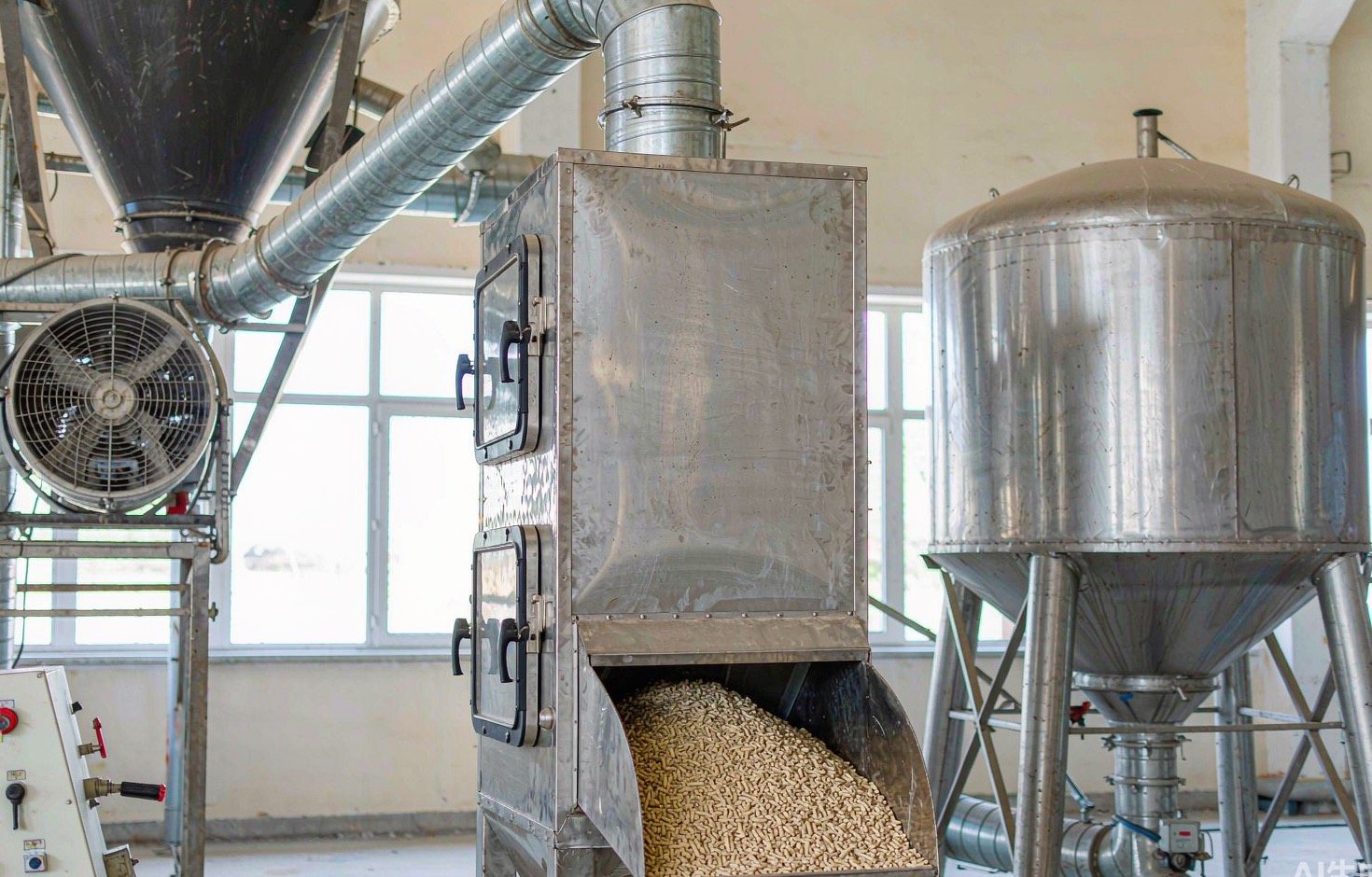
First, what a cooler is supposed to do
Pellets leave the die hot — typically 70-90°C — and soft, with residual surface moisture (RICHI Machinery). A counterflow cooler pulls ambient air upward through the pellet bed while pellets move downward, so the coldest air meets the coolest pellets at the bottom and the warmed air exits at the top. Done right, the pellets leave 5-10°C above ambient temperature after a retention time of roughly 6-15 minutes (RICHI). Research on industrial wood pellet plants describes the target the same way: cooling from approximately 70-90°C down to about 5 degrees above ambient, during which the moisture content drops by up to 1-2 weight percent (BioResources: cooling air and wood pellet durability study).
Why the tight temperature target? Because lignin that softened in the die needs to re-solidify for the pellet to hold its shape, and because warm pellets in a sealed bag evaporate water that condenses on the bag walls — the start of mold, sagging bags and rejected cargo. One feed-industry engineering reference puts the limit plainly: pellets leaving the cooler should be no more than 5°C above ambient, or condensation and molding follow (Feed Strategy: matching product to cooling process). If your product carries ENplus A1 claims, the stakes are codified: final moisture ≤10% and fines ≤1.0% bulk (≤0.5% bagged) per the ENplus Handbook v3.0 Part 3.
| Parameter | Typical value | Source |
|---|---|---|
| Pellet temperature at die exit | 70-90°C | RICHI; BioResources study |
| Discharge temperature target | Ambient +5-10°C (feed-industry guidance: ≤ +5°C) | RICHI; Feed Strategy |
| Retention time, counterflow | 6-15 minutes | RICHI |
| Moisture removed in cooling (wood pellets) | up to 1-2 wt% | BioResources (Kirsten et al.) |
| Moisture removable in feed-mill cooling | 2-4 percentage points depending on air and airflow | Feed Strategy |
Problem 1: Discharge temperature too hot
Symptoms: bags feel warm hours after filling; condensation inside pallet wrap; a moisture meter reads higher at bagging than at the cooler inlet — the condensate is re-wetting the product.
Root causes: the three usual suspects are retention time that is too short (bed level running low because the discharge gate opens too eagerly), airflow that is too low (dampers closed, fan belt slipping, or a cyclone and filter path clogged with dust so the fan can’t pull its design volume), and simply overloading the cooler past its design rate. Ambient conditions matter too: a cooler sized for a cool-climate plant struggles on a 35°C, 80% humidity day, because the air has less capacity to absorb moisture.
First checks: measure discharge temperature with a probe against ambient, at three points across the discharge — a spread of more than a few degrees means the problem is distribution, not airflow (see problem 4). Verify fan performance and damper positions. Check the bed level sensor against what you actually see through the inspection door. If everything is set correctly and the pellets are still hot, the line is asking for more tonnage than the cooler was designed to exchange — an upstream feed-rate fix, not a cooler fix.
Problem 2: Moisture out of spec at bagging
Symptoms: finished moisture above 10% on an ENplus A1 claim, or pellets arriving visibly damp in the middle of the bed.
Root causes: wetter material entering the cooler than the airflow can carry away. That starts upstream — conditioning steam set high, or a dryer drifting wet. It can also come from the cooler itself: air short-circuiting through a thin or uneven bed, leaving the middle of the bed untouched, or exhaust air that has saturated early because the plant recirculated warm humid air back into the inlet. Research on industrial cooling notes that moisture and temperature reduction both depend on airflow, air properties, raw material, pellet size and bed depth — all six, not just the fan (BioResources).
First checks: measure moisture at three points — before the mill, at the cooler inlet, at the cooler discharge. If inlet moisture is fine and discharge is high, the cooler isn’t removing what it should: check airflow, bed depth, and whether the exhaust air path is clear and venting outside. Note that pellets can also stabilize downward after cooling — storage handling shows finished pellets equilibrating with the air over time (Lakehead University thesis on wood pellet supply chains) — but you cannot bag your way out of wet pellets and hope for equilibration inside a sealed bag.
Problem 3: Cracked pellets and rising fines
Symptoms: durability index dropping, fines climbing toward or past the 1% ENplus limit, dusty loading bays, pellet surfaces showing hairline cracks.
Root causes: cooling that is too aggressive. Cooling at low air temperature with high airflow dries the pellet surface faster than moisture migrates from the core, and the resulting temperature gradients between outer and inner layers cause cracks, more fines and higher breakage risk (BioResources). Mechanical causes add on top: in counterflow coolers fitted with rotating discharge arms, the arm passing through the bed creates fines of its own — one reason newer designs use PLC-controlled dosing conveyors that fill the cooler without mechanical contact (Feed Strategy). Larger-diameter pellets are also more vulnerable: moisture travels from core to surface more slowly in an 8 mm pellet than a 6 mm, so the same airflow that suits one diameter cracks the other.
First checks: measure the temperature difference between cooler inlet air and ambient — a very cold inlet air blast combined with a wide-open fan is the classic crack generator. Compare fines at the cooler discharge versus after the screener to locate where fines are created. If the generation point is the cooler itself, throttle the airflow with the dampener and lengthen retention rather than shortening it, then re-test durability on the next batch.
Problem 4: Uneven bed and airflow channeling
Symptoms: some pellets dry and hard, others warm and soft, from the same discharge; moisture scatter between bags; air visibly roaring through one section of the bed while dust drifts elsewhere.
Root causes: air takes the path of least resistance. If pellets are dosed unevenly, valleys form in the bed and most of the air flows through those valleys — pellets in the peaks stay wetter and hotter (Feed Strategy). A worn spreader, a feed conveyor that dumps in one spot, or a partial blockage under one corner of the bed all produce the same signature.
First checks: open the inspection door mid-run and look at the bed surface — it should be flat and evenly bubbling with airflow. Probe discharge temperature in a grid pattern: variation across the discharge is direct evidence of channeling. Fix the distribution hardware (spreader, dosing conveyor, rotary feeder) before touching fan settings, because airflow changes cannot compensate for a bed that is half empty on one side.
Problem 5: Over-drying and shrink losses
Symptoms: finished moisture well below target — sometimes as low as 6% after the cooler in extreme cases (Lakehead University) — weight-based yield dropping, dusty product, customers reporting pellets that crumble at the edges.
Root causes: air that is too dry entering the cooler, or dwell time beyond what the product needs. Very dry air keeps pulling water after the target moisture is reached, causing “shrink” losses — product weight you paid drying energy for and then lost again (Feed Strategy). Over-dried pellets are also more brittle, which feeds problem 3.
First checks: log inlet and outlet moisture daily and compare against your target band. If discharge moisture runs consistently low, throttle airflow with the dampener or shorten residence time — the Feed Strategy reference recommends exactly that control. In winter or arid climates, this check matters more than in coastal plants, and it interacts with your dryer setpoint: the cooler is part of your drying system whether you planned it that way or not.
| Symptom | Most likely cause | First three checks |
|---|---|---|
| Hot discharge, condensation in bags | Short retention / low airflow / overload | Probe discharge temps; verify fan and dampers; check bed level |
| Moisture above spec at bagging | Wet inlet material or short-circuiting air | Measure moisture in/out; inspect bed evenness; verify exhaust path |
| Cracks and fines climbing | Over-aggressive cooling; mechanical fines | Compare inlet air vs ambient; locate fines creation point; throttle airflow |
| Wet-hot pellets beside dry-hard pellets | Bed channeling from uneven dosing | View bed through door; grid-probe discharge; inspect spreader |
| Moisture far below target, yield dropping | Over-drying from dry air / long dwell | Log moisture daily; throttle damper; shorten retention |
A ten-point cooler health scorecard
Run this check monthly, in order, and score each item 1 point. It takes one operator about 45 minutes and catches almost every failure above while it is still cheap to fix.
| # | Check | Passes when… |
|---|---|---|
| 1 | Discharge temperature probe (3 points) | All within 5-10°C of ambient |
| 2 | Temperature spread across discharge | Points within ~3°C of each other |
| 3 | Moisture at cooler inlet vs discharge, logged | In band, difference matches the 1-2 wt% expectation |
| 4 | Bed surface viewed mid-run | Flat, evenly ventilated, no valleys |
| 5 | Bed level sensor vs visual bed height | Readings agree; retention matches design |
| 6 | Fan, dampers, belts inspected | No slip, dampers at recorded positions |
| 7 | Cyclone / filter dust load checked | No heavy cake; airflow not choked |
| 8 | Fines at cooler discharge vs after screener | No fines generation inside the cooler |
| 9 | Discharge gate / rotary valve sealing | No air leaking in at the outlet |
| 10 | Exhaust ducting and vents | Clear, venting outside, no condensation pockets |
Eight points or better means the cooler is a steady machine you can stop thinking about for another month. Six or seven points means one of the five problems above is already developing — find it before the customer does. Below six, stop and run the full troubleshooting sequence for every item you failed; at that score, the cooler is usually not one problem but several quietly compounding. And when the scorecard keeps failing on temperature or moisture no matter what settings you try, the limitation may be design capacity rather than maintenance — a conversation worth having with real production data in hand. For how the cooler sits in the wider chain, see our walkthrough of a complete pellet production line.