
Ask a new producer about moisture and you’ll hear about the dryer. Ask an experienced one and you’ll hear about the warehouse. Pellets leave the cooler drier than they will ever be again — and from that moment, the air works on them until they’ve soaked back to whatever the room’s humidity dictates. If nobody manages that process, bags that read 7% in July read 10% or worse after a wet season in storage.
This article walks through the published data on how fast pellets absorb moisture, what it does to durability and heating value, and where the practical controls sit. Every number below is linked to its study so you can read the originals.
Pellets leave the cooler drier than they’ll ever be again
Start with the counterintuitive part. A well-tuned cooler can push pellets down to around 6% moisture, deliberately drier than the sales specification. A wood pellet supply-chain thesis from Lakehead University describes pellets cooling to as low as 6% after the cooler, then rebalancing upward to roughly 8–10% during storage (Lakehead University, Dujmović 2017).
That’s not spoilage — it’s physics, and it’s expected. But it has an immediate consequence: any moisture claim about a pellet lot is a claim about a moving number. The certificate value reflects the lab sample; the bag the customer opens reflects the warehouse it sat in since. Producers who don’t understand the drift end up arguing with customers about numbers both parties measured correctly.
The sorption curve, in plain numbers
How fast do pellets take on water, and how much? Researchers at the University of Greenwich conditioned pine and recycled-wood pellets in a climate chamber at 30 °C across a humidity ladder, and measured both weight change and final moisture content (Deng et al., University of Greenwich). The pellets started at 5.1–5.5% moisture, having been stored around 46% relative humidity.
| Relative humidity (30 °C) | Weight change, pine pellets | Weight change, recycled-wood pellets |
|---|---|---|
| 20% RH | −3.0% | −3.0% |
| 40% RH | −1.0% | −1.0% |
| 60% RH | +0.5% | +1.0% |
| 80% RH | +3.0% | +4.0% |
| 95% RH | +9.0% | +10.5% |
After four days at 95% RH, both samples had climbed to 14% moisture — from five. Read that row again: at tropical monsoon humidity, pellets gain around nine percentage points of moisture in days, not months. Between 40% and 60% RH, by contrast, the exchange is small — the study found no significant gain or loss in that band.
The same study logged a hysteresis loop between the absorption and desorption curves, the usual behaviour for organic materials: pellets that dried out don’t follow the same path back up. Practically, that means a lot that has been through a wet-dry-wet cycle carries damage the moisture reading alone doesn’t show — micro-cracks opened during the swings make later uptake faster.
One reassuring data point from a mixed-biomass pellet study in the Arabian Journal for Science and Engineering: between 15 and 25 °C, temperature had no measurable effect on the sorption isotherms — relative humidity was the lever that mattered (Springer, AJSE 2018). You don’t need refrigeration. You need humidity control.
What moisture gain does to durability and heating value
The best-controlled dataset here comes from a Polymers study that tracked white, brown and torrefied pellets through 30-day storage under different temperature and humidity regimes (Polymers 2020, 12, 970). Three findings matter to producers:
Durability falls in storage. Across conditions, mechanical durability dropped by up to 1.2 points for brown and 2.0 points for white pellets over 30 days. And the as-received starting point matters: pellets arriving at 7.2% moisture measured DU 98.6%, while those at 9.3% measured 92.7% — a weak lot degrades faster and starts lower.
Freeze–thaw is the worst case. Cycling temperatures cost up to 4.3 durability points — nearly double the worst static condition. The mechanism is physical: water in surface cracks freezes, expands and propagates the crack. The study also logged the sorption ratio climbing 1.7-fold after freezing and defrosting cycles, meaning damaged pellets drink faster from then on.
Heating value slides. After 30 days, higher heating value had decreased under every storage condition tested — on average 3.5% to 6.0% depending on pellet type — driven by moisture uptake (and some oxidation). The NCV you sold in October isn’t automatically the NCV the customer burns in March.
| Outcome after 30 days of storage | White pellets | Brown pellets |
|---|---|---|
| Mechanical durability loss | up to 2.0 points | up to 1.2 points |
| Extra loss under freeze–thaw cycling | up to 4.3 points total | |
| HHV change | −3.5% to −6.0% on average, all conditions | |
| Equilibrium reached | ≈7 days in most tested regimes | |
Bagged pellets and the 10% line
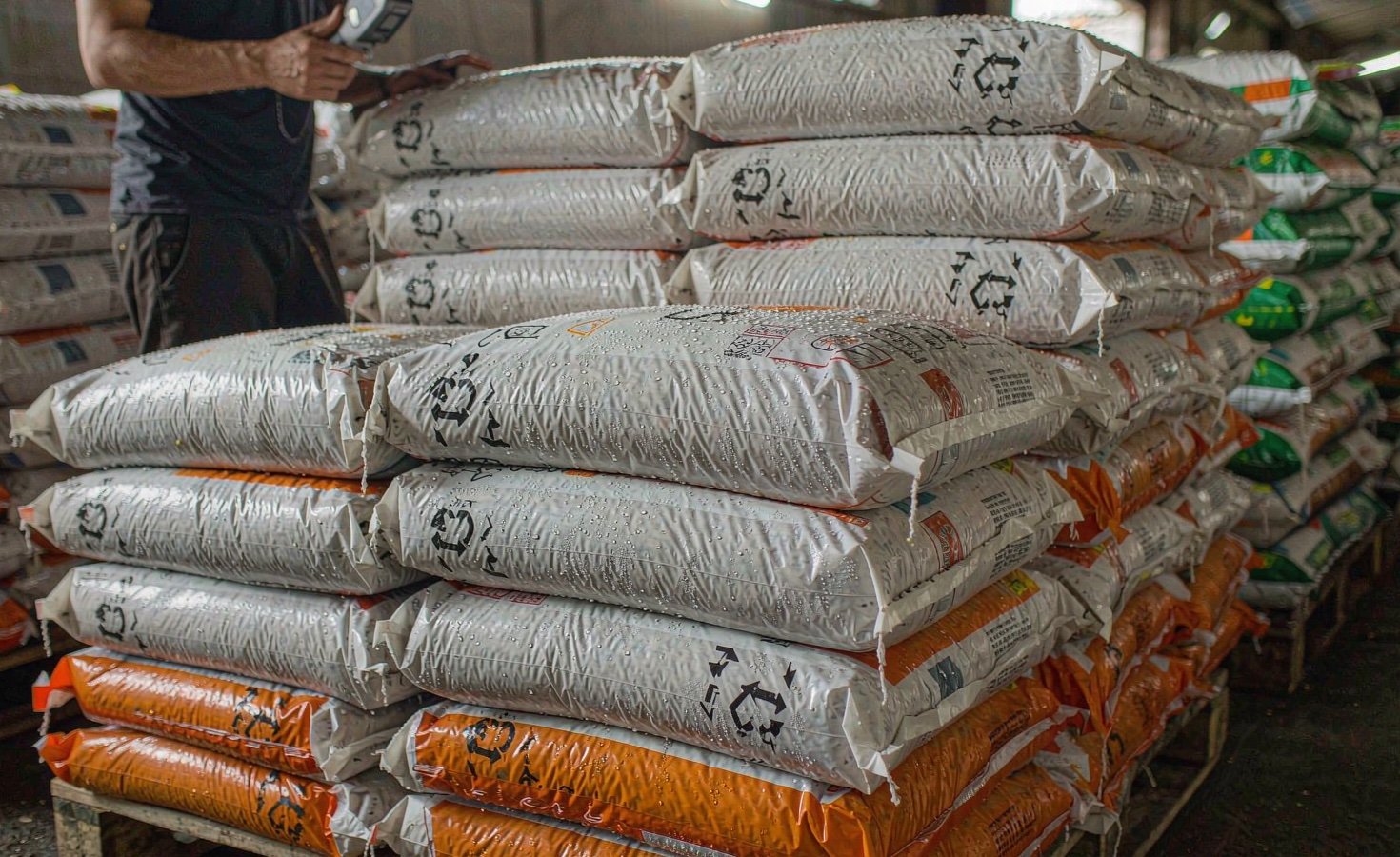
ENplus A1 caps moisture at 10%. Set against the sorption data, that limit has a hard meaning: a warehouse whose air sits above roughly 80% RH for long stretches is capable of pushing bagged product to the limit — the Greenwich study’s pellets at 80% RH gained 3–4% weight within days. The plastic film is a decent barrier against liquid water and a poor one against weeks of humid air, especially once a bag has been opened or heat-sealed imperfectly.
Then there’s condensation, the self-inflicted version. Bags filled with pellets that are still warm relative to the room will cool down inside the stack, and the air inside each bag reaches its dew point on the film. The cooling literature’s rule — discharge pellets at no more than about ambient +5 °C before bagging — exists precisely to prevent this (Watt, Matching product to cooling process). Warm bags on a cold concrete floor in a humid spring warehouse are the classic mould-claim generator. Retail-side guidance from national trade bodies says the same thing in gentler words — Canada’s wood pellet association, for instance, tells homeowners to keep bags sealed and stored off concrete in dry spaces (WPAC).
So the moisture risk in bagged product comes from three directions at once: humid air migrating through film, condensation from over-warm bagging, and the pellets’ own drive to rebalance upward from their just-cooled 6%. Good storage practice addresses all three with the same short list.
Practical controls, in order of value
Bag cool, stack cooler. Enforce the ambient +5 °C discharge rule mechanically — a timeout between cooler and bagging if your operators are optimistic. This single control eliminates the condensation mechanism entirely.
Know your warehouse’s RH by season. A €30 hygrometer per bay beats any argument. If your local summer sits above 80% RH, the data says bagged pellets will trend toward the 10% limit; plan stock rotation so retail bags don’t overstay a season. Our guide to bulk pellet storage covers the silo-side version of this problem, including why sealed silos still need ventilation.
Don’t fight the first two points of rebalancing. Pellets coming off the cooler at 6% climbing to 8–10% in storage are behaving normally, and the ENplus window is written with that in mind. The failure mode isn’t gentle rebalancing — it’s the 80–95% RH warehouse, warm bagging, and freeze–thaw cycles in unheated yards.
Watch the fines. Broken pellets have fresh, untreated surfaces, and the Polymers study noted that existing cracks raise moisture uptake. A storage bay full of fines in the corners is humidifying itself. Screen before storage where the layout allows, and keep the bay swept.
Sample stored lots, not just production. If you keep product for more than a season, pull bags from the stack quarterly and run moisture plus a quick durability check. The numbers drift, and the drift is what you’ll be asked about at the claim stage. For the lab side, see our walkthrough of in-house durability testing.
Give pallets a roof worth having. The Polymers study’s freeze–thaw result is a storage-design instruction: pallets that cycle through freezing nights and thawing afternoons lose up to 4.3 durability points even if the film never leaks. If your yard is the only space, at least keep pallets off wet ground and under a canopy; if pallets move between a heated warehouse and a cold yard regularly, the cycling happens inside the film either way. For export buyers, this is another argument for covered storage at destination too — the container ride protects against rain, not against a week of cold nights in a port yard.
Where the moisture actually comes from: an arithmetic sanity check
It’s worth converting the weight-change table into tonnes, because the numbers look abstract until you do. Take 500 tonnes of retail bags stored at 80% RH at 30 °C, with the Greenwich pellets’ +3% weight change. That’s roughly 15 tonnes of water taken up across the stack. Spread over 33,000 fifteen-kilogram bags, each bag gains about 450 g of water — a quarter of the pellet weight in the bag is now water that arrived after sealing.
This is arithmetic from published weight-change data, clearly labelled as such, and the takeaway doesn’t depend on the exact percentage: in humid climates, passive storage moves product toward the specification limit fast enough that a quarterly “we’ll test it later” habit will find a problem. In dry climates — the 40–60% RH band — the study found essentially no exchange, which is why high-desert producers sometimes don’t believe these numbers. Their warehouse really is safer.
Moisture rebalancing is one of those topics that costs nothing to manage and a fortune to ignore. Cool the bags below the condensation threshold, keep humidity out of the 80%+ band during storage, rotate stock before the wet season, and test stored lots rather than trusting production-day certificates. The physics isn’t negotiable, but the warehouse is.