
The hammer mill is the most ignored machine in a pellet line. Everyone watches the pellet mill’s ammeter and nobody watches the grinder, right up until capacity drops 15% and someone orders a bigger pellet press to compensate. In a feed plant, grinding can account for a large share of total electricity use; in a wood pellet line, a badly run hammer mill shows up as a slow dryer, an oversized particle distribution and pellets that fall apart at the cooler. The fixes for all five problems below cost almost nothing. They just require someone to actually open the door and look.
If you are still selecting the machine itself, start with our comparison of drum chipper vs hammer mill roles in the line, and our YHM series hammer mill product page. This article is about the faults that develop after commissioning.
Problem 1: screen blinding from wet material
Wet material is the fastest way to lose a hammer mill. Above roughly 15% moisture, fibrous particles smear across the screen openings instead of passing through them; throughput drops, specific energy climbs, and the mill runs hot. Technical literature on biomass grinding sets feed moisture below about 14–15% to avoid screen blinding, with sticky or fibrous feeds above 20% pushing energy use sharply higher (TCPEL biomass hammer mill guide).
The honest fix is upstream, not at the mill. If your feedstock arrives at 25–30% moisture, you either pre-dry or you accept a grinding bottleneck. Our sawdust drying guide covers where that moisture should actually be removed. Running the hammer mill against wet feed to “warm the material up” before the dryer is expensive friction — you pay electricity to squeeze water through holes that do not want it.
One nuance from research: rotor speed interacts with moisture and screen size in ways that are not intuitive. In trials on willow and miscanthus, grinding energy decreased as rotor speed increased, and a 10 mm screen needed more energy than 16 mm on the same material — smaller holes, more passes, more work per tonne (Sustainability 2019, 11(9), 2477). The takeaway: when output particle size changes, expect the amp draw to change with it, and re-baseline instead of assuming a fault.
Problem 2: the screen is wrong for the job
Screen selection is a compromise between particle size and throughput, and two details decide most of it.
First, the opening size should match your extraction method. For the 1–3 mm fraction that pelletizing wants, a screen of 5–6 mm typically works with pneumatic extraction, while mechanically extracted mills usually need 6–8 mm openings to reach the same fraction. Second, open area governs throughput: a perforation ratio of roughly 35–40% is what a good screen delivers, and anything lower quietly caps your capacity no matter how sharp the hammers are (Fundamentals of Pellet Technologies, grate hammer mill notes).
Then there is thickness, which operators forget until the screen folds. Screens are typically 3 mm sheet; once wear thins them to about 1.5–2 mm they flex, distort and tear, and a torn screen dumps unground chips straight into the pellet mill feed. Hold the used screen up to a light against a new one — thinning is visible long before it is catastrophic. Cheap carbon steel screens are fine for clean sawdust; if your feed carries grit or husk ash, upgrade the screen material, because the consumable you keep buying cheapest is the one you buy most often.
Problem 3: hammers worn past their point
Hammers do the work, so worn hammers are where grinding quietly turns expensive. Two failure patterns matter:
- Edge rounding. A rounded striking edge crushes instead of cuts. Output particle size drifts coarser, fines fraction rises at the screen, and energy per tonne climbs. The mill keeps running, so nothing seems broken — your electricity bill just creeps up.
- Uneven sets. Replacing hammers in a random pattern unbalances the rotor. Vibration rises, bearings take the difference, and a bearing failure on a 3,000 rpm rotor is never cheap.
The working rule: flip or rotate hammers to use all their wearing edges, and when edges are done, replace in mirrored sets so the rotor stays balanced. Check the hammer-to-screen clearance while you are in there. Mills adapted from grain duty run very tight clearances — around 5–10 mm — which is fine for grain and dangerous for wood: one hard knot and the screen takes the impact. For wood raw material, a clearance of roughly 20–25 mm with appropriately shortened hammers is the configuration the grinding literature recommends (Fundamentals of Pellet Technologies).
How much does wear actually cost? Grinding energy data on woody biomass shows the size of the stakes: dried willow on a 10 mm screen consumed on the order of 10–14 kWh per tonne, miscanthus 14–18 kWh per tonne, in controlled trials (Sustainability 2019). Research on corn residues shows even bigger spreads by material — cobs burned several times the energy of grain on the same screens (IJABE 2020, hammer mill energy study). A mill running worn hammers pushes every one of those numbers upward.
Problem 4: foreign objects and the door nobody latches
Hammer mills forgive a lot, but not steel. A rock, a bolt, or a chipped chipper knife entering the chamber at full rotor speed can crack a screen, snap hammers off their pins, and in the worst case deform the chamber. The defenses are simple and boring:
- Magnets ahead of the mill for ferrous scrap, checked and cleaned on a schedule — a magnet buried under dust protects nobody.
- A scalper or screen at intake for oversized pieces, so the mill grinds, not smashes.
- A working door safety switch. Every hammer mill we ship carries one (see the YHM design), and the most common bypass we hear about is a jumper wire installed after a nuisance trip. If the door trips the interlock, the real fix is balance or feeding, not a jumper.
After any metal strike, do not just replace the broken part. Inspect the remaining hammers for cracks at the pins, check the screen for hairline tears, and re-check rotor balance before full speed.
Problem 5: feeding and airflow
A hammer mill wants a steady, metered feed at the upper edge of its load curve. Underfeeding wastes installed power on air; overfeeding drowns the chamber, stalls particle circulation, and trips the overload — which is exactly what the drive is supposed to do. Use a feeder with speed control, and tune the feeder by watching motor amps, not by sound.
Airflow is the other half. Pneumatic extraction pulls ground material out of the chamber, which keeps the screen clear and the material moving; mills with integrated fans typically need an additional 4–7 kW for air and material transport, and underpowered air systems leave material circulating until the screen blinds (Fundamentals of Pellet Technologies). If you rely on mechanical extraction, the screen openings need to do more of the work — which loops back to Problem 2.
Finally, remember where grinding sits in the line. A hammer mill producing a wide, coarse distribution hands the pellet mill a material that presses unevenly and shows up later as fines — the connection we trace in the fines screening article. Grind quality is pellet quality’s upstream cousin.
Numbers worth pinning above the mill
Our own YHM series nameplate data shows how these parameters scale across a real product range — rotor diameters from 560 to 1,380 mm, hammer tip speeds in the 86–107 m/s band, and screen-determined capacity from 0.5 to 33 t/h depending on grind fineness (first-party data, HENGMU YHM series):
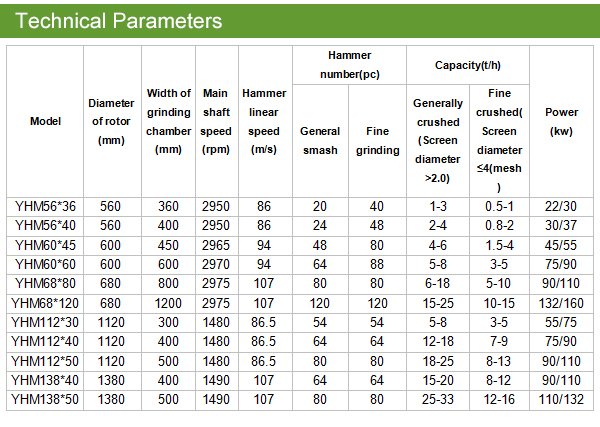
For day-to-day operation, this is the cheat sheet:
| Parameter | Working range | Source |
|---|---|---|
| Feed moisture at the mill | Below ~14–15% to avoid screen blinding | TCPEL biomass grinding guide |
| Screen opening (1–3 mm target fraction) | 5–6 mm pneumatic extraction / 6–8 mm mechanical | Fundamentals of Pellet Technologies |
| Screen perforation ratio | ~35–40% open area | Fundamentals of Pellet Technologies |
| Screen thickness, replace at | 3 mm new → replace at ~1.5–2 mm | Fundamentals of Pellet Technologies |
| Hammer tip speed | ~86–107 m/s (YHM range); ~100 m/s at 3,000 rpm with a 600 mm rotor | HENGMU YHM nameplate data / FP Tech notes |
| Hammer-to-screen clearance (wood) | ~20–25 mm, not grain-mill 5–10 mm | Fundamentals of Pellet Technologies |
| Symptom | Most likely cause | Check first |
|---|---|---|
| Throughput falls, amps rise | Screen blinding (wet feed) or worn hammers | Moisture reading; hammer edges; screen open area |
| Particles coarser than before | Rounded hammer edges or worn screen | Edge profile; screen thickness vs new |
| Fines fraction rising | Over-grinding: screen too small or hammer speed mismatched | Screen size vs pellet mill need; feed rate |
| Vibration and hot bearings | Unbalanced hammer set or trapped metal damage | Set pattern; pins; screen for hairline tears |
| Overload trips at feed surges | Feeder overrun or airflow starved | Feeder speed vs amps; fan and duct condition |
Before the first shift: record the baseline
Most of the five problems above hide because nobody knows what “normal” looked like. On commissioning day, or after the first hammer change, write down six numbers for each raw material you run:
- Motor amps at full feeder speed, steady state.
- Tonnes in per hour (or feeder setting that achieves it).
- Screen opening and thickness installed.
- Hammer set pattern and hours on the current edges.
- Ground particle fraction check against your pellet mill’s preference.
- Bearing housing temperature after two hours of running.
Repeat the check monthly. When amps drift 10% at the same feed rate, you have caught the problem while it is still a screen cleaning and a hammer flip — not a seized bearing on a Friday night. If you want the same discipline applied to the machines downstream, our pellet mill troubleshooting guide and the capacity article both start from the same principle: trend the numbers, then touch the machine.