
A pellet plant’s dust collector is the one piece of equipment designed to gather fuel into one place. Every gram of sawdust it captures is combustible, dry, and fine enough to explode. That is not alarmism — it is the reason insurers ask about your dust system before they ask about your pellet mill, and why OSHA’s combustible dust National Emphasis Program puts dry dust collectors near the top of an inspector’s list (OSHA Combustible Dust NEP).
The good news: collector fires and explosions follow a short, well-understood list of mechanisms, and each one has a code-backed control. This article walks the five mechanisms we see behind wood dust collector incidents, what OSHA and NFPA standards actually require, and the six questions your insurer or fire marshal will ask — with answers you can prepare this week.
First, the arithmetic of an explosion
Wood dust burns as a pile. Wood dust explodes as a cloud, inside a confinement, with an ignition source. OSHA’s enforcement guidance spells out the chain: combustible dust dispersed in air at or above the minimum explosive concentration, an ignition source, and a confined enclosure without sufficient venting — and it adds the detail that matters most in real incidents: a small initial deflagration disturbs and suspends settled dust, which then fuels a secondary, usually far more damaging, explosion (OSHA CPL 03-00-008).
The Imperial Sugar refinery disaster in 2008 remains the reference case: accumulated sugar dust, a small event, then a secondary explosion that killed 14 workers and injured dozens (U.S. Chemical Safety Board investigation). A pellet plant has every ingredient the sugar refinery had — fine dust, high spaces, beams, ducts — plus a heat source or three running all day.
Mechanism 1: fuel accumulating inside the ducts
Ducts carry wood dust at speed so it stays suspended. When airflow drops — a fouled filter, a slipping fan belt, a half-closed damper — particles settle inside the duct and form a combustible lining. Now the duct is no longer transport pipe; it is a long fuse that connects the pellet mill area to the collector.
OSHA’s woodworking guidance gives the working number: keep duct velocity at a minimum of 2,500 to 4,000 feet per minute (roughly 13 to 20 m/s) so sawdust and shavings stay airborne and the system does not plug (OSHA Woodworking eTool, wood dust). In practice that means checking differential pressure gauges on the collector every shift and investigating any duct you can hear rumbling or see sagging. A horizontal run with a low spot is where the fuel bed forms; the eTool’s maintenance advice is direct — check and clean ducts and collectors at regular intervals.
Mechanism 2: the collector itself is the most dangerous box on site
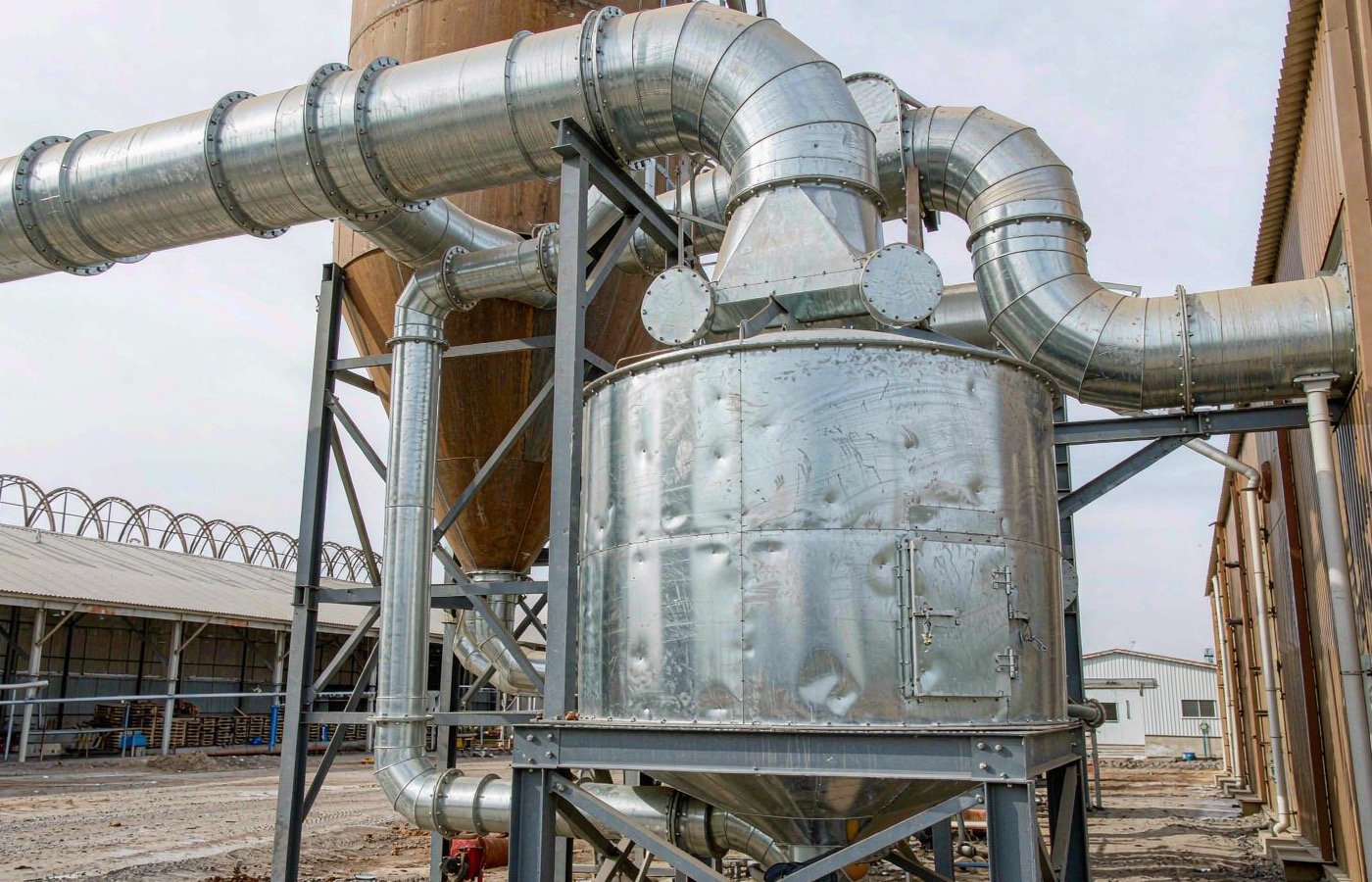
Inside a filter housing you have the densest dust cloud in the plant, repeated pulse-jet cleaning, and a large flexible surface area to propagate flame. Modern standards treat the collector as explosion equipment, not just filtration. NFPA 660, the consolidated combustible dust standard issued in 2025 that folded in the former NFPA 652, 654 and the wood-specific NFPA 664, requires a dust hazard analysis and protection where the analysis warrants it (NFPA 660).
For an outdoor collector, the usual answer is deflagration venting sized per NFPA 68, with vent panels directed to a safe area (NFPA 68). For equipment connected in series — collector to cyclone to bin — the standard’s worry is propagation: a primary event in one vessel travelling through ductwork to start a second elsewhere. A cyclone or day bin on the collector line carries the same enclosed-dust risk profile as a pellet storage silo, which is why our storage silo guide treats ventilation and gas monitoring as central, not optional. That is what isolation devices address, whether mechanical check valves or chemical suppression, under NFPA 69. When we lay out a complete line, we put the collector outside where venting can discharge safely, and we isolate the duct run back to the hammer mill and pellet mill — a point we also make in the plant layout guide.
Mechanism 3: ignition sources you own and can fix
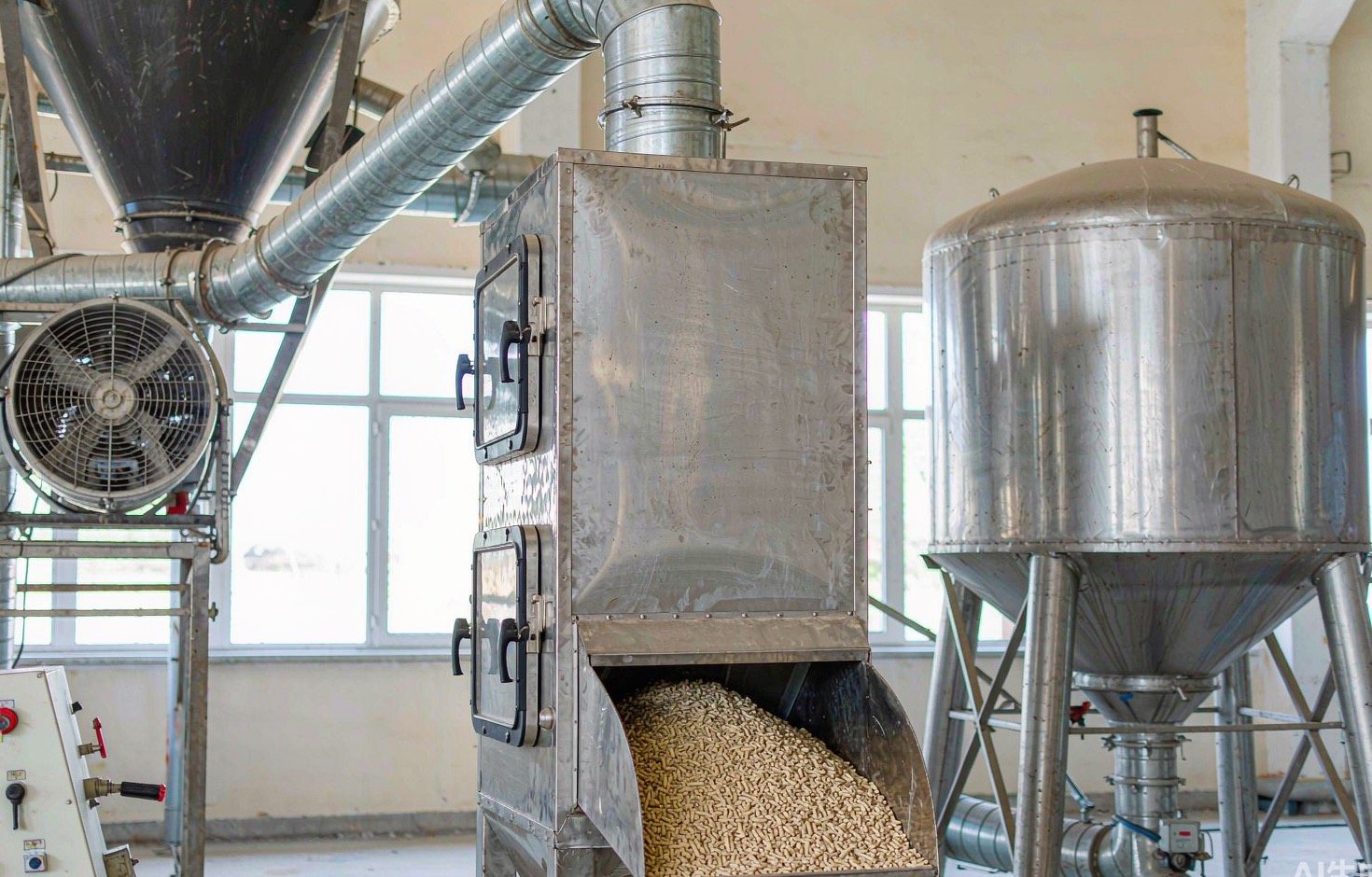
Collectors rarely ignite themselves. Something upstream supplies the spark, and the usual suspects are maintenance problems with well-known names:
- Hot bearings and friction. A bearing on a hammer mill, fan or conveyor idler that has been “running warm” for weeks is a glowing ember factory. Trend bearing temperatures the way our troubleshooting guide recommends — the mill that tells you it is hot is cheaper than the one that does not.
- Dryer embers. In direct-fired dryers, sparks from the furnace travel with the material. Spark detection and suppression on the dryer inlet is standard equipment in modern lines, and its absence shows up quickly in insurance reviews.
- Static and bonding. Plastic duct sections, ungrounded hoses and non-conductive filter media can accumulate charge. Bond and ground transfer points; if the dust hazard analysis calls for conductive media, replacing it with a cheap standard cartridge deletes a protection the analysis was counting on.
- Hot work. Grinding or welding near dust-coated steel lights the fuel you cannot see — overhead ledges included. A permit system exists for exactly this reason.
Mechanism 4: housekeeping — the 1/32 inch that decides the outcome
Even a well-protected collector cannot save a plant that has let dust build up everywhere else. The working threshold from OSHA’s NEP, drawn from NFPA 654 Annex D: immediate cleaning is warranted when a dust layer of 1/32 inch — the thickness of a paper clip — accumulates over an area of at least 5% of the floor area, counting overhead beams, joists, duct tops and equipment surfaces (OSHA CPL 03-00-008).
Look up, not just around. The bar joists above your pellet press have roughly the surface area of the floor below them; steel beams can reach 10% of floor area. That overhead dust is the secondary explosion’s fuel supply, and it is why the CSB’s photographs of every dust disaster look the same: ledges.
One rule of method: never blow dust down with compressed air. It converts a housekeeping task into the exact suspended cloud you are trying to avoid. Vacuum with rated equipment or sweep gently.
Mechanism 5: wrong retrofits that undo good design
The fifth mechanism is self-inflicted. We see these three in the field more than any code violation:
- Vents pointed at work areas. An explosion vent that discharges into a walkway or at a neighboring machine trades a structural event for a life-safety one. Vent discharge must reach a safe area.
- Media substitution. Swapping an anti-static filter cartridge for the cheapest equivalent changes the system’s behavior without changing its paperwork.
- Ducts “extended.” Every added elbow, flex hose and horizontal run lowers velocity and creates new settling zones. If the layout changed, the duct velocity calculation needs to change with it — the same arithmetic discipline we apply to moisture and capacity in our acceptance testing.
What the codes actually ask of a pellet plant
| Requirement | Source | What it means on your floor |
|---|---|---|
| Dust hazard analysis, reviewed when the process changes | NFPA 660 (2025, consolidated) | One document that lists your dust risks and the protections claimed against each |
| Deflagration venting of dust collectors where required | NFPA 68 | Vent panels sized and directed to a safe outdoor area |
| Explosion isolation between connected equipment | NFPA 69 | Devices that stop flame propagation from collector back to mill |
| Duct velocity 2,500–4,000 fpm minimum | OSHA Woodworking eTool | Velocity check after every filter change and layout change |
| Clean at 1/32 inch dust over ≥5% of floor area (incl. overheads) | OSHA NEP CPL 03-00-008 (citing NFPA 654 Annex D) | A weekly overhead inspection, not just floor sweeping |
Standards become enforceable through your local fire code, insurer and authority — the exact application varies by country, and European buyers will be working with the ATEX directives instead of NFPA citations. The engineering logic, however, translates: analyze the hazard, vent the collector, isolate the equipment, keep the ducts moving, keep the ledges clean.
Six answers to have ready for your insurer or fire marshal
| Question | What they want to see |
|---|---|
| Where is your dust hazard analysis, and when was it last reviewed? | A named document with a review date — NFPA 660 expects it to track the plant as built, not as commissioned |
| Is the collector outside or inside, and how is it protected? | Venting or suppression evidence, vent discharge direction, isolation devices in the ductwork |
| What is your duct velocity, and who checks it? | Design number within the 2,500–4,000 fpm band, plus gauge readings on a schedule |
| How do you clean overhead surfaces? | Written schedule, rated vacuum method, and photographs proving beams are visited weekly |
| What ignition sources have you controlled? | Bearing temperature logs, spark detection on the dryer, bonding/grounding records, hot work permits |
| What did your dust test show? | Explosibility and severity data (Kst/Pmax) from testing your actual dust — “it is just sawdust” is not a test result |
None of the six answers requires new technology. They require the same discipline that separates a pellet plant that runs 6,000 hours a year from one that spends its summer rebuilding a filter house: write down the numbers, walk the plant on a schedule, and fix the cheap things before they become the expensive things.