
Almost every new pellet producer asks the same question in the first week of commissioning: should we run 6 mm or 8 mm? The answer is not a matter of taste. It decides how many dies you buy, what your mill actually produces per hour, which buyers will take your fuel, and how much fines you sweep off the floor at the end of a shift.

This article works through the choice from the die outward: what the standards actually fix, what the hole geometry does to your throughput, where each diameter wins commercially, and what to write in your RFQ so you do not end up with the wrong die on a ship.
What the standards actually fix, and what they leave to you
ISO 17225-2 does not tell you to make 6 mm pellets. It defines a window, and both diameters sit inside it. The Canadian adoption of the standard, published as a guidance table by the Government of Ontario, lists diameter as 6 ± 1 mm or 8 ± 1 mm across grades A1, A2 and B, with length between 3.15 mm and 40 mm.
Everything else in the grade — moisture ≤10%, ash ≤0.7% for A1, durability ≥97.5% — applies equally to both diameters. So the standard will not make the decision for you, and a certificate will not save a pellet that the boiler cannot burn.
| Property | Grade A1 | Grade A2 | Grade B |
|---|---|---|---|
| Diameter | 6 ± 1 mm or 8 ± 1 mm | 6 ± 1 mm or 8 ± 1 mm | 6 ± 1 mm or 8 ± 1 mm |
| Length | 3.15–40 mm | 3.15–40 mm | 3.15–40 mm |
| Moisture (as received) | ≤10% | ≤10% | ≤10% |
| Ash (as received) | ≤0.7% | ≤1.2% | ≤2.0% |
| Mechanical durability | ≥97.5% | ≥97.5% | ≥96.5% |
| Fines (<3.15 mm) | ≤1% | ≤1% | ≤1% |
| Gross calorific value | ≥18.6 MJ/kg | ≥18.6 MJ/kg | ≥18.6 MJ/kg |
| Bulk density | 600–750 kg/m³ | 600–750 kg/m³ | 600–750 kg/m³ |
Note one detail that trips up sales teams: the ENplus scheme layers a stricter durability bar on top of that ISO base — 98.0% for A1 rather than 97.5%, as listed in the ENplus Handbook v3.0 Part 3. If your customer is buying certified fuel, the number you have to hit is the ENplus one, not the ISO one.
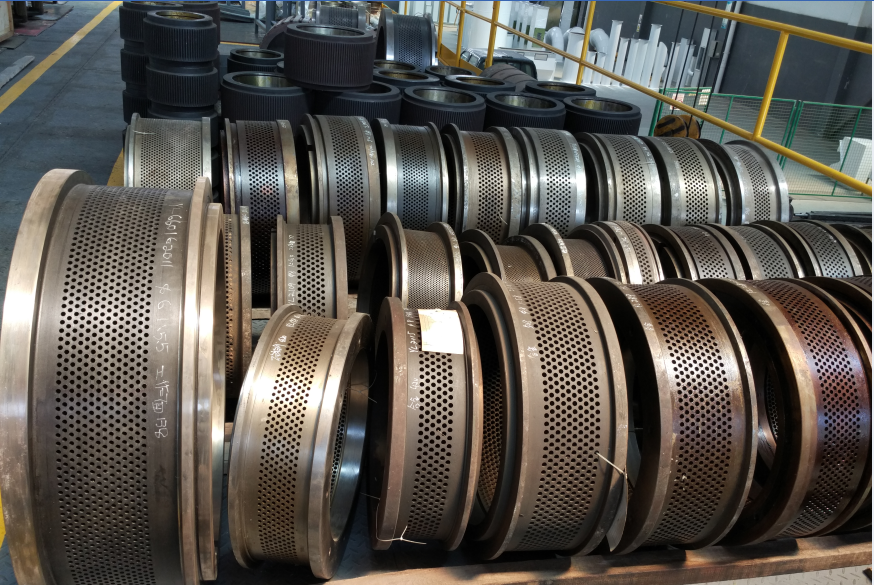
Where the standard stays silent is the point that costs money: die hole count, open area, compression length and press speed. Those decide whether 6 mm costs you 8% of output or 30%.
The hole-area arithmetic nobody puts in the brochure
Look at the die as a plate with thousands of small holes. The area of one hole is π/4 × d². A 6 mm hole is 28.3 mm². An 8 mm hole is 50.3 mm². Same strand speed, same number of holes, and the 8 mm die moves 78% more material per revolution.
That is the crude version, and it is why buyers assume 6 mm always costs them a third of their capacity. Real dies are drilled differently. A 6 mm die usually carries more holes on a tighter pitch, which claws back part of the loss, and a die maker who knows your target tonnage will specify hole count around it. The result is a gap, but a smaller one than the raw area ratio suggests.
Two other geometry effects matter more than most buyers expect:
- Friction per tonne. Pushing the same mass through a smaller hole means a higher pressure gradient along the same compression length. The main motor works harder per tonne, and the energy per tonne goes up. This is the cost that does not appear until the electricity bill arrives.
- Surface per unit volume. For a cylinder, lateral surface divided by volume is 4/d. At 6 mm that is 0.667 per mm; at 8 mm it is 0.5. A 6 mm pellet carries about a third more surface per unit of mass, which is good for rapid devolatilisation in a boiler and bad for fines generation in a pneumatic line.
If you want the fuller physics of compression length, hole taper and how suppliers quote L/D differently, we covered it in how to read a die compression ratio spec.
What 6 mm does better
Durability is the first argument. A 6 mm hole with a matched compression length builds a denser, harder pellet, and density is what survives the trip from the press to the silo. In our commissioning work on softwood sawdust at 10–13% moisture, 6 mm dies reach the ENplus A1 durability bar with more margin than 8 mm dies on the same feedstock and press.
The second argument is the appliance. Residential stoves and small underfeed stokers are built around a 6 mm fuel. The screw, the drop tube and the burn pot are sized for it, and a bag of 8 mm pellets in a stove designed for 6 mm is a service call waiting to happen. If your market is 15 kg bags and pallets, 6 mm is the default for a reason.
The third is combustion speed. More surface per unit mass means faster devolatilisation and a shorter flame. On a moving grate where the fuel has a fixed residence time before the ash discharge, that can translate into better burnout. It is also why some boiler makers specify 6 mm for smaller grate units and 8 mm for large ones — the furnace, not the pellet standard, sets the rule. Suppliers who publish diameter guidance for grate boilers make the same distinction, usually with the boiler OEM fuel sheet as the deciding document instead of the standard.
What 8 mm does better
Throughput, first. The bigger hole passes more material at the same die speed, so a given frame with an 8 mm die produces more tonnes per hour than the same frame with a 6 mm die. For an exporter selling into industrial bulk contracts, that difference is the whole margin.
Fines, second. An 8 mm pellet is heavier and has less surface per unit mass, so it survives conveying, silo drops and ship loading with fewer broken pieces. Fines under 3.15 mm are capped at 1% by the standard, and every handling step between the cooler and the hold is working against you.
Third, the practical one: bulk handling equipment. Chain conveyors, bucket elevators and truck loading chutes handle 8 mm pellets with fewer bridging problems than 6 mm, which behaves more like a fine, free-flowing material in a hopper.
One supplier-side reference on this point, worth reading alongside the boiler manual, is this diameter guidance for industrial boilers. Read it as one company’s engineering opinion, not as a standard.
The die is not interchangeable, so plan for two
A ring die cannot be re-bored to a different hole size in service. Hole size, hole count and compression length are fixed at drilling. That has a commercial consequence most first-time buyers miss: if you intend to sell both residential bagged fuel and industrial bulk, you need two die sets, and you need to budget for both at order stage rather than six months into production.
Two dies also means two sets of process settings. A 6 mm die on the same feedstock will usually want a slightly different feeder rate and a slightly lower throughput target to hold durability. Write both into your commissioning records so the operator on the night shift does not have to rediscover them.
| Factor | 6 mm die | 8 mm die |
|---|---|---|
| Hole area (single hole) | 28.3 mm² | 50.3 mm² |
| Output per hole at equal strand speed | Baseline | About 78% higher |
| Energy per tonne | Higher (smaller hole, higher pressure gradient) | Lower |
| Durability on softwood sawdust | Easier to clear ENplus A1 | Needs closer control of moisture and compression length |
| Fines after handling | Higher | Lower |
| Surface per unit volume (4/d) | 0.667 per mm | 0.5 per mm |
| Typical fuel systems | Stoves, small underfeed stokers, bagged retail | Industrial grates, bulk silos, export cargoes |
| Die cost and lead time | One die set; expect tighter hole drilling and more holes | One die set; fewer, larger holes |
How the market actually pulls
Split your order book in two and the choice usually becomes obvious.
Bagged residential. Fifteen-kilo bags, pallets, garden centres and heating contractors. The buyer is a householder with a stove, and the stove wants 6 mm. Retail specifications also tend to carry a fines limit at the tighter end, because dust in a bag is a complaint. Volume here is smaller per customer but the price per tonne is higher.
Industrial bulk. District heating plants, power stations, cement kilns and exporters shipping to Japan, Korea or Europe. The buyer cares about tonnes, ash, moisture and fines at the receiving port. 8 mm reduces handling losses and lifts output, which is why most industrial cargoes are 8 mm unless the boiler OEM says otherwise.
There is a third case that decides itself: a plant burning its own pellets. Match the boiler’s fuel specification and stop thinking about the market. A 500 kW boiler with a screw feed will not thank you for 8 mm pellets, and a 20 MW grate will not notice the difference in burnout but will notice the extra fines.
| Buyer situation | Practical default | What to verify first |
|---|---|---|
| Bagged retail for stoves | 6 mm | Stove OEM fuel spec; fines limit in the retail contract |
| Small commercial boiler, underfeed stoker | 6 mm | Screw and drop-tube dimensions |
| Industrial grate or fluidised bed, bulk delivery | 8 mm | Boiler OEM fuel sheet; grate bar spacing |
| Export cargo to Japan, Korea, EU | 8 mm unless contract says otherwise | Contract diameter clause and fines limit at discharge |
| Selling both channels from one line | Two die sets, one mill frame | Die lead time, changeover time, silo and screening capacity |
Where producers get this wrong
Three failures come up again and again in commissioning reports.
Buying the 6 mm die to hit a quality target that moisture was going to break anyway. If the feedstock arrives at 18% and the dryer cannot hold 12%, no die specification saves the durability. Fix the drying before you spend on a die.
Sizing the mill on 8 mm output and then selling 6 mm. The gap is real, and it lands on the customer’s delivery schedule, not on the supplier’s. Ask for the capacity figure at the diameter you intend to sell, and make the supplier state the moisture and screen size those tonnes were measured at.
Forgetting the cooler and the screen. A 6 mm pellet leaves the die hotter and softer than an 8 mm pellet at the same throughput. If the cooler was sized on 8 mm tonnage, the 6 mm campaign will push fines up and durability down, and the die gets the blame.
The die order itself
When you place the order, the die specification sheet should carry five things, not one: hole diameter, hole count, compression length (or L/D), hole taper and entry chamfer, and the material grade of the die and roller shells. A die quoted only as “6 mm, for wood” is a guess, and it will not be repeatable when you order the second one.
Ask for the drawing. A serious die supplier will send one, with the hole layout. If they cannot, that tells you something about the second die you will need in eight months.
One more point on wear. Abrasive feedstocks — rice husk, straw, palm shell — eat a die far faster than clean softwood, and the wear shows up as oval holes and a slow loss of throughput long before the die fails. If you run those materials, the diameter decision should be made together with the die material decision, not separately.
RFQ wording that avoids the argument later
Six lines, copied into the enquiry, will save a month of email:
- Target diameter and tolerance: “6 mm ± 1 mm” or “8 mm ± 1 mm”, plus the length window you will sell at.
- Capacity stated at that diameter: “rated output in t/h with a 6 mm die on softwood sawdust at 12% moisture, 4 mm screen” — the conditions, not just the number.
- Durability target: “ENplus A1, ≥98.0% by ISO 17831-1” if you intend to certify, and say so at enquiry stage. It changes the compression length and the cooler sizing.
- Die sets: “one 6 mm die and one 8 mm die, both with drawings and hole count stated”.
- Spare die timing: the lead time for a replacement die, in weeks, in writing.
- Test basis: who supplies the feedstock for the factory acceptance test, and how output is weighed and recorded.
That last line matters more than it looks. A capacity test run on the supplier’s dry softwood tells you what the machine can do, not what your plant will do. Bring your own material, or accept that the first month of production is the real test.
If you are still at the stage of choosing the mill frame rather than the die, start with the YPM630 vertical ring die mill for 1–1.5 t/h or the YPM850 at 280 kW for 4–5 t/h, and specify the die separately. The frame and the die are two decisions, and treating them as one is how plants end up with a mill that makes the wrong pellet very efficiently.