
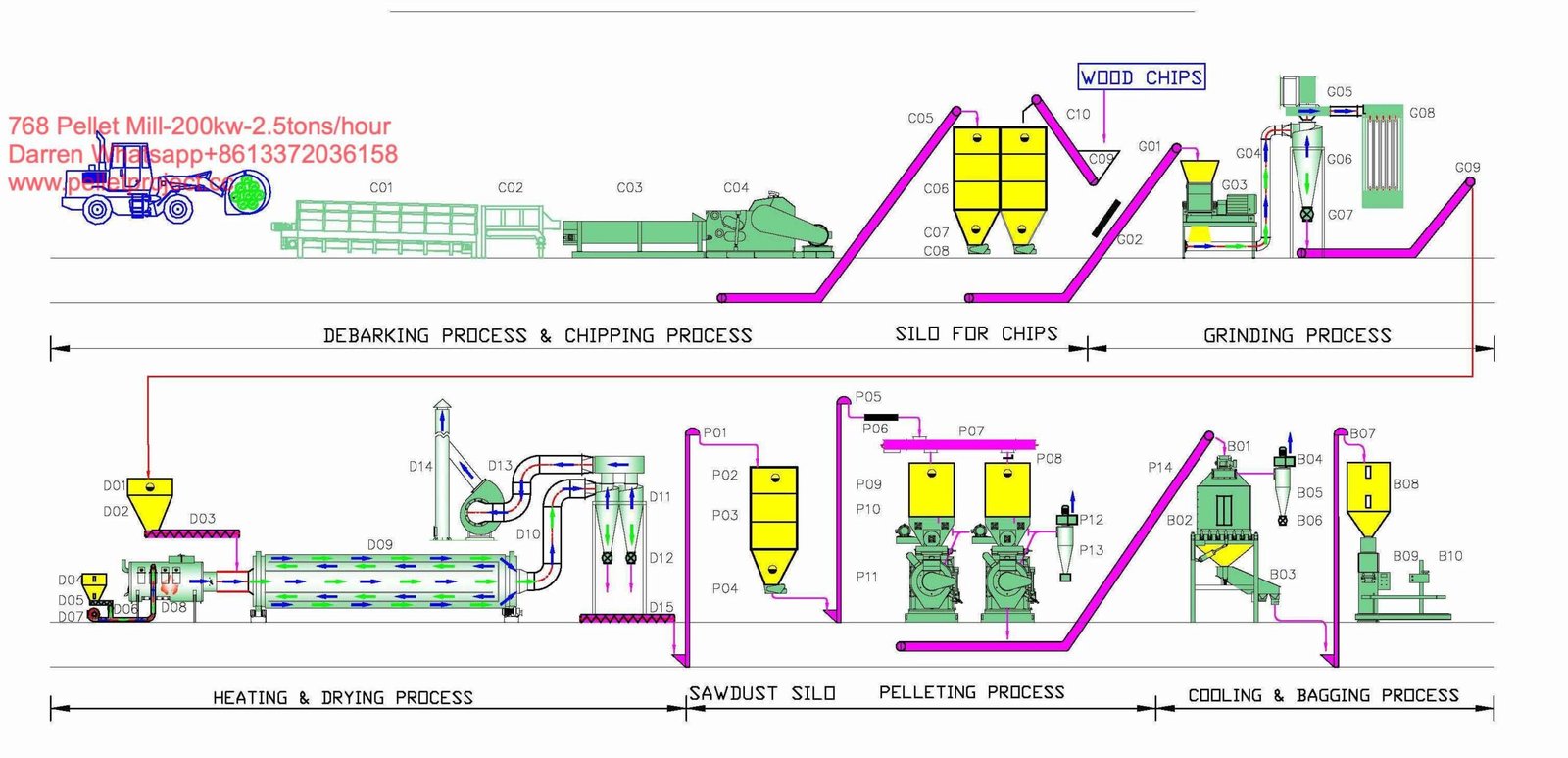
If you are reading this with a sawmill yard behind you and a quotation for a 1 t/h line on the desk in front of you, the machine is not the hard part. Proving that six thousand tonnes a year can leave your gate at a price that still leaves something behind is the hard part.
We have been building pellet equipment in Shandong since 2004, and we have watched enough plants start well and stall in month seven to know the pattern. The mill gets sized to a hope. The dryer gets sized to the mill. Nobody sizes the feedstock supply to either of them. Then the first wet week of monsoon, or the first sawmill that cuts back its shifts, exposes the whole plan.
What follows is the sequence of decisions that actually determines whether a wood pellet business works, in the order we would make them if the money were ours. No cheerleading, and no payback promises in three months.
The pellet market you are actually entering in 2026
Start with the size of the pool. Bioenergy Europe’s 2026 statistical report puts global wood pellet production at 53.5 million tonnes in 2025, up 10% on 2024 and the strongest year-on-year growth in recent years. Consumption reached 51.5 million tonnes. Europe took 70% of global demand and produced 45% of global output, with European production hitting a record 24.1 million tonnes after two years of contraction (Bioenergy Europe, June 2026).
Two things follow from those numbers, and they point in opposite directions depending on where you sit.
If you are building in Europe, you are building inside the demand centre. Freight is short, certification is mandatory in practice, and your competitor is a Polish or Romanian plant with the same sawmill residue problem you have. Your advantage has to come from logistics and grade, not from cheap capacity.
If you are building in Vietnam, Indonesia, Malaysia, Thailand or West Africa, you are building in the supply-growth region. Asian output rose 16% year on year in the same reporting period, driven by exports to Japan and Korea. Your cost base is lower, your residue is cheaper, and your buyer is often a trading house that will resell your tonnes into Europe or Japan. That model works, but it is a margin business measured in tens of dollars per tonne, not hundreds.
Either way, the household side of the market is worth noting: residential consumption in Europe reached 15.3 million tonnes in 2025, and more than 6.5 million European households now heat with pellets. Bagged retail is a real channel with real margins, and it rewards consistency far more than volume.
Step 1: Audit the feedstock you can actually get, not the feedstock you have heard about
Before any equipment conversation, answer four questions about your raw material with numbers, not adjectives.
Volume per day. Not per year, not “plenty”. How many tonnes arrive at your gate on a Tuesday in February? A 1 t/h line running two shifts needs roughly 16 tonnes of wet feedstock a day. If your sawmill produces eight, you have a part-time plant and a full-time problem.
Moisture, measured, not assumed. Weigh a sample, dry it, weigh it again. Do this five times across a month. Sawdust from a band saw and sawdust from a moulder are different materials with different water. Pelletizing works in a window around 10–15% moisture; below that the material will not bind, above it the die smears and the pellets come out soft (Biomass Connect pelletisation guide). We wrote a longer piece on how moisture behaves inside the die if you want the detail.
Contamination. Sand, grit, bark, plastic strapping, metal. A stone the size of a pea will take out a die worth more than a month of profit. Magnetic separation and a stone trap are not optional extras on a wood line, they are insurance.
Seasonality. Furniture factories slow in the wet season. Plantation thinning happens in bursts. If your supply swings 40% across the year, you either need storage or you need a line that can run on a second material.
Here is the arithmetic that surprises first-time buyers: one tonne of finished pellets at 10% moisture contains about 0.9 tonnes of dry wood. Feedstock arriving at 50% moisture is half water, so you need roughly 1.8 tonnes of wet material for every tonne of pellets. If your rotary dryer cannot remove that much water per hour, your mill’s rated capacity is fiction. This is why a “1 t/h pellet mill” and a “1 t/h production line” are not the same purchase, and why the dryer is often the largest single cheque in a wet-feed project.
Storage belongs in the same conversation. Wet sawdust piled three metres high will compost, heat and occasionally smoulder; a covered pad with a concrete floor and open sides costs less than the losses it prevents. Work out how many days of feedstock you need to hold. In a region with a real rainy season, two weeks is a sensible target — long enough to ride out a wet spell, short enough that the material does not degrade before it reaches the dryer.
If your own residue stream cannot fill the line, plan a second material now rather than later. Rice husk, palm kernel shell, coffee husk, straw and forestry thinnings all pellet, but they do not pellet the same way. Each one wants its own die compression ratio, its own moisture target and often its own pre-treatment. A line that runs one material at full rate and another at 70% is still a viable plant. A line that was never designed for the second material is a plant that stops when the first supplier does.
Step 2: Size the mill to the feedstock, then size everything else to the mill
Capacity is the slowest stage in the chain. A 3 t/h mill fed by a 1.5 t/h hammer mill produces 1.5 t/h. Buy the chain, not the headline.
| Capacity band | Typical mill | Connected power | Wet feedstock per hour | What the rest of the line looks like |
|---|---|---|---|---|
| 0.9–1.2 t/h | Ring die, 420 mm die | 90 kW | 1.6–2.2 t | Hammer mill, small drum dryer or pre-dried material, manual bagging |
| 1–1.5 t/h | Vertical ring die, 630 mm die | ~110 kW class | 1.8–2.7 t | Chipper or crusher, drum dryer, cooler, screener, bagging |
| 2.5–3 t/h | Ring die, 600 mm die | 185 kW | 4.5–5.4 t | Two-stage size reduction, larger dryer, automatic cooling and packing |
| 4–5 t/h | Ring die, 850 mm die | 280 kW | 7.2–9 t | Parallel hammer mills, silo buffer, PLC line control, bulk loading |
A word on model numbers, because they confuse buyers every week. Our model names follow die diameter in millimetres, so a 630 vertical mill and a 600 horizontal mill are close in output even though the numbers look far apart. Verticals and horizontals of the same nominal size behave differently too: the vertical ring die feeds material by gravity across the full face of the die, which suits light, fibrous wood dust; the horizontal layout is easier to bolt into an existing building and easier to reach for maintenance. Ask any supplier for a capacity curve against your material and moisture, in writing. A single headline number is a sales number.
For most plants under 2 t/h, a vertical ring die mill is the safer bet — the die wears more evenly and the machine tolerates the small moisture swings that a small plant always has. Above 3 t/h and running continuously, horizontal ring die machines with proper force feeding take over, because you can service rollers without pulling the whole die assembly.

Step 3: Budget the line, not the mill
Most first budgets are the mill price plus a vague allowance. That budget fails. The table below is the checklist we use with buyers, and the right-hand column is where projects actually go over.
| Budget block | What it covers | Where budgets break |
|---|---|---|
| Feedstock receiving and storage | Concrete pad, walls, loader, metering conveyor | Nobody budgets a roof, then the monsoon arrives |
| Size reduction | Drum chipper for logs and slabs, hammer mill for chips and sawdust | Buying a hammer mill for material that needs chipping first |
| Drying | Rotary drum dryer, heat source, cyclone, ducting, fan | Heat source fuel cost and duct length are discovered late |
| Pelletizing | Mill, feeder, conditioner, die and roller set | Sizing to dry material and then running wet material |
| Cooling and screening | Counter-flow cooler, screener, fines return | Skipping the cooler and losing durability in storage |
| Dust and fire safety | Bag filter, explosion venting, spark detection, grounding | Treated as optional until the insurer asks |
| Electrical | Transformer, MCC panel, cabling, instrumentation | Site supply is 30% short of connected load |
| Civil works | Foundations, workshop, silo bases, drainage | Weak floor under a vibrating machine |
| Installation and commissioning | Crew, rigging, alignment, trial runs, training | Assuming local fitters can align a die and roller gap |
| Working capital | Two to three months of feedstock, wages, spares | Spending it on a bigger mill |
Our own prices give you one anchor in that list. A vertical ring die mill in the 1–1.5 t/h class runs about USD 19,800–25,800, and an 850 mm machine at 4–5 t/h with a 280 kW motor runs about USD 48,800. A drum chipper in the 2–5 t/h range sits somewhere around USD 15,000–30,000 depending on infeed and drive. Everything else in the table scales with your site, your climate and your local labour rates, which is why a serious supplier asks for a layout drawing before quoting. If you want to see how those blocks fit together on one drawing, the complete line layout we build most often is a reasonable starting point.
One honest warning about the cheap route: if a quotation covers only the mill, the conveyor and a bagging spout, you are looking at a plant that will run for a week and then stop for a dryer. Ask for a scope list with every item marked “included” or “by client”, and compare those lists before you compare prices.
Step 4: Build a cost-per-tonne model before you commit capital
Banks and investors do not fund mills. They fund margin per tonne. The model below is deliberately incomplete — the empty column is yours, because the only numbers that matter are the ones from your own site.
| Cost line (per tonne of finished pellets) | How to calculate it | Reference point |
|---|---|---|
| Wet feedstock | Delivered cost per wet tonne × 1.8 | Your own supply contract |
| Electricity | kWh per tonne × your tariff | US industrial average was 9.64 ¢/kWh in August 2026 (EIA Electric Power Monthly) |
| Dryer fuel | Litres or kg of fuel per tonne of water removed | Depends on heat source: gas, biomass burner, waste wood |
| Labour | Monthly payroll ÷ monthly tonnes | Two to six operators per shift at this scale |
| Wear parts | Die and roller cost ÷ tonnes between changes | Ask the supplier for a written figure per tonne |
| Maintenance and spares | Bearings, belts, screens, lubrication | Track from month one, not from year two |
| Packaging and loading | Bags, pallets, stretch film, forklift time | Bagged retail costs more than bulk and sells higher |
| Financing and depreciation | Loan service + capital write-down | Straight-line over eight to ten years is common |
Energy deserves its own paragraph because it is the line buyers underestimate most. Pelleting is not free pressure — it is friction doing work. An Idaho National Laboratory study on a flat die press measured specific energy consumption between 75 and 275 kWh per tonne depending on feedstock moisture and die speed, with the low end reached at moderate moisture and higher die speed (US DOE OSTI). At 100 kWh per tonne and the US industrial average tariff above, that is roughly USD 9.60 per tonne before the dryer, the hammer mill or the conveyors draw a single kilowatt. Add drying and size reduction and the electrical bill can pass the feedstock bill in a grid with expensive power.
This is why we push buyers to put a meter on the line from day one and log kWh per tonne weekly. It is the single most useful number a plant manager has, and almost nobody records it in the first year.

Step 5: Set the quality target before you choose a die
The die is not a consumable you pick at the end. It is a design decision, because hole diameter, compression ratio and die thickness are what turn your material into a pellet that survives a truck ride.
If you intend to sell into Europe, ENplus is the reference buyers will ask about, and the A1 limits are specific: mechanical durability at or above 98.0%, ash at or below 0.7%, moisture at or below 10%, bulk density between 600 and 750 kg/m³, net calorific value at or above 4.6 kWh/kg, and fines at or below 1.0% (0.5% for bagged product). A2 relaxes durability to 97.5% and ash to 1.2% (ENplus; the full thresholds sit in the ENplus Handbook v3.0, Part 3).
Read those numbers as engineering targets, not paperwork. Ash at 0.7% means bark and grit have to stay out of your feed. Durability at 98% means your cooling and screening cannot be an afterthought. Moisture at 10% means your dryer control has to be better than a hand valve.
If you sell domestically or to industrial boilers in Asia, you may not need certification at all — but you will still be judged on ash, fines and consistency, and your buyer will test. Decide the grade first, then specify the die, the conditioner and the cooling time around it.
Step 6: Check power, permits and dust before you sign a lease
Three site questions kill more projects than equipment ever does.
Power. A 1 t/h line with dryer and hammer mill can pull several hundred kilowatts at peak. Confirm the transformer capacity, the voltage, and whether the utility will deliver three-phase to that plot. Upgrading a supply can take longer than building the plant.
Permits. Air emissions from a dryer, dust from a grinder, noise from a chipper, and the zoning of the plot itself. In the EU, biomass sustainability rules under RED III also affect what feedstock you can claim and which support schemes apply, so check eligibility before you design the supply chain.
Dust. Fine dry wood dust is a combustion hazard, and insurers in North America and Europe increasingly ask for documented dust management: collection at the grinder and the cooler, grounding and bonding, spark detection, explosion venting on the filter. A plant designed without it can be built cheaply and insured expensively, or not at all.
Step 7: Treat commissioning as a project, not a delivery
The first six weeks decide the next six years. Plan for them.
A new die needs breaking in — usually a run on oily or high-moisture material to polish the holes before you push full rate. Your operators need to learn what a slipping die sounds like and what a hot bearing smells like before they are running at night without support. Your dryer needs its control loop tuned against real feedstock, not the sample the supplier was given.
Insist on three things in the supply contract: a named commissioning engineer on site for a defined number of days, operator training with a written handover, and a spare die and roller set shipped with the line. Plants that start with a spare die lose hours when a die fails. Plants that start without one lose weeks.
Step 8: Line up offtake before the first tonne
Pellet plants do not fail because they cannot make pellets. They fail because they make pellets nobody contracted to buy.
Four channels exist, and they demand different things. Bagged retail wants consistent 6 mm or 8 mm pellets, clean bags, and a brand. Industrial boilers want volume, a steady ash figure and a price tied to an index. Trading houses want certificates, port access and container or bulk loading. Power utilities want tens of thousands of tonnes and will not talk to a 1 t/h plant.
Price expectations need calibrating carefully, because the numbers floating around the internet mix retail and wholesale. Germany’s DEPI benchmark for a six-tonne delivered order of ENplus A1 pellets stood at EUR 464.61 per tonne in October 2026, VAT and delivery included (Deutsches Pelletinstitut). That is a bagged, delivered, retail-weighted number. Ex-works bulk tonnage sold to a trader is a different market entirely, and anyone who models a plant on the retail figure is modelling a fantasy.
The safer structure for a new plant is a mix: a base contract with one industrial or trading buyer at a modest margin, plus a bagging line for local retail where the margin per tonne is higher and the volume risk is lower. That mix survives a bad quarter. A single export contract does not.
Five mistakes we see repeatedly
- Buying the mill first. The mill is the easiest item to compare and the least likely to be the bottleneck. Start with the feedstock and the dryer.
- Trusting a capacity number without a moisture test. Every mill on earth is rated on ideal material.
- Under-budgeting electrical work. Cabling, panels and transformer upgrades routinely cost more than the buyer expected, and they are the last thing anyone quotes.
- No spare die. A die is a wear part with a finite life. Running without a spare means running at whatever output the worn die allows.
- Modelling revenue on retail prices. Bulk ex-works is not retail delivered, and the gap is wide.
Terms worth knowing before you talk to any supplier
None of these are jargon for its own sake. Each one changes a number in your budget.
- Ring die / flat die. Die geometry. Ring dies are built for continuous industrial duty; flat dies suit small batch production.
- Compression ratio. The ratio of die hole inlet to outlet. Higher ratio means denser pellets and more load on the motor.
- Conditioner. A chamber that adds heat and moisture (or steam) before the die. It improves binding on dry, hard materials.
- Counter-flow cooler. Cools pellets by pulling ambient air up through a descending bed, so the coldest air meets the coolest pellets.
- Durability index. The share of pellets that survive a standard tumbling test. ENplus A1 requires 98.0%.
- Fines. Broken material under the screen. Recycled to the mill, but every pass costs energy.
- Bulk density. Kilograms per cubic metre. It decides how many tonnes fit in a container, and therefore your freight cost per tonne.
- Specific energy consumption. kWh per tonne of product. The number that decides whether your plant is competitive in five years.
If you work through these eight steps honestly, you will either end up with a plant that fits its feedstock and its market, or you will save yourself the capital. Both are good outcomes. The one outcome worth avoiding is a 1 t/h line standing idle under a roof you are still paying for.