
Wood chips and wood pellets start life in the same forest and end up in completely different businesses. Chips feed pulp mills and neighbourhood boilers; pellets cross oceans in containers and bulk carriers to fire power stations. If you sit in a mill that could produce either — a sawmill with residues, a plantation owner, an exporter choosing what to densify — the question “which one should I export?” has a harder answer than most sales pages admit.
I’ll compare the two fuels on the things that actually decide money: specification, energy density, container economics, moisture behaviour, storage risk, and the structure of each market. One spoiler: the global wood chip trade is mostly a paper-industry trade, not a fuel trade, and that single fact shapes everything else.
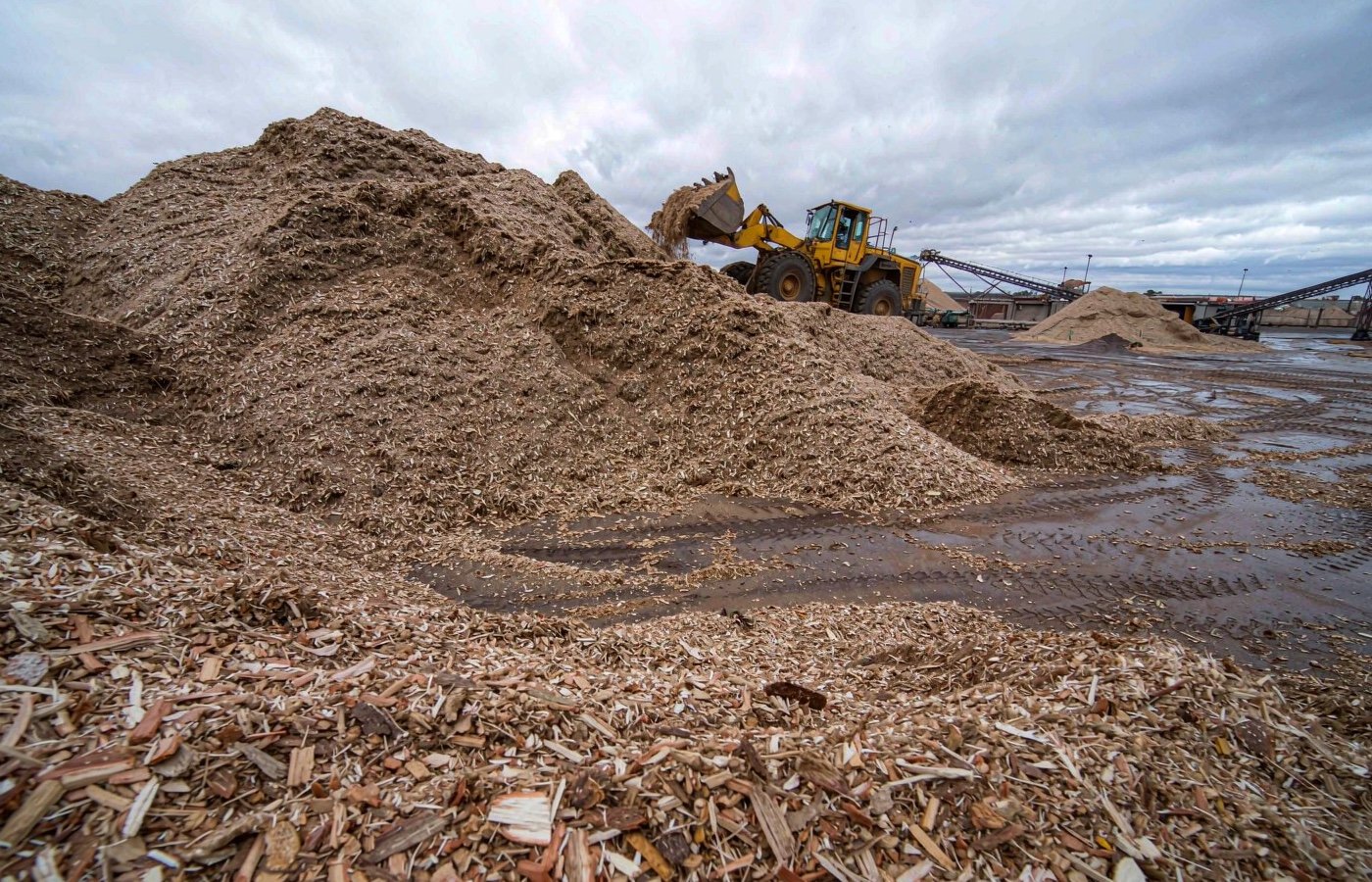
Two fuels, two different markets
Follow the money first. Vietnam’s trade press summaries of Japan Customs data (compiled in the ITTO Tropical Timber Market report) show that in the first half of 2025 Vietnam shipped US$405.8 million of wood pellets to Japan — up 96% year on year — and US$302.3 million of wood chips, up just 6%. Pellets and chips together made up 70% of Vietnam’s wood exports to Japan, but they were heading to different customers: imported pellets “primarily for biomass power generation”, imported chips “mainly for paper making”.
The chip market’s centre of gravity confirms it. IndustryEdge analysis of importing-country statistics (reported by Timberbiz) puts China’s hardwood chip imports at 16.1 million BDMT in the year to June 2025 — dominated by Vietnamese acacia for pulp mills — and Japan’s at 9.2 million BDMT, also overwhelmingly pulping fibre. Weighted average prices run around US$182.50/BDMT CIF into the main Asian markets, with Vietnam trading roughly 20–30% below Australian eucalypt chips on quality and yield grounds.
So when a buyer says “wood chips export”, they usually mean pulp chips — graded for fibre yield, brightness and cooking chemistry, not for calorific value. Fuel-grade chips exist, but they are largely a local or regional business. Pellets, by contrast, are an energy commodity from the first screw conveyor to the ship hold.
How the specifications differ
Both fuels have ISO 17225 specification families, and they are not interchangeable. Chips are graded under ISO 17225-4 (and the Canadian CAN/CSA implementation, summarised in the NRCan Solid Biofuels Bulletin No. 6), pellets under ISO 17225-2, whose industrial limits we covered in the 6 mm vs 8 mm diameter guide.
| Property | Graded wood chips (ISO 17225-4) | Wood pellets (ISO 17225-2 / ENplus) |
|---|---|---|
| Moisture classes | M10 ≤10%, M25 ≤25%, M35 ≤35%, or “max stated” for Grade B | A1/A2 ≤10%; industrial grades typically ≤10% |
| Ash limits | A1.0 ≤1.0%, A1.5 ≤1.5%, A3.0 ≤3.0% (dry) | A1 ≤0.7%, A2 ≤1.2% (ENplus A1/A2) |
| Particle size | P16S / P31S / P45S: main fraction 3.15–45 mm, fines (≤3.15 mm) 10–15%, oversize up to 200 mm | Diameter 6 or 8 ±1 mm, length 3.15–40 mm |
| Energy per tonne (typical) | 8–15 GJ/t depending on moisture | 17–18 GJ/t |
| Energy per m³ (typical) | 1.6–3.8 GJ/m³ | 11–11.7 GJ/m³ |
| Bulk density | ~200–250 kg/m³ | ~650 kg/m³ (600–750 band) |
The last four rows come from the Alberta government’s small-scale biomass district heating handbook, which compares the two fuels side by side; its delivered-cost bands ($50–100/BDt for chips vs $150–310/BDt for pellets) are dated but the physical ratios have not changed.
Two specification details deserve a flag. First, chip grades carry far looser moisture ceilings — Grade B chips can be “maximum value to be stated”, which in practice means wet fuel sold by weight. Second, chips’ fines fraction (anything under 3.15 mm) is defined but tolerated at 10–15%, while pellet fines are capped at 1% for bags. You get much less forgiveness in the pellet contract.
The container arithmetic
Density is where the trade economics diverge. Put both fuels in the same 40′ high-cube container — 76.4 m³ of volume, about 28.7 t of payload — and count the gigajoules (arithmetic, using the density and calorific values in the tables above):
| Fuel | Load basis in 40′ HC | Tonnes loaded | NCV basis | Energy delivered per container |
|---|---|---|---|---|
| Wood pellets | Weight-limited at ~28.7 t | 28.7 | 17 GJ/t at ~8–10% moisture | ≈ 488 GJ |
| Wood chips (semi-dry) | Volume-limited: 76.4 m³ × ~0.25 t/m³ | ≈ 19 | ~10 GJ/t at ~30–35% moisture | ≈ 190 GJ |
| Wood chips (fresh) | Volume-limited, same volume | ≈ 19 | ~8 GJ/t at ~45% moisture | ≈ 152 GJ |
One container of pellets carries roughly 2.5–3 times the energy of one container of chips. Freight, port handling and container positioning costs are broadly per-container, so the pellet pays the same freight bill while delivering two to three times the energy. That is the single strongest argument for densifying before you export — and it compounds with chips’ higher moisture, because you are frequently paying ocean freight on water.
Even the customs codes tell the story: under HS heading 4401, processed wood pellets get their own subheading (4401.31) while chips sit in the round-wood/chips lines (4401.22) — the distinction the WCO/FAO amendment note formalised to separate the energy commodity from the fibre commodity.
Moisture decides everything downstream
Moisture is the reason the numbers above look the way they do. Fresh chips run 20–50% water; every point of it must be evaporated in the customer’s boiler, at roughly 2.4–2.6 MJ per kilogram, before any useful heat appears. A chip stream at 45% moisture delivers less than half the net energy per tonne of the same wood at 10%. Pellets arrive at 5–10% and are graded to stay there — which is also why pellet contracts obsess over moisture regain in storage.
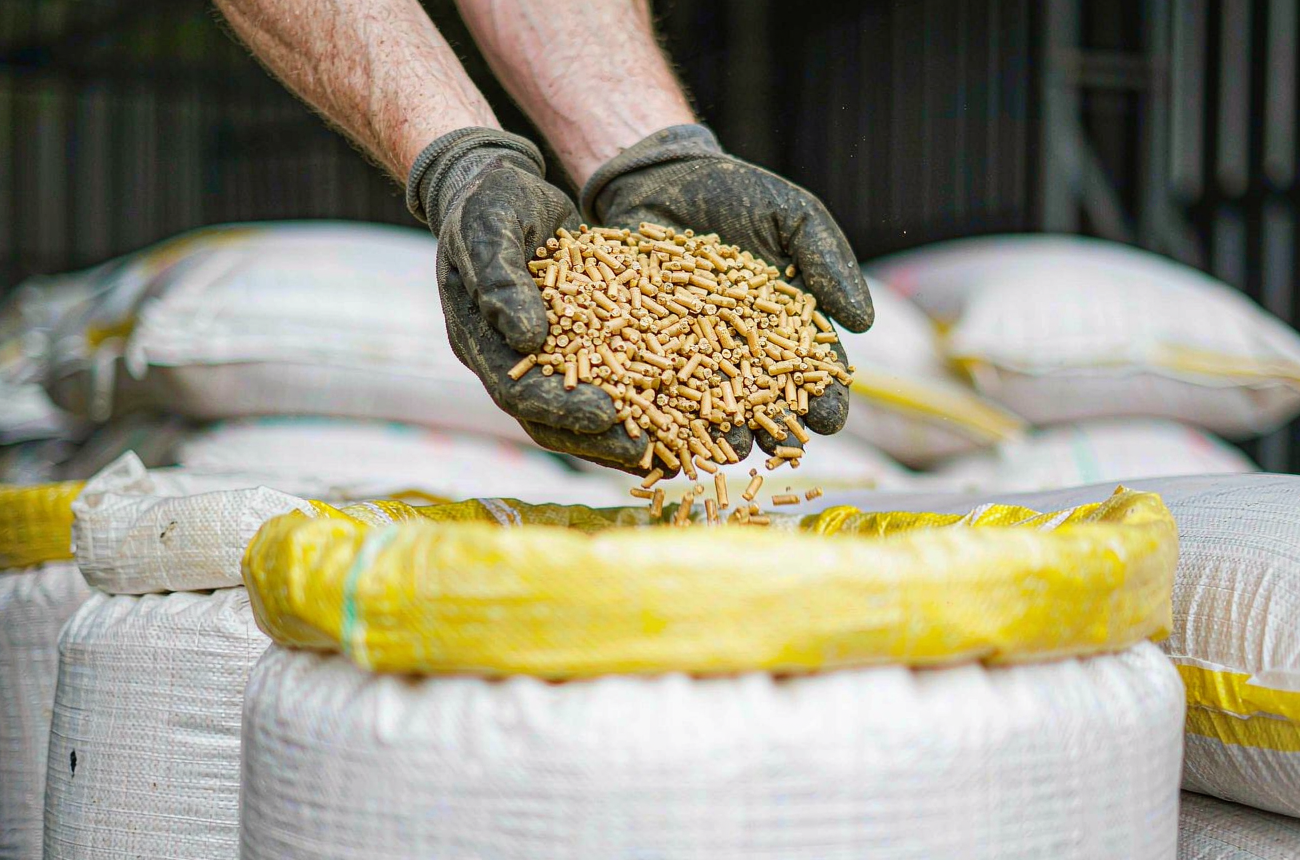
For a producer, moisture is also the cost driver in the other direction. Making pellets means drying to ~10% before the press, which consumes fuel; chips can be sold green with no drying at all. Chips therefore win on production simplicity — no dryer, no press, no conditioning — and lose on every downstream logistics metric.
Where chips genuinely win
This is not a one-sided argument. Chips beat pellets in four situations:
- You are next to the customer. The Alberta handbook is explicit that chips “usually has to be local” because low volumetric energy density makes long hauls uneconomic; inside a 100–200 km radius with a hauling fleet, green chips to a district heating plant or industrial boiler can beat pellets on delivered cost per GJ.
- You own the dryer’s feedstock already. A sawmill burning its own bark and residues for kiln heat has chips at near-zero marginal cost.
- The customer burns them wet on purpose. Pulp mills buy bone-dry tonnage and re-wet anyway; energy chips for fluidised-bed boilers tolerate 30–50% moisture by design.
- You have pulp-grade fibre. Acacia and eucalypt chips with clean debarking earn the CIF premiums quoted above — often more per bone-dry tonne than low-grade energy chips, with a fraction of the processing investment.
Note what is not on that list: long-distance fuel export. On that specific playing field, pellets win by a wide margin.
Shipping and storage realities
Chips bring handling risks that pellet exporters rarely think about. The NRCan bulletin warns that chip piles self-heat: fine fractions absorb water, microbial activity accelerates, and “in the worst case this can lead to self ignition” — covered storage and short pile dwell times are the stated countermeasures. Chip holds also need their own ventilation and gas discipline during ocean transport, similar in spirit to the wood pellet IMSBC Group B requirements we detailed in the wood pellet shipping guide.
Pellets trade those problems for different ones: they need dry, covered storage and careful loading to protect durability and fines limits, but a 650 kg/m³, 8%-moisture product fits the entire coal-style handling chain — grabs, silos, pneumatic unloaders — without modification.
So which one should you export?
Match the answer to distance and customer type. The distance bands below are our practical summary of the physics and market structure described above (a decision aid, not a standard):
| Distance to customer | Best move | Why |
|---|---|---|
| < 150 km, heat customer | Sell green or semi-dry chips | No processing capex; trucking water is tolerable at short haul |
| < 150 km, pulp customer | Sell graded pulp chips (P45S and similar) | Pulp premiums; fibre quality matters more than energy |
| 150–1,000 km | Dry the chips, or pellet if volumes justify | Every extra 100 km taxes water weight; drying or densifying starts to pay |
| > 1,000 km / intercontinental | Pellets | 2.5–3× energy per container; standardised spec; fits bulk and container chains |
| Any distance, utility co-firing | Pellets (white now, black later) | Utilities buy specifications, not truckloads |
One last reality check for the “why not both?” camp: the two products compete for the same residue stream. Every tonne of clean sawdust you pellet is a tonne that never enters the chip pile, and vice versa. Decide based on where your customer sits on the distance table — and on which market you can actually pass a specification test in. For most readers of this blog, that test is ENplus-style pellet quality, which means a chipper and hammer mill stay upstream partners in your pellet line, not product lines of their own. If your fibre is pulp-grade acacia and a chip buyer is already calling, sell the chips and buy back sawdust — the chipper-vs-hammer-mill division of labour exists precisely because the two products need different size reduction, not different forests.