
Sawdust leaves a sawmill and meets a fork in the road: it can be pressed through a ring die into 6 mm pellets, or compressed into a log-shaped briquette. Same raw material, same drying step at the front, and — on paper — the same families of customers. Yet the two products live in different markets, run on different machines and are bought by different kinds of buyers. If you are deciding which line to build, the differences below are the ones that actually move money.
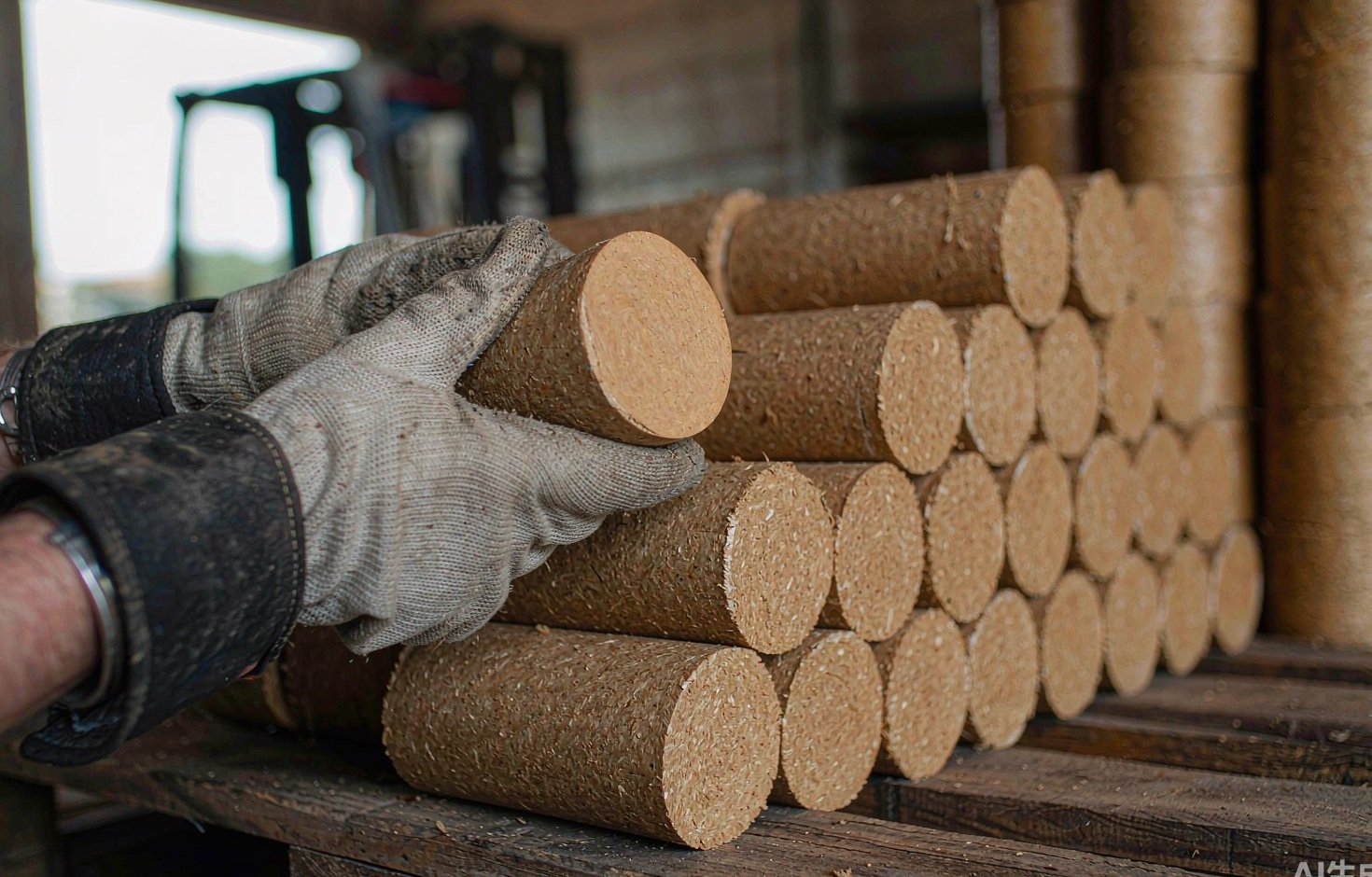
What a wood briquette actually is
A briquette is densified biomass pressed into a block, log, puck or cylinder — typically 50–90 mm across, with or without a centre hole. Unlike pellets, there is no single dominant shape; Canadian government guidance describes two broad families, larger bricks and logs and smaller pucks and cubes (Natural Resources Canada, Solid Biofuels Bulletin No. 5). The European trade reference is ISO 17225-3, the standard for graded wood briquettes, which classifies briquettes A1, A2 and B by raw material origin and explicitly excludes torrefied products from its scope (ISO 17225-3:2021 summary).
Both products are made by mechanical compression. The real difference is downstream of the press: a pellet is small and uniform enough to flow, dose and burn automatically, while a briquette is a hand-fed, stove-and-boiler fuel. Keep that sentence in mind and every difference below follows from it.
Specifications side by side
The table compares the strictest common grades of each product: ENplus A1 for wood pellets (limits from the ENplus Handbook, Part 3) against ISO 17225-3 grade A1 for briquettes, with the certification requirements from DIN CERTCO’s published scheme.
| Property | Wood pellets, ENplus A1 | Wood briquettes, ISO 17225-3 A1 |
|---|---|---|
| Form | Cylindrical, typically 6 mm diameter | Blocks/logs/cylinders, commonly 50–90 mm |
| Moisture | ≤ 10% | ≤ 12% |
| Ash | ≤ 0.7% | ≤ 1.0% |
| Mechanical durability | ≥ 98.0% | ≥ 95% (DIN CERTCO scheme) |
| Net calorific value | ≥ 4.6 kWh/kg | ≥ 15.5 MJ/kg ≈ 4.3 kWh/kg |
| Density measure | Bulk density 600–750 kg/m³ | Particle density ≥ 1.0 g/cm³ |
| Additives | Per ENplus rules | ≤ 2%, type and amount declared |
Three things jump out. Briquettes are allowed more moisture (12% versus 10%), which is why briquette production typically needs less drying — Canada’s bulletin states outright that briquettes “typically require less drying leading to less power consumption and lower cost in manufacturing” than pellets. Briquette durability is a looser 95% against 98% for premium pellets. And the density figures are not comparable as printed: briquette particle density (the material itself) is higher, but pellets win on how densely they pack into a silo or tanker, which is what bulk handling and freight actually care about.
The production line: where the two paths split
Up to the dryer, a briquette line and a pellet line look alike: size reduction, drying to the target window (the Biomass Connect pelletisation guide documents the 10–15% working window for pelletising). After drying they diverge.
| Stage | Pellet line | Briquette line |
|---|---|---|
| Grinding | Fine grind through hammer mill screens; particle size feeds the die | Coarser particles acceptable; less aggressive milling |
| Drying | To roughly 10% for ENplus A1 compliance | Can stop drier of the 12% limit — lower heat load |
| Pressing machine | Ring die pellet mill: rollers force material through a perforated die; our YPM-series vertical mills run 1–5 t/h | Briquette press: piston, screw or hydraulic ram compacting material into a mould or extruder |
| After the press | Counterflow cooler, screener, silo or bagging — built for flowable product | Cooling rack, stacking, palletising — built for discrete units |
| Automation ceiling | Silo storage, tanker and bulk vessel loading, fully automated boiler feeding | Manual or semi-automated handling; palletised retail logistics |
The pressing stage is where buyers underestimate the difference. A ring die mill is a continuous, high-throughput machine whose economics live in tonnes per hour — this is the machine side we supply and know best, from the 1–1.5 t/h YPM630 to the horizontal ring die models. Briquette presses are slower, unit-based machines whose economics live in pieces and shifts. If your business case is tonnes per year shipped by the truckload or vessel, the pellet line is the industrial answer; if it is palletised bags sold retail or to stove users, briquettes compete directly.
Who buys which — and why it matters more than the spec sheet
Pellets dominate wherever heat is produced automatically. Europe alone counts more than 6.5 million households heating with pellet appliances, and the residential market consumed about 15.3 million tonnes in the latest statistical round (Bioenergy Europe). Automatic stokers, pneumatic delivery, silos and bulk tankers all presuppose a fuel that flows — pellets. Briquettes, by contrast, serve hand-fed appliances: fireplaces, log stoves, small boilers without feed screws, and — at the lower grade — larger combustors, since ISO 17225-3 grade B is aimed at bigger-scale combustors such as district heating plants (NRCan).
That split shapes the commercial risk. Pellet producers sell into a standardised, certified market where ENplus opens doors and buyers test shipments; briquette producers sell into a more fragmented retail trade where branding, packaging and stove compatibility decide repeat orders. Certification exists for briquettes too — DIN CERTCO’s scheme certifies them against DIN EN ISO 17225-3 — but there is no ENplus equivalent driving the trade. We compared fuel economics directly in the pellets versus coal analysis, and the same per-GJ logic applies when you price briquettes against pellets for a given customer.
Freight, storage and the moisture clock
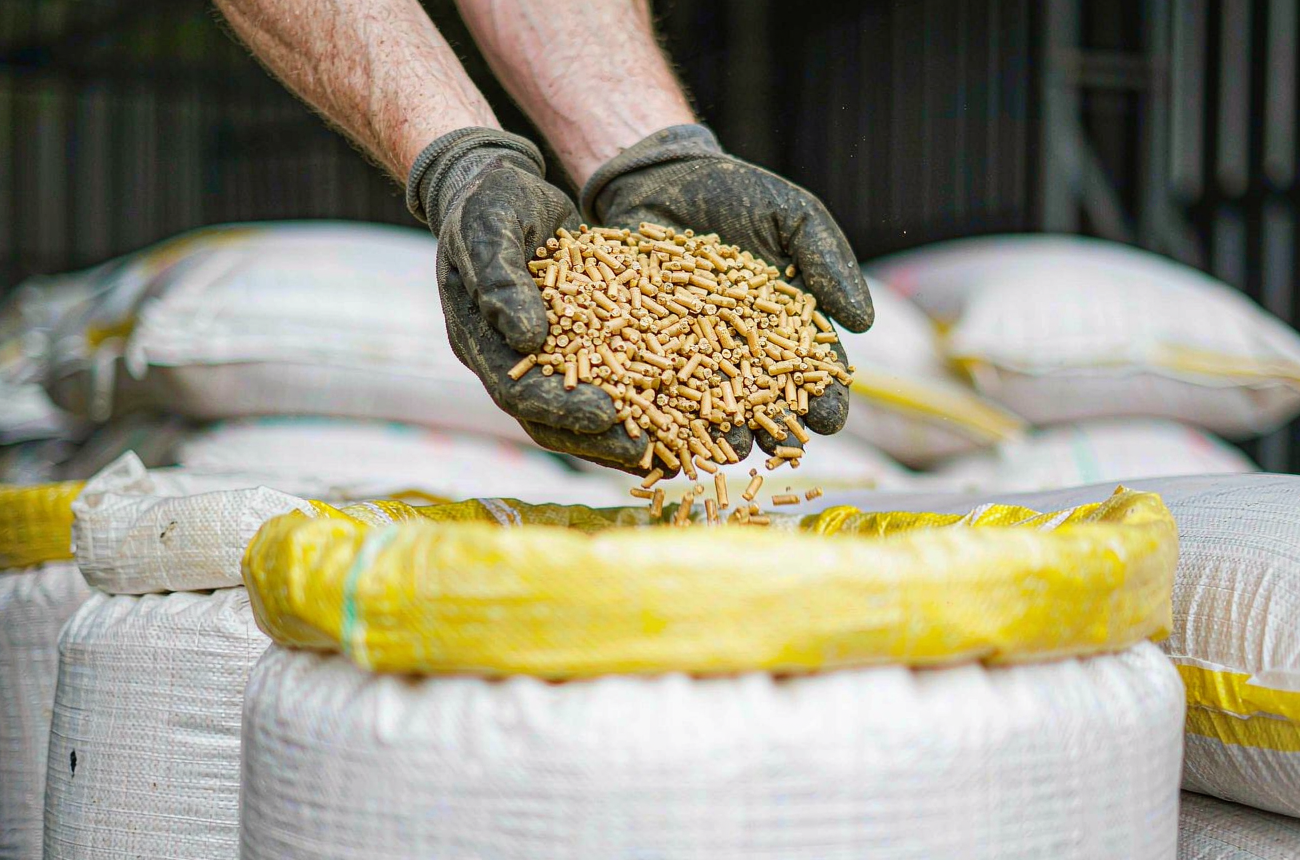
Once pressed, the two products travel differently. Pellets at ENplus bulk density of 600–750 kg/m³ flow through silos, pneumatic delivery lines and tankers, which is what makes bulk vessel shipment and automatic boiler feeding possible. Briquettes ride on pallets: stacked, wrapped and kept dry, loaded with a forklift, sold bag or shrink-wrapped. You gain the ability to sell by the pallet to retail, and you give up the entire bulk handling chain — there is no briquette tanker.
Moisture behaves differently too. Pellets have the tighter limit (10% against 12% for grade A1 briquettes), but both products are dry wood and both will pull water from the air. A wrapped pallet survives a damp dock; an open bag in a wet warehouse does not. Because briquettes are larger units, a wet outer layer does not mix through the stack the way it does in a pellet silo — you can often see and discard the damaged units, whereas moisture gain in a bulk pellet load is invisible until it reaches the boiler. Neither product should ever be stored uncovered outdoors, and both need airflow under the pallet to stop ground moisture wicking in.
For a plant planner, the storage consequence is simple: pellets want silos and flat storage with conveyor loading, briquettes want a dry, palletised warehouse with truck access — two different buildings attached to two different presses.
Which line should you build?
For most industrial projects we see, the answer is pellets, for three practical reasons. The automated heating market — where volume and repeat contracts live — is a pellet market. The logistics chain, from 1,000 kg bulk bags to vessel loading, is built around a flowable fuel. And the pellet line’s equipment (grinding, drying, ring die pressing, cooling, bagging) scales in proven steps from 1 t/h upward, which is what a financing partner wants to see; our wood pellet business guide walks through that build-up.
Briquettes make sense in three situations: your raw material is coarse and already fairly dry (fresh planer shavings, for instance), so the drying saving is real; your market is retail stove fuel with strong margins per pallet; or you want to monetise mill residue with minimal grinding infrastructure before committing to a full pellet line. Some plants do both, pressing pellets from the fines and briquettes from the coarser fraction — but that is two production lines, two quality systems and two markets, and it only pays when both sides have real demand behind them.
Claims versus what the standards say
Briquette marketing is full of confident sentences. Before you build a line around one, hold it against the actual documents.
| Claim you will hear | What the standards and data actually support |
|---|---|
| “Briquettes burn hotter than pellets.” | Standards set minimums, not superiority: ISO 17225-3 A1 requires ≥ 15.5 MJ/kg net as received, ENplus A1 requires ≥ 4.6 kWh/kg — essentially the same fuel energy per kilogram, with a small edge to the drier pellet limit. |
| “Briquettes are cheaper to produce.” | Partially supported: less drying and less fine grinding lower heat and power demand (NRCan). But slower, unit-based pressing can offset that at industrial tonnages. |
| “Any woody biomass can be briquetted.” | Only within the raw material classes of the standard: A1 is virgin wood and mill residue; bark, used wood and treated residues push you to A2 or B — and B is aimed at larger combustors, not retail bags. |
| “Briquettes can feed automatic boilers just as well.” | Not what the market does: automated feeding is built around pellet flow; briquettes dominate hand-fed appliances, and grade B targets larger combustors where feeding is engineered per plant. |
| “No certification needed for briquettes.” | Certification exists (DIN CERTCO against DIN EN ISO 17225-3) and retail buyers increasingly ask for it, especially in Europe. |
One last practical note from the factory floor: whatever product you choose, the press is only as good as the material preparation behind it — moisture and particle size decide quality long before the die or mould does. If pellets are your path, our complete production line page shows the full chain from chipper to bagging, and the Canadian Pellet Association’s industry resources are a useful window into how the export trade actually works. If briquettes are your path, visit a plant running your target raw material before you sign anything; the machines look simple and run unforgiving.