
Every fuel comparison starts with a table of calorific values, and that table is where most of them go wrong. Wood pellets at roughly 16–17 GJ per tonne against bituminous coal at close to 29 GJ per tonne looks like a knockout. It is not, because nobody buys gigajoules. Plants buy tonnes, burn them at some efficiency, and pay for the emissions that come out of the stack.
This is a working comparison for plant engineers and procurement teams who are being asked whether to switch, co-fire or stay on coal. The numbers come from published fuel data, and the arithmetic is shown so you can replace our price inputs with your own quotes.
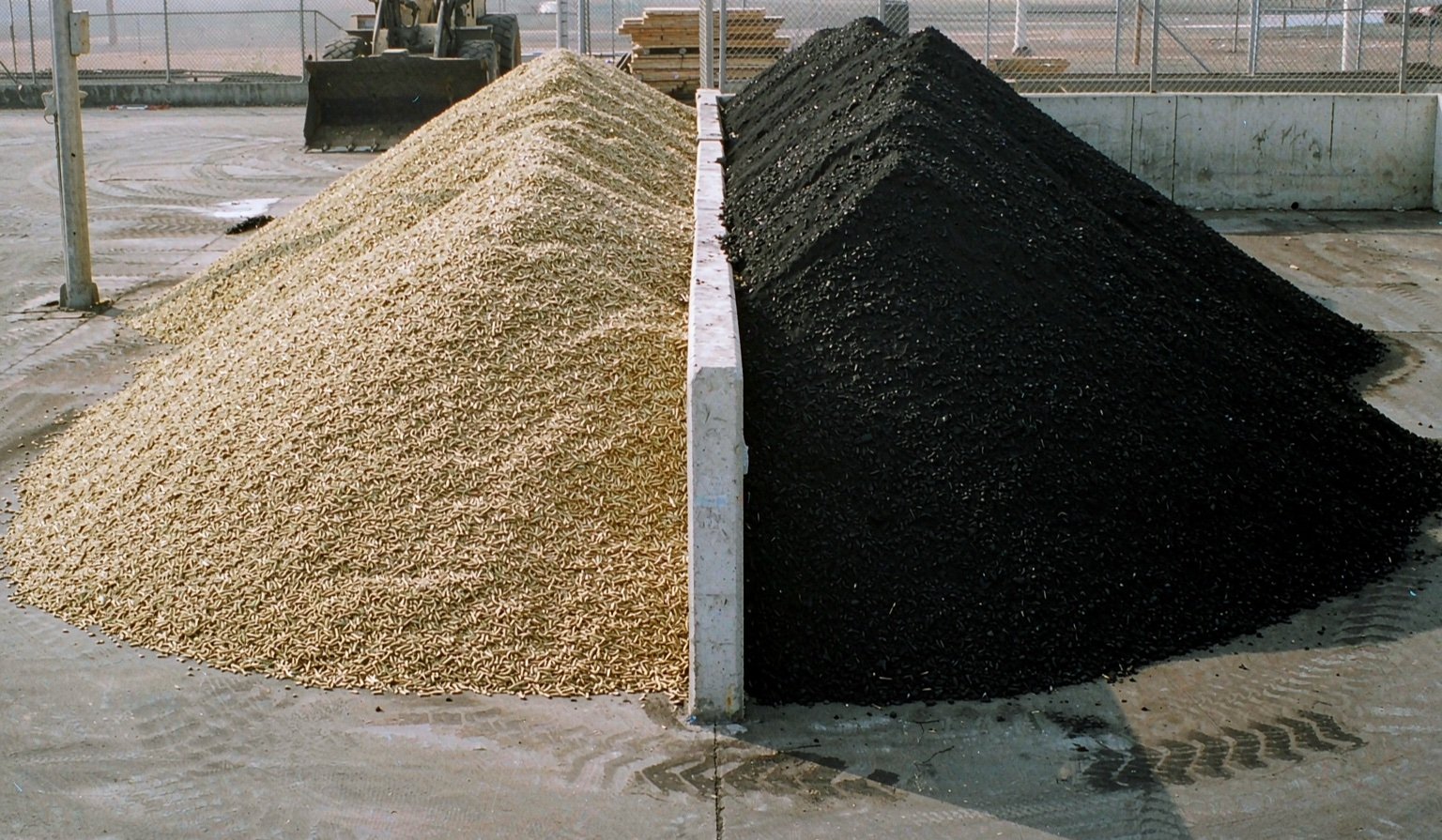
Two numbers decide the comparison
The first is energy per tonne, the second is energy per tonne of useful heat. The gap between them is boiler efficiency, and it is where most of the marketing claims quietly fall apart.
Pellet energy content is bounded by a standard, which makes it easy to work with. ENplus A1 requires a net calorific value of at least 4.6 kWh/kg, which is 16.56 GJ per tonne, with moisture at or below 10% and ash at or below 0.7% (ENplus Handbook v3.0, Part 3). That is a floor, not an average, but it is a defensible number to model with.
Coal is messier because rank matters. The US Energy Information Administration publishes carbon coefficients that let you back out the heat content of each rank, because the coefficient is given both per short ton of fuel and per million Btu of energy. Bituminous coal at 5,124.76 lb CO2 per short ton against 205.57 lb CO2 per million Btu implies about 25 MMBtu per short ton, or roughly 29 GJ per tonne. Subbituminous works out near 20 GJ per tonne, lignite near 16.5 (EIA, Carbon Dioxide Emissions Coefficients). The ranks themselves differ in carbon content and heating value in the way EIA describes for anthracite through lignite (EIA, Coal explained).
That last figure matters more than it looks. Lignite and wood pellets carry almost the same energy per tonne. A plant burning lignite is not making a dramatic energy-density sacrifice by switching. A plant burning high-rank bituminous is.
The fuel data, from primary sources
| Fuel | Energy, GJ per tonne | CO2 per GJ of fuel energy | Moisture | Ash |
|---|---|---|---|---|
| ENplus A1 wood pellets | 16.56 minimum | Biogenic, accounted separately | ≤ 10% | ≤ 0.7% |
| Bituminous coal | ≈ 29.0 | ≈ 88 kg | Varies by rank and washing | Varies, higher than pellets |
| Subbituminous coal | ≈ 20.1 | ≈ 92 kg | Higher than bituminous | Varies |
| Lignite | ≈ 16.5 | ≈ 93 kg | Highest of the ranks | Varies |
Two readings of this table are both correct and both incomplete. Pellets lose on energy per tonne against bituminous coal by a factor of about 1.75, which is a real logistics cost: you buy more tonnes, you need more silo volume, you make more truck movements. Pellets win on emissions per GJ by a wide margin in any accounting system that treats biogenic carbon as part of the short cycle, which is how the EU treats sustainable biomass (European Commission, Bioenergy).
What pellets do not do is emit zero CO2 at the stack. Wood contains carbon and burning it releases carbon dioxide. The climate argument rests on where that carbon came from and how fast it returns, not on the absence of the molecule. Buyers who repeat “carbon neutral” without that sentence are setting themselves up for an awkward meeting with a sustainability auditor.
Cost per GJ of useful heat, worked through
Here is the calculation that decides most projects. Take fuel price per tonne, divide by energy per tonne, divide by boiler efficiency. That gives cost per GJ of heat delivered.
Base case, and the assumptions are deliberately plain: bituminous coal at 90 USD/t, pellets at 180 USD/t, and the same 85% boiler efficiency for both so the comparison is about fuel and not about equipment claims.
| Step | Coal, bituminous | Wood pellets A1 |
|---|---|---|
| Delivered price | 90 USD/t | 180 USD/t |
| Energy per tonne | 29.0 GJ | 16.56 GJ |
| Cost per GJ of fuel | 3.10 USD | 10.87 USD |
| Cost per GJ of heat at 85% | 3.65 USD | 12.79 USD |
| Gap | 9.14 USD per GJ of heat, in favour of coal | |
| CO2 avoided per GJ of heat | ≈ 0.104 t CO2, using 88 kg CO2/GJ of coal energy | |
Divide the gap by the emissions and you get the carbon price at which the two fuels break even: about 88 USD per tonne of CO2 in this case. That is the honest headline. Pellets are not cheaper than coal on fuel cost. They become comparable when carbon is priced, or when the alternatives are worse for another reason.
The result moves with the inputs, so here is the same calculation across a range of prices. Each cell is the CO2 price, in USD per tonne, at which pellets match coal on cost per GJ of heat.
| Coal price | Pellets 150 USD/t | Pellets 180 USD/t | Pellets 220 USD/t |
|---|---|---|---|
| 70 USD/t | 75 | 96 | 123 |
| 90 USD/t | 67 | 88 | 115 |
| 110 USD/t | 60 | 80 | 107 |
Read it as a map rather than a forecast. In markets where carbon sits well below these figures, the switch is a compliance or sustainability decision, and it should be justified as one. In markets above them, it is a cost decision that happens to be green.
What coal gives you that pellets do not
Pretending these advantages do not exist is how feasibility studies get written and then quietly shelved.
Energy density and storage footprint. Replacing one tonne of bituminous coal takes about 1.75 tonnes of pellets, and pellets need roughly 1.3 to 1.7 m³ per tonne on the ENplus bulk density band. Your coal yard will not hold the same energy in pellets. Most conversions need either more storage or more frequent deliveries.
Supply depth. Coal has a global traded market with futures, indices and decades of logistics. Industrial pellet supply is thinner, more regional and more exposed to single-plant outages. A 12-month contract with one producer is a concentration risk that a coal buyer never had to think about.
Flame temperature and ash chemistry. High-temperature processes such as cement kilns and glass furnaces rely on flame conditions and ash behaviour that biomass does not reproduce. Biomass ash also carries alkali and chloride that behave badly in kiln systems. This is why cement decarbonisation projects usually go to alternative raw materials and fuels other than plain wood pellets.
Handling behaviour. Pellets are soft, friable and hygroscopic. Coal is forgiving. Every transfer point in your yard becomes a fines generator and every open store becomes a moisture risk, which means the conversion is a materials-handling project before it is a fuel project.
What pellets give you
Ash volume. ENplus A1 caps ash at 0.7%, and good A1 material runs below that. Coal produces ash at a multiple of that rate, and the ash has to be handled, landfilled or sold. For plants paying for ash disposal, the saving is real and often underestimated in the fuel-only comparison.
Sulphur and SO2. Coal combustion produces sulphur dioxide and needs control equipment or low-sulphur coal to meet limits. Wood carries very little sulphur, so a pellet boiler usually meets SO2 limits without flue gas desulphurisation. That removes a capital item and a consumable cost from the equation.
Carbon accounting. Under EU rules, sustainable biomass counts as renewable and its combustion emissions are reported in the biogenic stream rather than as fossil emissions (European Commission, Bioenergy). For a plant with a customer asking for Scope 1 reductions, that accounting change is often worth more than the fuel saving.
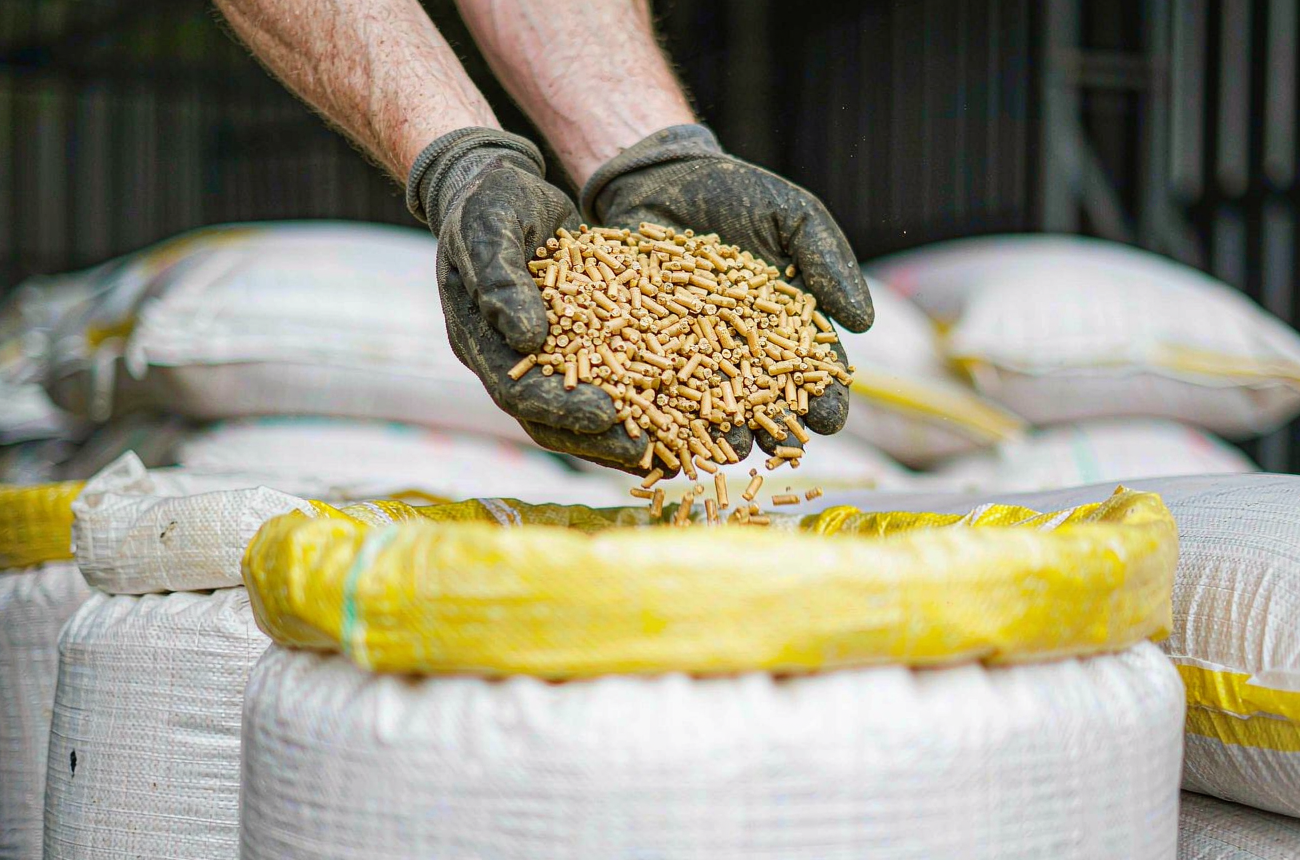
Certification you can audit. A certified supply chain gives your sustainability team something concrete to attach to the claim. ENplus covers quality; SBP-style schemes cover sourcing. Neither exists in the coal chain.
Co-fire first, convert later
Full conversion is a capital project. Blending is an operating change, and for many plants it is the sensible first step: a 10% blend by energy reduces coal CO2 by roughly 10%, proves the receiving, storage and feeding systems, and gives the boiler operator real data before anyone signs a purchase order for a new combustion system.
Blending has its own discipline. Pellets and coal do not behave the same in a mill or a feeder, and the blend ratio that works in a trial may not hold at full load. If you go this route, size the pellet store next to the coal yard rather than inside it, keep the two fuels separate until the burner, and meter each stream so you know what you actually fired.
If you are building the pellet supply side at the same time, the line configuration and the machine cost structure determine the delivered cost that goes into the table above. Certification is the other half: what ENplus A1 actually requires decides whether your pellets can be sold into the premium market or only into industrial co-firing.
Three cases where switching is the wrong move
Most articles like this end with a recommendation to switch. Here is the opposite, because a bad conversion costs more than a delayed one.
1. Your boiler is pulverised coal and your only pellet source is 400 km away. Pulverisers are built for brittle fuel. Pellets are fibrous and soft, and they arrive with a moisture spec that your coal handling was never designed around. If the fuel has to travel and be re-handled twice before it reaches the burner, the logistics cost will eat the carbon case.
2. You need high flame temperature. Cement, lime, glass and some metallurgical processes need conditions that wood pellets do not deliver, and the alkali in biomass ash creates operational problems downstream. Electrification, alternative fuels or CCS are usually better routes for these plants than pellet substitution.
3. Carbon is unpriced and your coal is cheap. At a coal price of 70 USD/t and pellets at 220 USD/t, the break-even carbon price is above 120 USD per tonne, as the table shows. A plant in that position that converts on fuel economics alone is buying an expensive sustainability story. Convert because a customer, a lender or a regulation requires it — and say so in the business case.
If none of those three apply, the comparison is worth running properly with your own numbers. Start with delivered price per tonne, not headline price, and use the energy and emissions figures from the standards rather than a supplier brochure. The arithmetic is simple. The inputs are where projects are won and lost.