
A buyer sent us two inquiries last month. Same week, same country, same species of pine sawdust. One asked for a quote on a 500 kg/h flat die mill. The other asked for our YPM630 vertical ring die machine at 1–1.5 t/h. Both had read the same forum posts and both were confused about whether the “better” machine was worth the money.
The honest answer is that neither machine is better in the abstract. A flat die mill and a ring die mill solve different problems, and the cost difference between them is only justified when your throughput, your feedstock, and your market push you past a fairly predictable threshold. This article walks through that threshold with real numbers: our own machine prices, the pellet quality limits European buyers test for, and the market data behind the demand side.
Two designs, two force paths
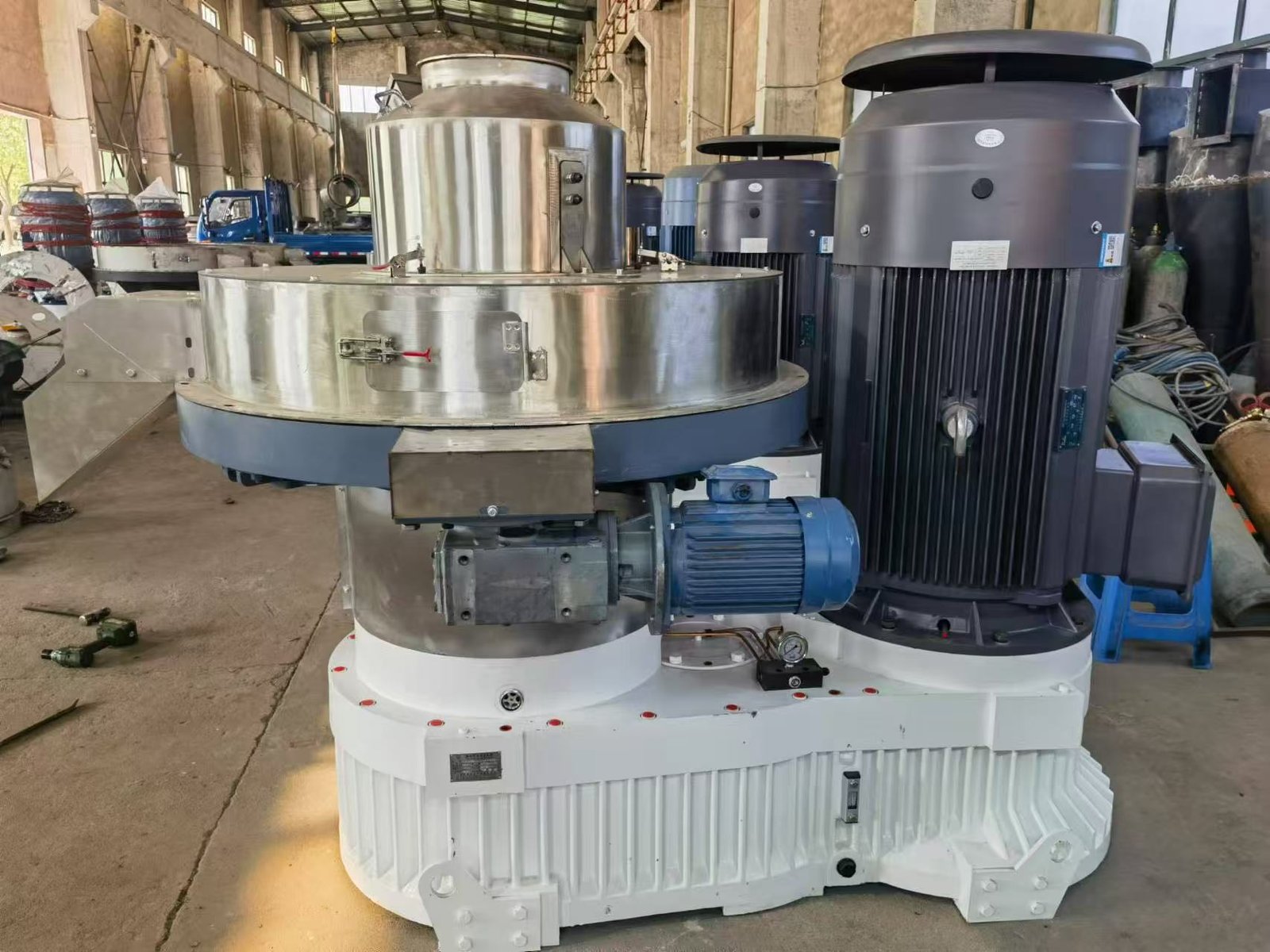
In a flat die mill, a horizontal steel disc carries the die holes. Rollers ride on top of the disc and press material downward through the holes. Gravity does the feeding. The design is simple, the rollers and die are easy to swap, and a workshop with basic tools can strip one down in an afternoon.
A ring die mill works the other way around. The die is a rotating cylinder, the rollers sit inside it, and material is pressed outward through the die wall. Because the entire inner circumference of the ring is working at once, the compression area is much larger than on a flat disc of comparable diameter. That single geometric fact drives most of the differences that matter to a buyer: throughput, energy per tonne, die life, and pellet consistency.
Vertical ring die machines — the category our YPM630 and YPM850 belong to — add one more twist. The die stands upright and material drops into the chamber by gravity, so the machine tolerates slightly less-than-perfect feed preparation and sheds heat better than a horizontally fed press. Feed mills in Europe mostly run horizontal ring die presses; in China and much of Southeast Asia, vertical ring die designs dominate wood pellet work because they are forgiving with fibrous, variable sawdust.
What changes when you cross the half-tonne line
Capacity is the clearest dividing line. A flat die press is mechanically limited by how much disc area a pair of rollers can sweep. Past roughly half a tonne per hour, you are either running an oversized disc at high wear or stacking multiple machines. Ring die presses scale differently: bigger ring, more rollers, more power, and the compression geometry stays efficient.
This matters now more than it did five years ago. Global wood pellet production reached 53.5 million tonnes in 2025, up about 10% from 2024 — the strongest annual growth the sector has recorded recently, according to Bioenergy Europe’s 2026 Statistical Report. Asia grew fastest of all regions, with output up 16% year on year, driven by Vietnamese, Malaysian and Thai exporters supplying Japanese and Korean power plants, as Argus reported from the same dataset. Plants competing in that export market are not building 500 kg/h lines. They are building 2–6 t/h lines around ring die presses.
Here is how the three configurations compare using our own product range, since supplier specifications are the only numbers we can vouch for completely:
| Factor | Flat die | Horizontal ring die | Vertical ring die |
|---|---|---|---|
| Typical single-machine output | Below ~1 t/h (supplier catalogs generally position it for small-scale work) | 0.1–6 t/h (our YPM250 through YPM800 series) | 1–5 t/h (our YPM630 and YPM850) |
| Feeding method | Gravity onto a rotating disc | Forced screw feeder into the die chamber | Gravity drop into an upright die chamber |
| Working compression area | Small — one disc face | Large — full inner ring circumference | Large — full ring, double-sided dies on many models |
| Heat behavior | Poor — die overheats in long runs | Good with cooling oil circulation | Good — vertical chamber vents heat naturally |
| Die change | Quick, light parts | Heavier, alignment-sensitive | Double-layer dies flip for a second working face |
| Best fit | Workshops, farms, pilot lines | Commercial plants, feed and fuel | Continuous wood pellet production, fibrous feedstock |
One caution on that table: catalog capacities assume ideal feed. Real output depends on your moisture control, particle size, and how many hours a day the mill actually runs. We tell every buyer the same thing — quote capacity against your own material, not against a brochure.
The price gap, stated honestly
Flat die machines cost less. There is no way around that, and anyone who tells you a ring die press “pays for itself instantly” is selling something. What you deserve is a clear picture of what the premium buys.
Our own price list makes the gap concrete:
| Machine | Type | Capaciteit | Indicative price (FOB) |
|---|---|---|---|
| Small flat die units (typical market range) | Flat die | 100–500 kg/h | A few thousand USD — quotes vary widely between suppliers |
| YPM630 vertical ring die | Vertical ring die | 1–1.5 t/h | $19,800–25,800 |
| YPM850 vertical ring die | Vertical ring die, 280 kW | 4–5 t/h | $48,800 |
| YPM420 horizontal ring die | Horizontal ring die, 90 kW | 0.9–1.2 t/h | On request |
| YPM800 horizontal ring die | Horizontal ring die, 315 kW | 5–6 t/h | On request |
So the step from a small flat die setup to a 1–1.5 t/h vertical ring die press is roughly a factor of three to five on the machine price. The step from 1.5 t/h to 4–5 t/h is less than double — capacity pricing is not linear, which is one reason under-buying a mill “to start small” often costs more per tonne than buying the right size once.
What the premium actually buys: a compression system that holds quality across a full shift, die surfaces that keep working for hundreds of hours instead of tens, and a machine that does not need babysitting every time the feedstock shifts slightly.
Cost per tonne: where the ring die earns its premium back
Buyers fixate on purchase price. Plants that survive think in cost per tonne. The difference between the two machines shows up in four places:
Labor per tonne. A 1.5 t/h ring die line with one operator produces roughly three times what a 500 kg/h flat die setup produces with the same operator. Your wage cost per tonne falls with it.
Die and roller consumption per tonne. Consumable cost is where cheap mills quietly lose money. A flat die working at its capacity limit wears fast, and when you divide consumable spend by the small tonnage it produced, the cost per tonne often exceeds that of a bigger press running relaxed. On our own service records, customers running clean pine sawdust through a YPM630 get far more working hours from a die set than flat die users get from discs at equivalent total tonnage. We won’t quote you universal hour figures — die life depends on your material, your cleanliness, and your moisture discipline — but we do put it in writing: ask any supplier to state expected die life on your feedstock, with a sample pelletizing test if possible.
Energy per tonne. A larger ring die press distributes compression over more working area, so less of the motor’s work turns into friction heat and wasted motion. Independent reviews of pelletizing technology, such as the Biomass Connect technical guide on pelletisation, describe how pressure, die geometry and material properties interact to determine both pellet quality and the energy needed to achieve it. The practical takeaway for a buyer: two machines making the same tonnage can draw very different power, and the difference compounds over every shift.
Downtime per month. Simplicity is a genuine advantage of flat die machines — but only at low duty. A workshop running four hours a day benefits from quick disc swaps. A plant running two shifts loses money every time the press stops, and ring die machines with automatic lubrication and forced feeding are built for that duty cycle.
Pellet quality: the tests buyers actually run
If you plan to sell pellets beyond your local boiler market, quality limits are not negotiable. The ENplus scheme — the quality certification most European buyers ask for — sets a mechanical durability requirement of at least 98.0% for its A1 grade, alongside limits on moisture, ash, fines and bulk density, all specified in the ENplus Handbook and built on ISO 17225-2.
Durability is where die type matters most. The repeated, even compression inside a ring die consolidates particles along the whole die wall, producing pellets that survive trucking and bagging with fewer fines. Flat die presses can hit good durability on easy materials at low throughput, but holding 98% across a full production day — with feed moisture drifting, ambient temperature changing, die surfaces wearing — is materially harder on a small disc.
Nobody should take our word for it, or any manufacturer’s word, as proof. What we recommend to every exporter-bound customer: run a pelletizing test on your actual material before you buy anything, and have an independent lab test mechanical durability to ISO 17831-1. One test report is worth more than ten brochures.
Feedstock decides more than the die does
We have watched buyers agonize over die type while treating feedstock as a footnote. It is the other way around. Pelletizing works when the material is dry enough, small enough, and has enough natural binder to fuse under pressure and heat. Research summaries such as the Biomass Connect pelletisation guide put the practical moisture window for pelletizing at roughly 10–15%, with quality falling off outside it. Material much wetter steams and swells in the die; material much drier lacks the water that helps lignin flow and bond.
| Feedstock | What it needs before the die | Machine recommendation |
|---|---|---|
| Clean dry sawdust (furniture mills) | Often none — screen and feed directly | Flat die workable below 500 kg/h; vertical ring die above it |
| Wet sawdust, sawmill residue | Rotary drying to the moisture window | Vertical ring die; pair with a roterende droger |
| Wood chips, branches, logging waste | Chipping, then hammer milling, then drying | Ring die line with hammer mill and chipper upstream |
| Rice husk, palm fiber (EFB), straw | Size reduction, tight moisture control, abrasion-resistant dies | Vertical ring die with hardened dies; expect faster die wear |
| Mixed or contaminated yard material | Screening, stone removal, metal magnets | Ring die line with full pre-processing |
Agricultural residues deserve a specific warning. Silica in rice husk and straw grinds die steel aggressively, and low lignin content in straw weakens pellet bonding compared with softwood. A flat die can process them in small batches; a plant doing it commercially needs a ring die press with dies specified for abrasive material, and it needs to budget for more frequent die replacement than a sawdust plant would.
Die life, spare parts, and the true cost of a cheap mill
The mill itself is a one-time cost. Dies, rollers, bearings and seals are a forever cost, and this is where cheap machines turn expensive. Three questions separate a sound purchase from a regret:
Who makes the die? Dies drilled on CNC gun drills and heat-treated in vacuum furnaces hold hole geometry and surface hardness far longer than dies finished on conventional equipment. We machine our own ring dies this way, and we can show material certificates — ask any supplier you evaluate to do the same.
Can you get spares fast? A die set that takes three months to arrive turns a consumable into a shutdown. Before you sign anything, get the spare parts price list and the shipping commitment in writing.
What does the warranty actually cover? “One year warranty” means different things to different suppliers. rollers and dies are wear parts and usually excluded; motors and gearboxes are not. Read the exclusions before you compare prices, because a quote without exclusions listed is not a comparable quote.
Power supply and installation realities
Machine price is not the whole capital picture, and the difference between die types extends to the building around them. A YPM850 draws 280 kW at the main motor alone; add the feeder, lubrication and conveyor loads, and the connected power of a 4–5 t/h line reaches well past 300 kW. Flat die machines in the small commercial range can sometimes run from a generator or a modest rural supply, which is genuinely useful in places where grid upgrades take years.
Ask yourself three installation questions before choosing. First, what can your electrical connection actually deliver — not today, but after the second machine arrives? We have seen buyers order a small mill because their transformer could not support a larger one, then pay twice for the upgrade anyway. Talk to your utility before you talk to a machine supplier.
Second, who will install and commission the line? Ring die presses arrive heavy and alignment-sensitive; the foundation, the anchor bolts, and the alignment of upstream conveyors all affect die life. Our standard practice is on-site installation and commissioning with operator training included, and we recommend buyers weight that service heavily when comparing suppliers. A cheaper machine installed without commissioning support often produces worse pellets than a costlier machine set up properly.
Third, what floor space and headroom does each option need? Vertical ring die machines carry a compact footprint for their capacity, while horizontal presses with forced feeders and conditioners need more length. Flat die machines win on floor space, but at capacities where floor space is the binding constraint, you are usually below the throughput where a ring die press would pay off anyway.
How to compare quotes fairly
Once you collect quotes from several suppliers, resist the urge to sort by price. Quotes for the same nominal capacity can differ by 30% and deliver completely different value. Make them comparable instead:
Normalize the Incoterm. One quote on FOB and another on CIF are not the same offer. Ask every supplier to restate their offer on the same basis, then compare machine-to-machine.
Compare scope, not machines. Does the quote include the feeder, the lubrication system, the electrical cabinet, spare parts for commissioning, and installation? A press quoted without its feeder is not a working press. List what each quote contains and price the gaps separately.
Ask for component specifications in writing. Motor brand, bearing brand, die material and heat treatment method, gearbox type. Two machines can share a capacity rating while carrying completely different componentry — and those components are what you will be maintaining for a decade.
Request the wear-parts price list with the offer. Suppliers who publish die and roller prices upfront are usually confident in their consumption rates. Suppliers who dodge that question are telling you something about the total cost of ownership.
Weight the test run over the brochure. Any serious supplier will run your material — or a close substitute — through their workshop machine and send you the pellets plus a process log. Judge the offer on that sample, the supporting data, and how precisely the sales engineer answers your questions. Vague answers before the sale become vague answers during commissioning.
Three buying scenarios we see every month
Scenario one: a furniture workshop with dry waste, selling heat locally. Output target under 500 kg/h. Material is clean, dry, consistent. A good flat die mill is the rational choice here. The ring die premium buys nothing the market rewards, and the workshop’s maintenance crew can service a flat die without specialist help.
Scenario two: a sawmill with 2,000 tonnes a month of wet sawdust, targeting ENplus-grade bags for the domestic market. Drying is mandatory, so budgeting a full line is already on the table. At 1–2 t/h, a vertical ring die press is the safer bet: it holds durability through feed variation, its dies last, and the same press will still be the right machine if the plant doubles in three years. We would not build this plant on stacked flat die machines — synchronizing several small presses costs more in labor and fines than one press of the right size.
Scenario three: a Vietnamese exporter shipping industrial pellets to Japanese utilities. Contract specifications, continuity of supply and audit-ability dominate. This is ring die territory without qualification — typically multiple YPM850-class presses in parallel, so one machine down never stops the vessel. Flat die machines do not appear in serious industrial supply contracts, and no amount of capital savings justifies showing up to a contract negotiation with a workshop-grade machine.
Notice the pattern. Die type follows the market you sell into. Choose the market first, the feedstock second, and the machine third — in that order, and the decision usually makes itself.
Frequently asked questions
Can a flat die mill make ENplus A1 quality pellets? It can on easy, clean, dry softwood at modest throughput, and some small producers do. The difficulty is holding durability above 98.0% consistently across shifts and die wear. If certification is your goal, test before you commit.
Is a vertical ring die mill better than a horizontal one? For wood pelletizing, vertical machines handle fibrous and slightly inconsistent feed better and dissipate heat well. Horizontal ring die presses dominate feed pelletizing and very large lines. Both make good pellets when set up correctly.
What capacity should I buy if I’m unsure? Buy against your verified feedstock supply, not your ambition. A press running at 60% load because material runs out is a worse investment than a smaller press running full. Size the line to the tonnes you can actually collect.
How much does a complete line cost beyond the press? Dryer, hammer mill, cooler, screener, and packing usually add up to a multiple of the press price depending on how wet and how coarse your raw material is. Ask for a line-level quote, not a machine-level one.
Do you supply dies for other brands of machines? Yes — we manufacture ring dies to drawing. Send us the die drawing or the machine model and we’ll quote.
We already own flat die machines. Do we have to scrap them? No. Flat die presses keep earning in the roles that suit them — small-batch production, trial runs on new materials, or a second small product line such as barbecue pellets. Many plants grow by adding a ring die press for volume while the flat die units handle specialty work. The mistake is expecting workshop machines to carry a commercial contract; the machines themselves are not the mistake.