
Fines are the quiet tax on every pellet plant. They don’t show up on the invoice the day they’re made, but they show up later: as a discounted price at the gate, as a rejected container, or as a boiler operator complaining about smoke. If you’re buying equipment for a new line — or retrofitting an old one — the screening stage deserves more attention than it usually gets on a quotation.
This guide covers the whole fines problem: where they come from, what ENplus certification actually demands from a screening system, how vibrating and rotary screeners differ, how to size one to your line, and what a screening investment returns. The numbers below come from the ENplus handbook, published research and supplier data — I’ve linked every source so you can check it yourself.
Why fines decide your price
“Fines” means particles passing a 3.15 mm sieve, measured by ISO 18846 with a round-hole screen, a recommended 400 mm sieve diameter, horizontal circular sieving motion and a balance reading to 0.1 g. It’s the definition that appears in every pellet contract, so memorise the 3.15 mm cut — everything in this article hangs on it.
ENplus A1 sets two limits. For pellets delivered in bags, the fines content must not exceed 0.5 wt-%. For bulk deliveries the limit is 1.0 wt-%. Those figures come from the ENplus Quality Certification Scheme handbook, and they are checked daily at bagging stations — more on the monitoring schedule below.
Why so strict? Because fines burn badly. Shandong Changsheng, a pellet machinery maker that publishes field data, notes that fuel with more than 5% fines causes higher emissions, clinker formation and reduced boiler efficiency in their troubleshooting documentation. A residential customer with a smoking boiler doesn’t renew the order; an industrial buyer with emission limits has a compliance problem.
The commercial gap between a clean product and a dusty one is real. Changsheng’s worked example compares a pellet discounted for quality against one sold at an A1 premium of €30 per tonne; at 5,000 tonnes a year, the clean product earns €150,000 more, against a fix that cost roughly €6,000 (a reconnected screener, a belt conveyor and operator training). That’s a return most equipment upgrades never touch.
| Parameter | ENplus A1 (bagged) | ENplus A1 (bulk) | Where it’s checked |
|---|---|---|---|
| Fines ≤3.15 mm | ≤0.5 wt-% | ≤1.0 wt-% | Last point before bagging / loading |
| Separation duty for traders | Must cut fines from up to 10 wt-% down to below 1.0 wt-% | Storage discharge | |
| Outgoing pellet temperature | ≤40 °C at loading | Loading station | |
| Self-monitoring frequency | Daily at <1 t/min loading speed; weekly above 1 t/min | Each loading/bagging site | |
The last two rows come from ENplus ST 1001, the trader-standard change document (ST 1001 PDF). Read them again before you skip the “trader” part — if you ever load bulk trucks or fill big bags for someone else, those rules apply to your plant, and auditors treat the screening device as named equipment.
Where fines actually come from
You can’t screen your way out of a production problem, so start by mapping the sources. In my experience they break down into five, roughly in this order of importance:
1. Moisture that’s wrong at the mill. Weak, under-compressed pellets shed fines everywhere downstream. If your die conditioning is off, the screener just becomes a meter that measures your problem. Our article on why wood pellets crumble covers the causes in detail.
2. Die wear. Oval, worn die holes reduce compression pressure and produce soft pellets. Changsheng’s guidance is to replace the die when output drops about 20%, and keep the roller gap at 0.1–0.3 mm. A die audit is free; a screener is not.
3. Cooling stress. Pellets whose core is still hot when they leave the cooler crack later, as residual steam escapes. Changsheng recommends cooling to ambient +5 °C with a retention time of 10–15 minutes. If your cooler can’t hold that, see our piece on pellet cooler problems before spending money on sieves.
4. Mechanical handling. This is the one buyers forget. Every drop, every transfer point, every flight of a screw conveyor abrades pellets. Changsheng’s figure: screw (auger) conveyors add 2–5% fines while belt conveyors add roughly 0.5%. Over a long transfer run, the conveyor choice alone can put you over the 1.0% bulk limit. Drop heights, chute linings and the number of transfers matter as much as the conveyor type. There’s a measurement trap here too: fines riding in the product inflate the apparent bulk density, so a dirty lot can look denser than it is — our guide to wood pellet bulk density explains why a dusty sample reads heavy.
5. Storage degradation. Pellets keep breaking down in the bag and the silo. A controlled storage study published in Polymers measured mechanical durability falling by up to 2 percentage points over 30 days of humid storage, and showed that freeze–thaw cycling alone cost up to 4.3 points (Polymers 2020, 12, 970). Broken pellets are fines. So the fines content at bagging is a snapshot, not a permanent property — which is exactly why ENplus forces traders to screen again before loading.
One more subtlety: pellet length. A study in Energies showed that the measured durability index — and by extension the fines generated in the test drum — depends on the length distribution of the sample (Energies 2020, 13, 3000). Long, fragile pellets snap in handling; a consistent knife setting on the mill reduces the long-tail that ends up as dust.
What ENplus demands from a screening system
If you pursue certification, the screening device stops being optional hardware and becomes a specified, audited asset. From the handbook and ST 1001, here is the practical reading:
Duty: the device must be “constructed to reduce the share of fines from 10.0 wt-% to below 1.0 wt-%” in day-to-day operation. That’s a design brief, not a suggestion — your screener has to handle a dirty feed and still discharge under 1%.
No storage after separation. Pellets may not be stored once fines have been removed, except in a hopper or big bags. The logic is simple: separated product left in a pile regenerates fines through its own weight and handling. If you install a hopper under the screener, it must be emptied periodically — once after ten times its volume has passed through it, and if the hopper is bigger than 20 tonnes, completely discharged every 200 tonnes.
Monitoring: at loading stations, fines are checked once per day when the loading speed is under 1 tonne per minute (or can’t be verified), and once per week above that rate. At bagging stations, the handbook requires mechanical durability and fines testing at the last possible point after separation and before bagging, at least once per operating day.
Temperature interlock: outgoing pellet temperature is measured during loading and must not exceed 40 °C. Screening hot pellets also matters for a second reason: warm pellets are softer and abrade faster on the deck, so a hot feed inflates your own fines reading.
| ENplus requirement | What it means for your equipment list |
|---|---|
| Reduce 10 wt-% → <1.0 wt-% | Screener must be sized for worst-case dirty feed, not average |
| No storage after separation | Direct discharge to bagging/loading, or a small hopper with enforced discharge schedule |
| Hopper >20 t: discharge every 200 t | Consider keeping the under-screener hopper small to make the rule easy |
| Fines test daily (<1 t/min) or weekly (>1 t/min) | Budget a sieve set, a balance and a sampling routine in the lab |
| Bagging station: DU + fines daily before bagging | Sample point after the screener, not in the silo |
| Outgoing temperature ≤40 °C | Screen only cooled pellets; add a thermometer to the loading routine |
Vibrating vs rotary screeners
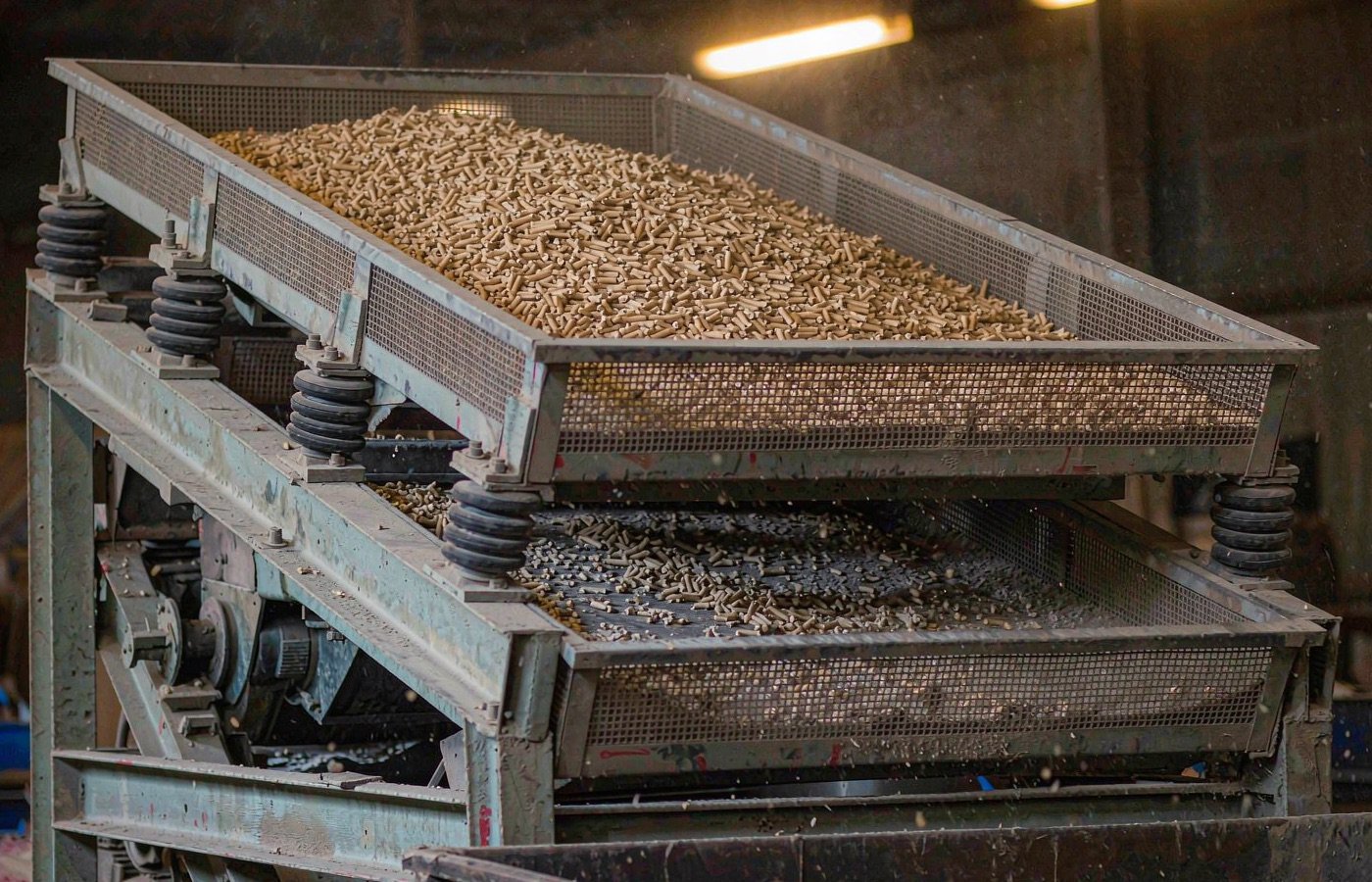
Two machine families dominate pellet plants. Linear vibrating screeners use twin vibration motors to throw material forward in a straight line across one or two decks — compact, cheap, easy to seal. Rotary (gyratory “sifter-style”) screeners use an eccentric drive to move the screen box in a gentle circular motion — larger footprint, higher capacity per deck, less violent on the product, and generally quieter.
To make the comparison concrete, here are published model tables from two Chinese suppliers. Treat them as market-typical, since every brand rescales these numbers to its own deck sizes.
Vibrating screeners (Rotex Master data)
| Model | Power (kW) | Capacity (t/h) | Screen size (m) |
|---|---|---|---|
| SKFZ60×2C | 0.25 | 1–2 | 1.0 × 0.6 |
| SFJZ80×2C | 0.25 | 2–4 | 1.5 × 0.8 |
| SFJZ110×2C | 0.37 | 3–6 | 1.8 × 1.1 |
| SFJZ150×2C | 0.37 | 5–10 | 2.2 × 1.5 |
Source: Rotex Master’s published specification sheet on china.cn. Note how little power these machines draw — even a 10 t/h screener needs less than half a kilowatt. The energy cost of screening is negligible; the cost of not screening is not.
Rotary screeners (Iklay / Yufeng data)
| Model | Power (kW) | Pellet capacity (t/h) | Decks |
|---|---|---|---|
| SFJH80×2C | 1.5 | 5–6 | 2 |
| SFJH110×2C | 2.2 | 8–10 | 2 |
| SFJH130×2C | 3.0 | 10–12 | 2 |
| SFJH150×2C | 5.5 | 20–23 | 2 |
Source: Iklay Machinery’s specification table on Made-in-China (pellet-feed column). For the same nominal throughput, rotary machines cost more and take more room, but they handle surges better and generate less product abrasion because the motion is gentler than a linear vibrator’s throw.
My recommendation for most lines under 3 t/h: a two-deck linear vibrating screener is the right balance of cost, simplicity and spare availability. Above 5 t/h, or where the feed is expected to be dirty (say, product reclaimed from silo bottoms), a rotary screener earns its price. European integrator AM Tehnolog, which builds 1–4 t/h vibro sieve stations into its lines, describes the target simply: ENplus requires under 1% fines in the finished product (AM Tehnolog).
Mesh size and the cut point
The 3.15 mm definition tells you where the fines deck should sit, but a good screener usually cuts twice: once to remove dust and fines, once to remove oversize (long pellets, lumps, anything that jammed through the die). Changsheng’s published guidance on mesh choice: 3 mm wire mesh for fuel pellets, 2 mm for feed pellets, 4 mm where the product is bedding and coarser rejects are acceptable. For ENplus fuel work, spec the fines deck at 3.15 mm so the plant’s QC number and the screener’s physical cut match — otherwise your daily bagging test and your machine are measuring different products.
The oversize deck is usually 6–8 mm or a slotted screen that catches long pellets but lets 6 mm diameter product through. Oversize isn’t waste: crushed and returned to the hammer mill, it re-enters production. Decide that route at design time, because oversize that accumulates in a corner becomes moisture hazard and fire load.
Deck loading matters as much as mesh. An overloaded deck lets fines ride out with the good product; a starved deck wastes screen area. The usual fix is a distribution feed — a static spreader or a small feeder belt — so the bed is thin and even across the full width. Ask any screener supplier for their recommended bed depth at your capacity, and check it during commissioning.
Sizing the screener to your line
Three steps, in order:
1. Size for the dirty case. ENplus assumes the separation device must handle 10 wt-% incoming fines. If your mill in bad conditions emits 5%, and silo reclaim can run higher, quote the screener at the peak, not the average. A screener rated exactly at the mill’s nameplate capacity will flood on the first bad day.
2. Match the deck to the cut. Fine cuts need more open screen area than coarse ones. For a 3.15 mm cut at 5 t/h, the 2.2 × 1.5 m deck of the SFJZ150-class machine is comfortable; the 1.0 × 0.6 m entry model is not. When in doubt, buy the bigger screen area — deck area is the cheapest insurance in the plant.
3. Keep the fines path short. Separated fines should drop into a closed bag or hopper directly under the deck, not onto a shared conveyor where they remix. The ENplus “no storage after separation” rule exists precisely because fines re-mixing defeats the whole exercise.
A note on placement: the screener belongs between the cooler and the bagging/loading point — never before the cooler, where hot soft pellets shed dust on the deck and blind the mesh. If your layout forces screening after a long screw conveyor, revisit the conveyor choice first; Changsheng’s 2–5% auger penalty can exceed everything else on this list.
What screening returns
Put the money math in front of anyone who questions the line item. Changsheng’s example, again: a plant at 5,000 t/year loses a €30/t premium for quality; reconnecting an idle screener, adding a belt conveyor and retraining staff cost around €6,000 and restored the premium — a 20% one-year ROI framing on that spend, worth €150,000 annually. Your numbers will differ, but the shape doesn’t: the premium on certified, low-fines product dwarfs the cost of the screening stage, which on small machines runs well under €10,000 before installation.
There are hidden returns too. Fines sold as sawdust fetch a fraction of pellet prices. Fines left in bags generate warranty claims and boiler complaints. And dust around a bagging station is a combustible-dust hazard — regulators including the US OSHA treat combustible dust as an recognized deflagration risk, so dust that escapes the screener ends up as an inspection topic.
Where to put the screener: three layout patterns
Position matters as much as machine choice, and most plants end up choosing between three placements — each with a different failure mode.
Pattern A: between cooler and bagging silo. This is the textbook placement and the one ENplus auditors expect. Cooled, hard pellets cross the deck, fines drop into a closed hopper, clean product rises into the bagging silo. The weakness: if the silo itself is dirty — reclaimed product, old dust on walls — you screen and then re-contaminate. Keep the silo clean and this pattern works.
Pattern B: direct over the bagging line. Screener discharge feeds the bagger’s hopper through a short belt. Best for plants without a bagging silo, and it satisfies the “no storage after separation” rule almost by accident. The trade-off is surge tolerance: the bagger and the screener must track each other, so add a small buffer hopper (kept small to respect the ENplus discharge schedule) between them.
Pattern C: at the loading station. For plants that sell mostly bulk, a screener on the truck-loading line implements the ENplus trader requirement directly. Note the monitoring frequencies from ST 1001 apply here — once per day below 1 tonne per minute of loading speed, once per week above it — and the temperature check rides on the same sampling routine.
Whatever the pattern, keep one principle: the 3.15 mm cut must be the last thing that touches the product before it leaves. Every transfer after the screener adds fines back — Changsheng’s auger-versus-belt data makes the point plainly. If a maintenance crew reroutes a conveyor and pushes product through a screw conveyor after the screener, your certified number is gone by the time it reaches the truck.
Commissioning: what to test before sign-off
A screening installation isn’t finished when the machine is bolted down. Run these checks before you accept it:
- Dirty-feed test. Blend fines back into a batch at 8–10 wt-% and run the machine at full rate. Sample the discharge: if clean product reads above 1.0%, the deck is overloaded or under-screened — fix it now, not during an audit.
- Oversize check. Confirm the top deck catches long pellets without losing good 6 mm product into the reject stream. A mis-set oversize deck quietly sends sellable tonnes to the crusher.
- Mesh blinding over a shift. Screen wood can carry resinous dust that builds up on the mesh. Run a full production day and check throughput decay; if output sags, the cleaning system needs adjusting.
- Fines outlet sealing. Watch the discharge point under extraction. Fines escaping here defeat the machine and feed the dust hazard.
- Vibration isolation. Check that the deck’s oscillation isn’t transmitting into the building structure — a recurring complaint in older plants with concrete mezzanines.
Hand your QC team a written protocol for the daily post-screening sample on commissioning day. The habit formed in week one is what keeps the ENplus bagging-station records alive in month twelve.
Buyer’s checklist for a fines screening system
Before you sign an RFQ, make sure each of these is answered in writing:
- Rated capacity at your pellet bulk density (600–750 kg/m³), stated for the dirty-feed case with your expected fines percentage.
- Deck configuration: number of decks, mesh sizes, and confirmation that the fines deck matches the 3.15 mm contract definition.
- Screen cleaning system (ball trays or wipers) and how quickly a blinded deck can be cleared without shutting the line.
- Under-deck fines discharge design: closed bagging or hopper, and the hopper discharge schedule if a hopper is fitted.
- Sealing and dust extraction points, both at the inlet and the fines outlet.
- Power consumption and vibration isolation — mounting matters in older buildings.
- Wear parts: mesh panels and their unit price, and how long a changeover takes.
- Spare sieve set and a lab balance in the delivery scope, so daily ENplus-style self-monitoring can start on day one.
Two of these — the 3.15 mm deck and the sealed fines outlet — decide whether your certification audit goes smoothly. The rest decide whether you enjoy owning the machine.
Where the fines go: a disposition guide
Screening produces a second product, and treating it deliberately turns a disposal cost into a small revenue line. The right destination depends on quantity and local demand:
| Fines destination | When it makes sense | Watch out for |
|---|---|---|
| Return to the hammer mill, re-pelletise | Fines are clean wood, low ash, and the mill has headroom | Re-pelletised material is weaker; blend, don’t run 100% returns |
| Sell as animal bedding / stable litter | Local farms or stables within trucking distance | Dust content limits; some buyers want a coarser cut |
| Burn in the plant’s own dryer furnace | Any plant with a biomass heat source | Feeding fines steadily to a furnace takes a dosing screw, not a shovel |
| Sell as sawdust to board or briquette makers | Regional particleboard or briquette industry exists | Price is a fraction of pellet price; transport distance kills margin |
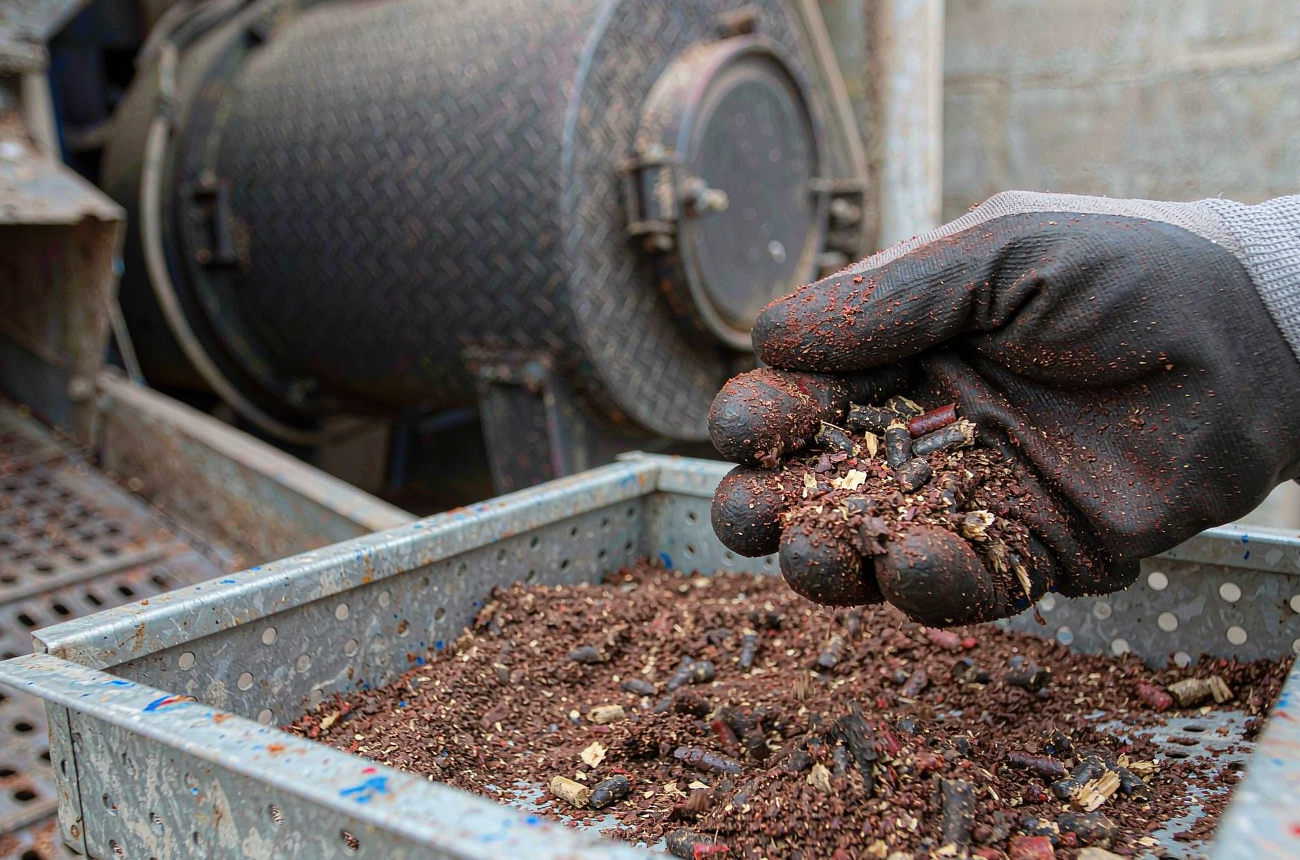
One caution on the first route: fines are already heat- and press-treated wood. Running them straight back at high percentage produces soft pellets, so most operators cap returns at a fraction of the fresh feed and watch durability after any change. Our in-house durability test guide shows how to verify that the blend hasn’t hurt your DU number.
Screening will never fix a process problem, and no screener makes bad pellets good. What it does is guarantee that the product leaving your gate matches the number on your certificate — and that the premium you negotiated survives the trip to the customer. Size it for the dirty day, keep the 3.15 mm cut honest, and give the fines somewhere deliberate to go.