
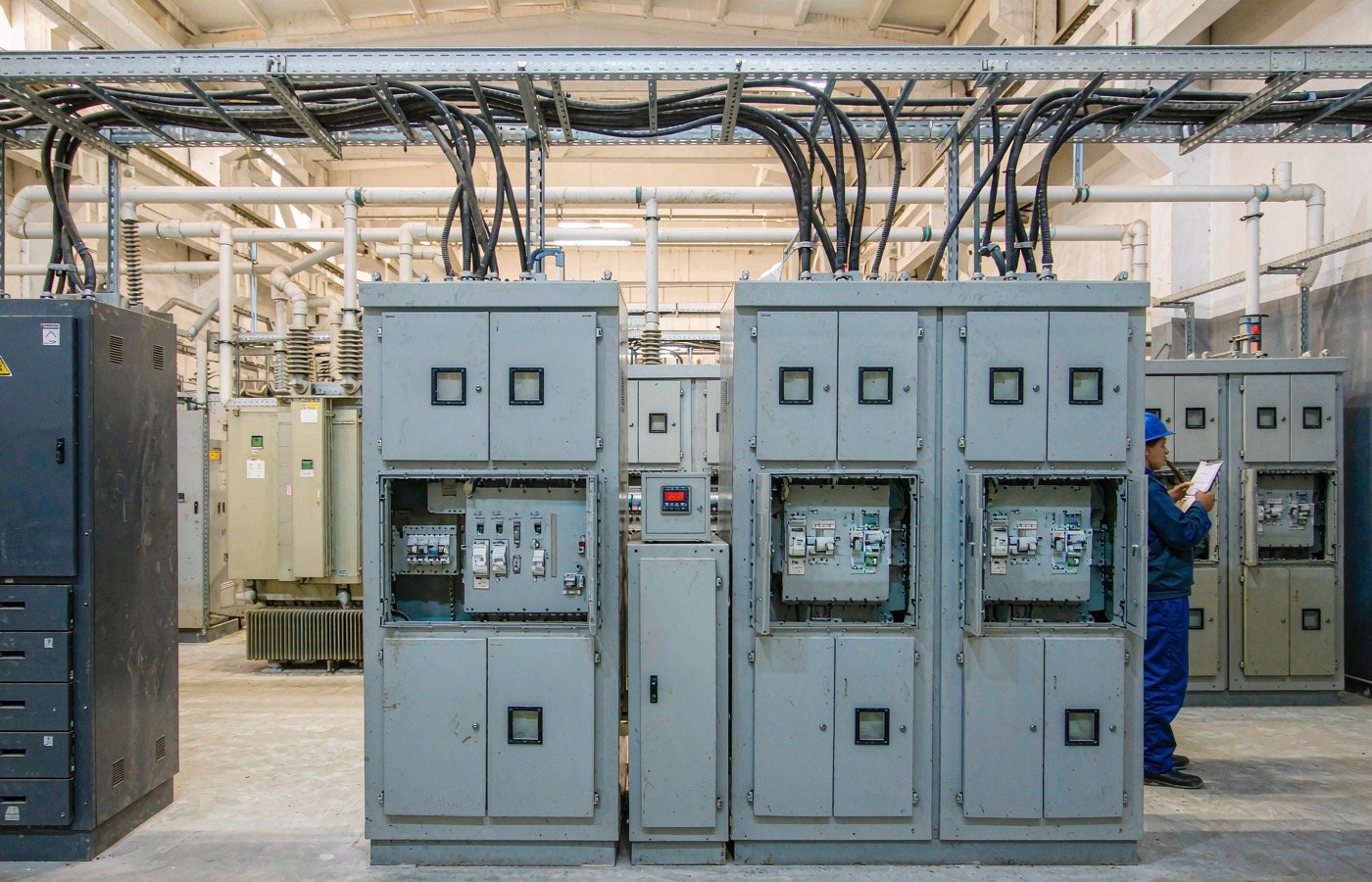
 Mechanical problems announce themselves with noise. Electrical problems announce themselves the week you try to start the plant: the main motor stalls against the transformer, the contactors chatter, the utility calls about voltage sag, and commissioning slips a month while panels get rebuilt. After watching buyers go through this, we can list the mistakes that cause almost every electrical delay on a pellet line — and every one of them is cheaper to fix on paper than on site.
For the machine side of the same conversation, see our guide to pellet mill motor overload causes. Here we stay upstream of that: power supply, starting method, and the specification decisions that decide whether your 280 kW YPM850 line starts on the day the installer promised.
Mistake 1: Sizing the transformer on running load
The most common mis-sizing on a biomass project is sizing the supply transformer from the running load list instead of from the starting case. A large motor started direct-on-line pulls roughly six times its full-load current for the first seconds. Plant engineers working on biomass projects size the transformer for the worst realistic instant: the largest motor starting while every other load is already running, plus about 20% spare capacity, because pellet plants add conveyors and dust extraction after commissioning (Ryan Electric, transformer sizing for biomass plants).
Run the numbers and the gap between the two approaches is not subtle. A plant whose steady load looks comfortable on a 400 kVA unit may need 630 kVA or more to start its pellet mill without the voltage collapsing. The transformer is fixed infrastructure — you cannot upsize it later without a shutdown and a utility conversation, which is exactly why this mistake delays startups.
Mistake 2: Ignoring voltage dip and the torque that follows
Voltage dip is not just a flicker on a meter. Motor torque falls with the square of voltage, so a dip that looks tolerable can leave the motor unable to accelerate its load. The working relationship is simple: dip (%) ≈ transformer impedance (%Z) × (starting kVA ÷ transformer kVA), and the practical target is keeping the dip under about 10 percent (Johsun Tec, motor starting and transformer sizing).
| Voltage during start | Available torque | What happens |
|---|---|---|
| 95% | 90% | Normal starting, no issue |
| 90% | 81% | Acceptable for most loads |
| 85% | 72% | Marginal for loaded conveyors |
| 80% | 64% | Risk of failure to accelerate; contactors may chatter |
| Below 75% | 56% | Stall; overload protection trips on every start |
A pellet mill is a high-inertia load with a full throat of material resistance. It sits near the bottom of that table on a weak supply. If your starting study says 80% voltage at the terminals, plan on a stall and plan again.
Mistake 3: Guessing the starting current
Buyers copy “6–8 times full load” into their calculations and move on. Real motors differ: the locked-rotor current is stated on the motor datasheet and by its NEMA code letter, and no universal multiplier fits every machine. Engineering references are explicit that procurement should use the manufacturer’s locked-rotor data wherever it exists, and that simplified multipliers are screening tools only (Transformer Grid, motor starting current and transformer sizing). If the datasheet has no code letter, a reasonable planning assumption for a three-phase IEC motor is six times full-load current — stated as an assumption in the RFQ, not hidden inside a spreadsheet.
Mistake 4: Deciding the starting method after the transformer is ordered
Starting method changes the demand more than motor size does, and it must be chosen together with the transformer, not after. Chinese mill suppliers publish the same working bands we do: direct-on-line start pulls 6–8× full-load amps, a soft starter cuts that to 2–3×, and for one 30 kW mill the minimum supply works out at 50 kVA direct-on-line versus 40 kVA with a soft start (Changsheng, pellet mill power consumption guide). Scale that ratio up to a 280 kW main drive and the difference is measured in hundreds of kVA.
| Starting method | Current vs FLC | Practical transformer size | Notes |
|---|---|---|---|
| Direct on line | 5–8× | 2.5–4× running kVA | Full starting torque; worst case for the supply |
| Star-delta | 1.7–2.6× | 1.6–2× running kVA | Torque drops to one third; needs six motor terminals |
| Soft starter | 2.5–4× | 1.5–2× running kVA | Ramp time must respect the transformer limit |
| VFD | 1.1–1.5× | 1.3–1.6× running kVA | Close to sinusoidal input current; adds harmonics |
For most pellet plants under 5 t/h, a soft starter on the main mill motor is the sweet spot: it protects the supply, costs far less than the transformer upsize it avoids, and pellet mills do not need speed control that a VFD would add. Specify the starter in the same RFQ as the transformer.
Mistake 5: Ignoring voltage unbalance and motor thermal life
Unbalanced supply voltage is a slow killer rather than a startup blocker, which is why it gets missed. The US Department of Energy’s motor guidance sets a practical limit: keep voltage unbalance under 1%, derate the motor if you cannot, and treat every extra degree of operating temperature as insulation life spent — each 10°C above rated temperature cuts insulation life roughly in half. The temperature rise from unbalance grows with the square of the unbalance percentage (DOE Motor Systems Tip Sheet #7). A mill that runs hot on a 2% unbalanced supply is aging its main motor many times faster than its owner realizes, and the eventual rewind or replacement lands right when the plant is trying to run at capacity.
Mistake 6: Surprising the grid with drive harmonics
Add VFDs and the electrical story gains a chapter: harmonics. A six-pulse drive without mitigation can draw 25–40% current distortion at its terminals, while utilities typically cap the distortion a plant may inject at the point of common coupling near 5% (IEEE 519, IEEE Std 519). The answers — line reactors, 12- or 18-pulse drives, or an active front end — change what the supply transformer must withstand, and that decision belongs before the transformer order, not after the utility’s compliance test fails. If your drive vendor and transformer vendor never speak to each other, you are the one who will introduce them, at your own cost.
A worked sizing example for a 280 kW main drive
Here is the arithmetic end to end for a YPM850-class mill, 280 kW main motor, 380 V supply. The power factor and efficiency assumptions (0.85 and 0.93) are stated placeholders — substitute the motor datasheet values before you commit money. Every step below is simple arithmetic on published formulas:
| Step | Calculation | Result |
|---|---|---|
| 1. Running kVA | 280 kW ÷ (0.85 × 0.93) | ≈354 kVA |
| 2. Full-load current | 354,000 ÷ (1.732 × 380) | ≈538 A |
| 3. DOL starting kVA (6×) | 354 × 6 | ≈2,124 kVA |
| 4. Dip on a 630 kVA unit, %Z 6, soft start 2.5× | 6% × (354 × 2.5 ÷ 630) | ≈8.4% dip — acceptable |
| 5. Same start DOL | 6% × (2,124 ÷ 630) | ≈20% dip — stall territory |
The conclusion writes itself: with a soft starter, a 630 kVA transformer holds the dip inside the 10% working target for a 280 kW mill; the same transformer fails on a direct-on-line start. Change the assumptions to your real motor data and the method still stands. When you plan a complete pellet production line, put this table in the electrical section of your plant layout plan — it takes one page and saves the month of delay this article is about.
The budget line most buyers forget
Electricity is not a one-time line item. At the EIA’s US industrial average of 9.64 cents per kWh (EIA Table 5.6.A), a 280 kW main drive running 6,000 hours a year consumes 1.68 GWh — roughly $162,000 a year at full load, before dryer fans and conveyors. That is why motor efficiency class matters at this scale: IE3-to-IE4 upgrades on pellet mill motors typically pay back in one to two years of energy savings, per supplier data. Spec the efficiency class in the same paragraph as the starter and the transformer, and the electrical package arrives coherent.
None of the six mistakes above is exotic. They are all arithmetic that someone skipped. Do the arithmetic twice — once for the start, once for the running year — and your electrical room will be the quietest part of commissioning.