
Most pellet quality problems are blamed on the mill. A good share of them happen after the mill, in the silo or the shed where the product waits for a truck. Pellets leave the cooler at their best: dense, cool, low in fines, dry. Every week they sit in a store that is too humid, too warm or too open, they give some of that back.
There is a second issue that gets far less attention in equipment brochures and far more in accident reports. Stored wood pellets produce carbon monoxide. In a closed store the gas can build to concentrations that cause unconsciousness within minutes, and the people who find out are usually the ones who opened the door to check on something.
This guide covers both sides of a bulk pellet store: keeping the fuel dry enough to sell, and keeping the space safe enough to enter.
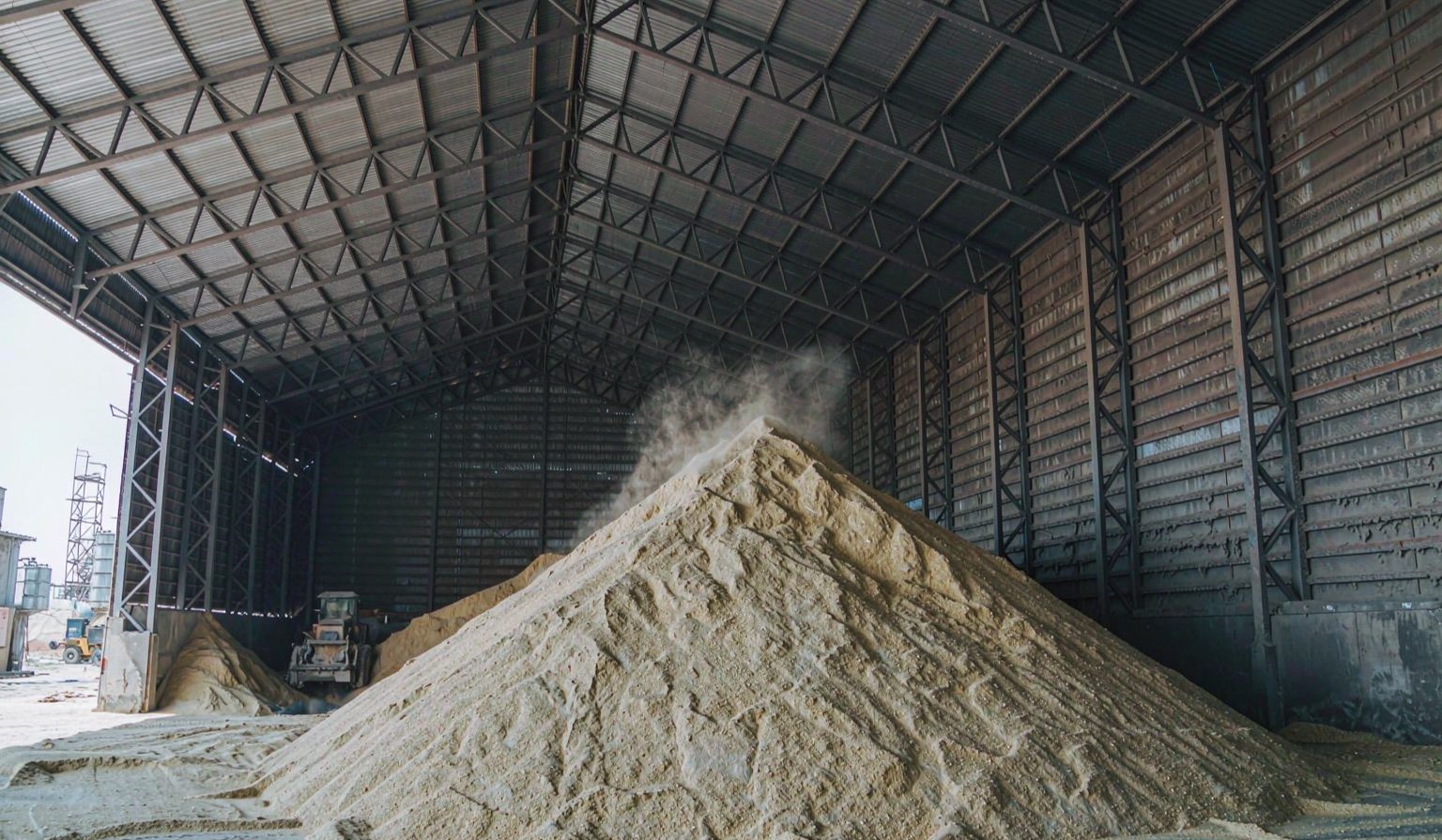
What a store actually does to pellets
Four processes run at once, and three of them are slow enough to be invisible until a customer complains.
Moisture uptake. Pellets are hygroscopic. They equilibrate with the air around them, which means a dry pellet in humid air gets wetter, and a warm pellet in a cool space can condense water on its surface. ENplus sets an upper limit of 10% moisture for graded pellets, and the practical target for long storage is lower than that (ENplus Handbook v3.0, Part 3). Once surface moisture enters, pellets swell, the binder bonds relax, and durability measured at the lab starts to disagree with durability in the truck.
Fines generation. Every transfer drops a little material. A conveyor, a bucket elevator, a silo drop and a truck load are four chances to make dust. Fines are not just a quality defect: ENplus caps fines at 1.0% for bulk and 0.5% for bagged, and fines are the fraction that burns fast, smoulders in a store and hangs in the air as a dust cloud.
Oxidation and self-heating. Wood extractives react with oxygen for weeks after pressing, and the reaction releases heat. In a small pile the heat escapes. In a deep silo of fresh pellets, it does not, and the pile warms from the inside. Warm pellets oxidise faster, which is the feedback loop that turns a warm spot into a hot spot.
Gas release. The same oxidation produces carbon monoxide, carbon dioxide and traces of aldehydes. Germany’s Federal Institute for Risk Assessment describes the mechanism plainly: cutting, heating and drying the wood sets off auto-oxidation in some wood components, and gases form from unsaturated fatty acids. The institute notes that pellets can still emit gas months after production (BfR, Avoiding toxic gases from the pellet bunker).
The gas problem: why a pellet store can kill
The BfR assessment is worth reading in full before you design a store, because the numbers are blunt. Experimental studies found carbon monoxide concentrations of up to several thousand ppm inside pellet storage rooms. At 200 ppm, prolonged exposure causes headaches. At 800 ppm, light-headedness and nausea come on after a short time. Above that, loss of consciousness can follow within minutes.
Carbon monoxide is colourless and odourless, so nobody notices it building. The BfR also reports that several poisonings, including fatal ones, have occurred when people entered pellet bunkers or storage rooms to do maintenance, and that the stores involved were airtight, allowing gas to accumulate without any warning.
Two practical conclusions follow, and both contradict habits that are common on site.
Opening the door for a minute is not a control measure. The BfR states directly that brief airing before entry has not been enough to bring concentrations down to a safe level in the accidents it reviewed, and that warning signs alone are not adequate protection either.
Ventilation and detection are the control measures. Continuous ventilation to open air, gas-tight separation from rooms people use, and carbon monoxide detectors are the measures the institute recommends. For a commercial store, add an entry procedure: test the atmosphere before entry, never enter alone, and treat any alarm as an evacuation rather than a nuisance.
Designers of small domestic bunkers often learn this the hard way. If you supply pellets in bulk to households, the store is part of your product’s safety envelope, and a one-page handout with the delivery is cheaper than a liability case.
Sizing a store without undersizing it
The common error is to size on volume and forget density. ENplus specifies bulk density of 600–750 kg/m³ for graded wood pellets. Divide 1,000 kg by that band and one tonne occupies roughly 1.3 to 1.7 m³, not the 1 m³ that a mental shortcut suggests. Size a store on grain numbers and you will be short by a quarter or more.
| Line output | Running hours per day | Days of cover wanted | Tonnes to store | Working volume at 650 kg/m³ |
|---|---|---|---|---|
| 1 t/h | 16 | 14 | 224 | ≈ 345 m³ |
| 2 t/h | 20 | 7 | 280 | ≈ 430 m³ |
| 5 t/h | 20 | 7 | 700 | ≈ 1,075 m³ |
| 10 t/h | 20 | 5 | 1,000 | ≈ 1,540 m³ |
Add headspace for filling, and remember that the last 10% of a silo is often the part that will not discharge cleanly. A store that holds seven days on paper and five days in practice is a store that runs out on a Friday night.
There is a commercial argument for a smaller store as well. Long residence time is the enemy of quality: the longer pellets sit, the more moisture, fines and oxidation they collect. For export plants, a store sized for the shipping schedule rather than for maximum buffer usually produces a better container.
Moisture: the 10% line and how to hold it
Three things decide whether a store holds moisture out.
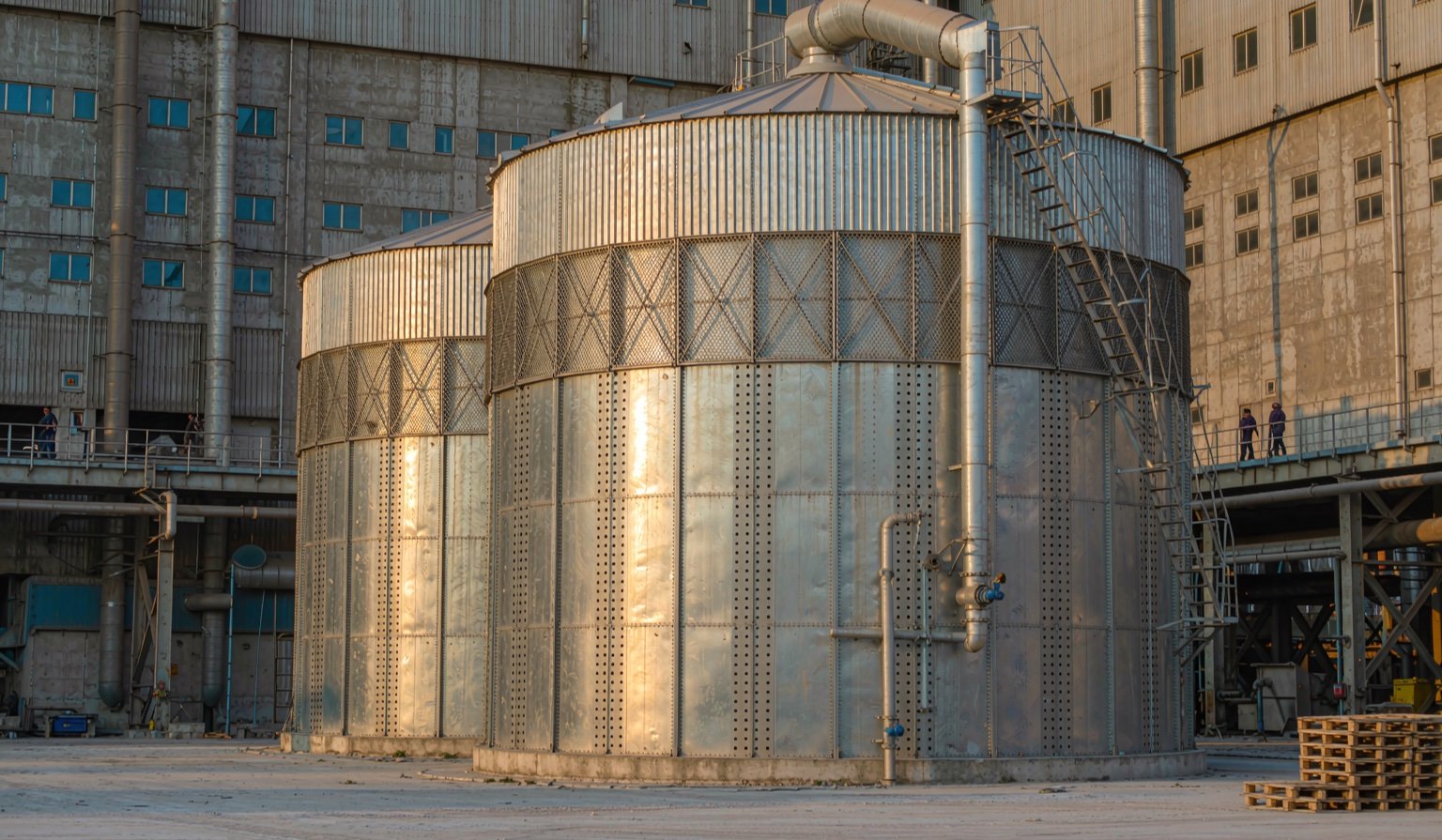
The building envelope. A steel silo with a sealed roof and a proper gasket at the fill hatch behaves very differently from a shed with an open side. If the store is a flat warehouse, keep pellets on pallets or on a sealed floor rather than directly on concrete, and keep the walls ventilated but the product covered. Water runs downhill and pellets wick it upward.
Temperature difference. Warm pellets going into a cold store, or a cold silo wall meeting humid air, gives you condensation on the surface and on the wall. Let the product cool in the counterflow cooler before it goes into storage, and do not chase throughput by sending 60 °C pellets to the silo. The cooler is part of quality control, not just a conveyor with fans.
Air exchange. A store needs enough ventilation to carry away moisture and gas, and not so much that humid outside air becomes the supply. In tropical markets this is the hard part: the outside air is often wetter than the product. A humidity-controlled fan that only runs when the outside dew point is lower than the store’s is worth more than a permanently open louvre.
Dust, fire and the paperwork nobody wants to write
Wood pellet dust is a combustible dust. The US Occupational Safety and Health Administration treats accumulations of combustible dust as a recognised deflagration hazard and requires employers to assess and control it (OSHA, Combustible Dust). In the EU, equipment and protective systems intended for use in potentially explosive atmospheres fall under the ATEX directive, and a silo interior is exactly the kind of zone the directive exists for (Directive 2014/34/EU). Producer associations publish practical guidance for plants in the same position; the Wood Pellet Association of Canada keeps its safety material public (WPAC).
What that means in practice, in order of cost-effectiveness:
- Keep dust layers off beams, ledges and the floor. Housekeeping is the cheapest explosion control there is.
- Screen fines out before storage rather than after. Fines are the fuel for both smouldering and dust clouds.
- Use gentle conveying. Pneumatic systems grind pellets and make dust; belt and drag conveyors are kinder.
- Fit explosion venting or suppression to silos, sized by an engineer for your volume, and route the vent away from walkways.
- Control hot work. Welding on a silo that has held pellets needs a permit, a gas test and a fire watch, not a verbal agreement.
Bags, flat store or silo: pick by throughput, not by taste
| Option | Where it works | Main risk | Where it fails |
|---|---|---|---|
| 15 kg bags on pallets | Residential retail, premium A1, slow-moving SKUs | Pallet wrap condensation, bag damage in handling | Industrial offtake, anything over a few thousand tonnes a year |
| One-tonne bulk bags | Small industrial boilers, export trials, mixed grades | Fines migration to the bottom of the bag | High-volume plants, where handling cost per tonne dominates |
| Covered flat warehouse | Plants with irregular shipping, container stuffing on site | Humidity, dust accumulation, no first-in-first-out discipline | Wet seasons, coastal sites, long residence times |
| Steel silo with discharge | Continuous plants, boiler feed, port terminals | Gas accumulation, bridging, uneven discharge | Low throughput, where the silo costs more than the product it holds |
Most plants end up with two of these, not one: a silo for the bulk contract and a bagging line for the retail SKU. That combination is why the layout decision should be made when the line is being designed, not after the first container ships. The complete line layout is where storage, cooling and bagging get fixed together.
Decisions you make before the line ships
Retrofitting storage is expensive. Getting these five right at the design stage costs almost nothing.
Cooler outlet. Specify a pellet exit temperature close to ambient, and put a thermometer on the outlet so the operator can see it. Warm pellets are the root cause of most silo hot spots.
Fines screening. Put the screen before the store, not before the bag. What goes into the silo is what the customer receives three weeks later.
Moisture measurement point. One meter at the dryer outlet and one at the bagging line. The difference between them is the moisture your store is giving back.
Gas detection. A CO detector in the silo headspace and at the entry point, wired to an alarm people can hear from outside. Choose a model with a visible fault indication, because a dead sensor that reads zero is worse than no sensor.
Access procedure. Written, posted at the door, and rehearsed once. Testing the atmosphere, a second person outside, and a rescue plan are the three items that show up in every serious incident report as missing.
Commissioning tests for a new pellet store
Run these before you put the first commercial tonne through the system. Each one takes under an hour and each one catches a failure that would otherwise appear in month three.
1. Envelope test. Close the store, run the ventilation for an hour, then inspect for daylight at seams and hatches. Any visible gap is a moisture path and a gas path.
2. Detector bump test. Challenge the CO sensor with test gas and confirm the alarm sounds at the panel and at the entry. Record the response time in the log.
3. Baseline moisture. Sample pellets at the cooler outlet and again after 24 hours in the store. A rise of more than a fraction of a point overnight means the store is wetter than the product.
4. Discharge test. Fill to the working level, then discharge at the design rate and watch for bridging, rat-holing and surging. Note how much material is left when flow stops. If the answer is “a lot”, the hopper geometry needs work before you sign off.
5. Fines audit. Measure fines at the cooler, after conveying, and at the truck. Whichever step adds the most is the one to modify. If you want the upstream half of this picture, the causes of crumbly pellets covers what happens before the cooler, and the YPM850 mill page shows the throughput class where storage design starts to matter commercially.
Storage is the least glamorous part of a pellet plant and the one most often designed by whoever has a spare shed. Treat it as process equipment, with a moisture spec, a gas spec and a flow spec, and the two problems that hurt most — claims and accidents — both get smaller.