
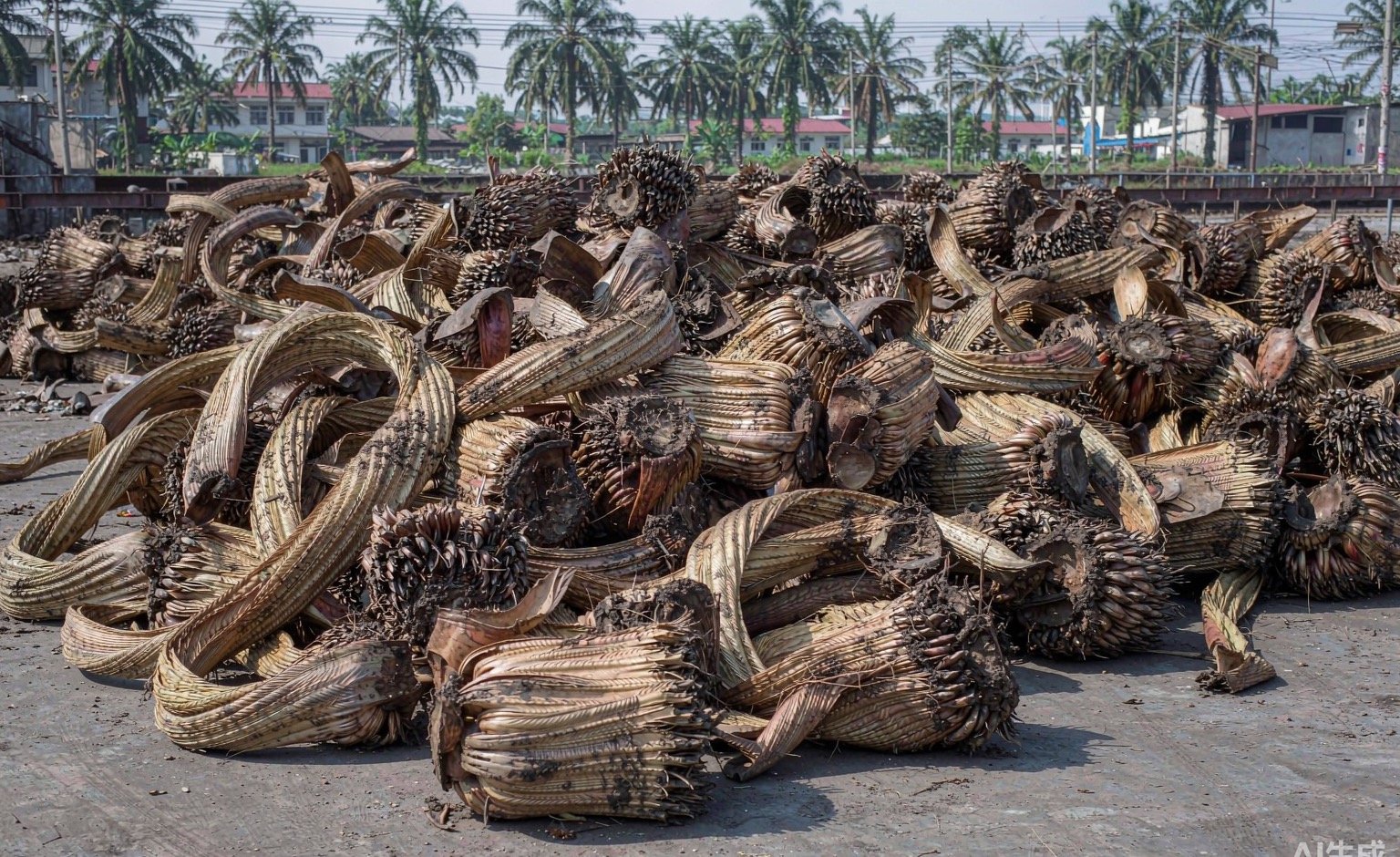
Walk around almost any palm oil mill in Indonesia or Malaysia and you will see the same scene: mountains of empty fruit bunches (EFB) rotting behind the sterilizer station, mulching fields, or slowly burning. Meanwhile, in Japan and South Korea, utilities are signing long-term contracts for biomass fuel and paying real money for dense, dry, spec-compliant pellets. The gap between those two pictures is exactly why EFB pellets have moved from curiosity to serious export business in the past two years.
We supply pellet machinery to buyers across Southeast Asia, and the number of palm-sector clients asking about EFB pellet lines has grown visibly since 2024. This article explains what changed on the demand side, how big the resource actually is, who is already building capacity — and what an honest assessment of the constraints looks like.
What EFB Is, and Why It Won’t Travel As-Is
EFB is the fibrous bunch left behind after palm fruitlets are stripped for oil pressing. From every tonne of fresh fruit bunches (FFB) processed, roughly 22 to 25% comes out as EFB, according to industry analysis citing FAO production data (IPOSS Indonesia). It is wet, bulky, stringy fiber. Raw EFB cannot travel economically: you would be paying freight on water and air, which is why almost all of it historically stayed on the plantation as mulch or fertilizer.
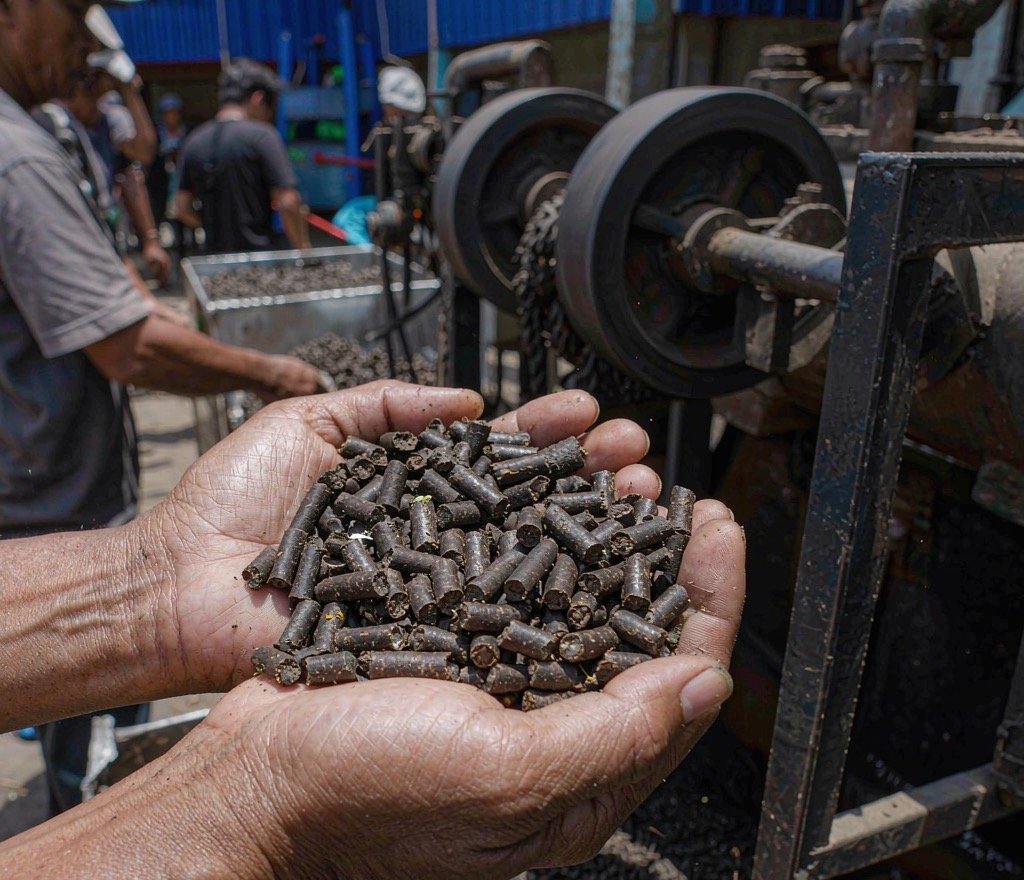
Pelleting changes the economics. Shred it, press out free water, dry it, and compress it into a dense cylindrical pellet, and suddenly a material that could not justify a 50 km truck trip becomes a storable, containerizable fuel commodity. That transformation — not any single technology — is what turned EFB into an export story.
How Big Is the Resource? The Numbers Behind the Hype
The headline numbers are large, but the honest answer requires distinguishing three different figures: total generation, technical potential, and what is actually recoverable after existing uses. Indonesian and Malaysian data give a clear picture.
| Estimate | Value | Source |
|---|---|---|
| EFB share of fresh fruit bunch weight | 22–25% | Industry analysis citing FAO 2024 data (IPOSS) |
| Indonesia FFB production | ≈ 256 million t/yr | FAO 2024, via IPOSS |
| Indonesia EFB generated | 48.2–55.4 million t/yr | Palmex Medan 2026 session figures (Palm Oil Magazine / Shev) |
| Indonesia EFB, university estimate | 46.16 million t/yr | Prof. Diana Chalil, Universitas Sumatera Utara |
| EFB recoverable after existing uses | ≈ 23.08 million t/yr | Same USU analysis of 28 mills in North Sumatra and Riau |
That last row is the one serious investors should memorize. About half of Indonesia’s EFB is already spoken for — returned to plantations as organic material, processed into ash fertilizer, or sold into other uses. Shipping it away carries an opportunity cost for the plantation, and transport research presented at Palmex Medan 2026 showed that in one EFB-to-bioethanol case, haulage costs exceeded the price of the fiber itself (Shev). The lesson is old but consistently ignored: processing plants belong close to the mills, and recoverable volume, not headline volume, is what your financial model gets to count.
Why Buyers Are Now Paying for It
The demand side has shifted faster than the supply side. Three forces are at work.
First, the wood pellet trade that fed Japan and Korea is under pressure. Vietnam exported about 6.03 million tonnes of wood pellets worth USD 805 million in 2024, with Japan and South Korea taking roughly 94% of the volume (Agrideco Vietnam), and the trade then jumped 52% to about USD 1.08 billion in 2025 (Wood Central). But the base is wobbling: Japan’s METI announced in February 2025 that it will stop approving new biomass projects under the FIT/FIP subsidy scheme from fiscal year 2026 (Tridge), capping how much the wood pellet market can grow. Buyers hunting for supply beyond traditional wood pellets are exactly who EFB producers want to meet.
Second, supply rankings are shifting in Southeast Asia’s favor. Indonesian shipments overtook Vietnam’s to South Korea in late 2025, and Korean buyers rate Indonesian material — alongside Canadian and Russian cargoes — above Vietnamese supply on quality, with Vietnamese cargoes facing rejections over moisture and impurities (Thang Long). For a palm-producing country, every tonne of accepted biomass export builds exactly the track record that EFB pellets will be sold on.
Third, palm biomass already has a proven beachhead in Japan. Palm kernel shell exports to Japan have run above 5 million tonnes a year, and at the International Biomass Expo 2026 in Tokyo, the Indonesian Palm Kernel Shell Entrepreneurs Association (APCASI) showcased EFB pellets alongside PKS as the sector’s next growth product — with APCASI’s chairman describing EFB pellet development as a promising alternative energy source to accelerate. The industry press has followed the same thread: Malaysia’s plantation ministry publicly invited palm mills to commit 10 to 20% of their EFB to scale up black pellet production, noting that a Malaysian producer’s TG2 EFB-based fuel plant can make 80,000 tonnes a year and that Japan has begun buying (World Energy News / Reuters).
Who Is Building EFB Pellet Capacity Right Now
Announced projects give the clearest signal of where this market is heading. The names involved — Japanese trading-linked ventures, European traders, listed Indonesian groups — are not fringe players.
| Company / venture | Plan | Timing |
|---|---|---|
| G7 (Poland) + PT Biomassa Energy Group (Indonesia) | Six new plants; first a 120,000 t/yr EFB pellet plant in Sumatra; JV targets 700,000 t/yr total | First plant operating 2026 |
| Tess Holdings (Japan) | EFB pellet production; capacity projected at 100,000 t/yr | Production from June 2026; target by 2030 |
| Wilhelmina Malaysia Energy | TG2 EFB black pellet plant, Kuantan; ~17,000 t/yr now, max capacity above 80,000 t/yr | Operating; Japan buying process started |
Project details from Southeast Asia biomass market reporting (Thang Long) and Reuters coverage of the Malaysian announcement. Black pellets and white pellets serve different segments, but they compete for the same EFB fiber — another reason to secure feedstock agreements early.
Put the pieces together: recoverable EFB of roughly 23 million tonnes a year in Indonesia alone, an established Japanese import channel for palm biomass, subsidy-capped growth in wood pellets pushing buyers toward alternatives, and concrete multi-hundred-thousand-tonne plant announcements. That is why “why now” has a real answer.
What a Good EFB Pellet Line Needs to Handle
Now the uncomfortable engineering truth: EFB is not sawdust. If you have read our pieces on palm kernel shell pellets or rice husk pellets, you know agricultural residues punish copy-pasted line designs. EFB is arguably the hardest of the three to prepare.
Raw EFB arrives as long, tough, tangled fiber with high moisture and low bulk density. A workable line therefore typically adds stages a sawdust plant never needs: coarse shredding of whole bunches, fiber separation, often mechanical screw pressing to squeeze out free water before thermal drying, then hammer milling to a consistent particle size before the pellet mill. Drying duty is heavy because the water load per tonne of dry matter is far higher than for sawmill residues — the same mass-balance logic that governs any dryer applies with extra force here. On the pellet mill itself, vertical ring die machines with proper fiber handling tend to cope better with stringy material than small flat die units, and die compression ratio must be matched to the material rather than copied from a wood specification.
The selection principle we give palm-sector clients is simple: buy the line around your fiber, not around a catalog capacity. Ask every supplier for a test run on real EFB, with actual forming rate, output and energy consumption measured — not projected. Our complete production line configurations for agricultural residues are built on that principle, and we would rather run the test twice than size a line once from a chart.
The Honest Constraints
No credible article about EFB pellets should pretend it is easy money. Four constraints keep repeating in every serious assessment:
- Fuel quality expectations. Japanese power plants apply strict fuel specifications on ash, chlorine and calorific value, and poorly processed EFB can fail those criteria and risk boiler damage (industry reporting on Japan’s biomass imports). Managing ash and chlorine starts with fiber cleaning and process discipline upstream of the die.
- Sustainability scrutiny. Palm-sector biomass faces intense examination over deforestation and labor practices; Japanese buyers increasingly demand certification of the supply chain, and Indonesian certification bodies have been working with Japanese quality assurance organizations to build that credibility.
- Existing uses compete. Half the national EFB resource is already committed to plantations that will not give it up for free. Your feedstock cost model must include the plantation’s alternative value, not just collection cost.
- Logistics risk. Export infrastructure can fail in ways no spreadsheet predicts — the collapse of a major biomass export jetty in Riau in January 2026 disrupted shipments across the region (Thang Long). Site your plant with more than one realistic route to port.
Should Your Mill Add an EFB Pellet Line? A Decision Tree
Run your own situation through these questions in order:
1. Do you have EFB surplus after existing commitments? If your plantation’s mulch and fertilizer demand consumes the bunches, stop here — your raw material is already deployed at its best alternative value.
2. Is your mill within a short, all-weather haul of the pellet plant? Fiber is cheap to collect near the mill and expensive beyond it; transport cost can exceed the fiber price itself. If the answer is no, the right investment may be a pressing/densification step at the mill rather than a full pellet line far away.
3. Can you pre-sell, at least in trial volumes, to a buyer with clear specifications? Japanese and Korean buyers publish fuel specifications. If you cannot get a specification sheet and a trial-offtake conversation, you are producing on spec-ulation.
4. Is your capital plan sized for the preparation stages, not just the pellet mill? Shredding, pressing, drying and milling are where EFB lines differ from wood lines — and where budgets fail. Get the mass balance and the test run first.
If you passed all four, the timing arguments above work in your favor: demand channels exist, reference projects are being commissioned now, and the mills that move early lock up the cheapest fiber. We help palm-sector clients configure EFB-capable lines from shredding to bagging — send us your EFB volume and current disposal arrangements, and we will tell you honestly whether a line makes sense.