
The pellet that leaves your cooler is rarely the pellet your buyer tests. Between the plant gate and the discharge port, cargo passes through loaders, transfer points, bags, container walls or a ship’s hold — and every one of those stages either protects the product or quietly turns it into fines and damp fuel. Exporters in Vietnam and Indonesia have learned this the hard way: Japanese and Korean buyers now test at discharge, and a certificate from your own lab carries less weight than the sample taken off the ship.
If you are planning your first export sale, the shipping decision comes down to three things: how each packing format changes your fines and moisture numbers, what each option physically carries, and the carriage rules that apply once pellets go into a hold. This guide walks through all three, using the limits published in the ENplus scheme and the requirements of the IMO’s solid bulk cargo code.
The spec your buyer tests at discharge
Start from the contract, not the truck. The ENplus Handbook sets fines at no more than 1.0% for bulk pellets and 0.5% for bagged A1 pellets at the point of delivery, alongside bulk density of 600–750 kg/m³, moisture no higher than 10%, and mechanical durability of at least 98.0% (ENplus Handbook v3.0, Part 3). Similar numbers appear in most industrial supply contracts even where ENplus certification itself is not required.
The trap is the phrase “at the point of delivery”. The limits are not measured at your cooler outlet. Every conveyor transfer, every drop into a bag, every fork-lift bump and every hold trimming pass adds breakage after your last screening. A plant that measures 0.4% fines at the bagging outlet can easily ship a cargo that tests at 0.8% — still inside the bulk limit, but with almost no margin left.
So the first habit of a serious exporter is to run the same bench tests the buyer will run. Our guide to the wood pellet durability test shows a low-cost in-house setup for durability and fines sampling; run it on the loading sample, not just on production samples.
Four ways to move pellets, and what each one protects
There is no single “right” format. Each one shifts risk between price, fines, moisture and handling speed:
| Format | How it ships | Main quality risk | Where it fits |
|---|---|---|---|
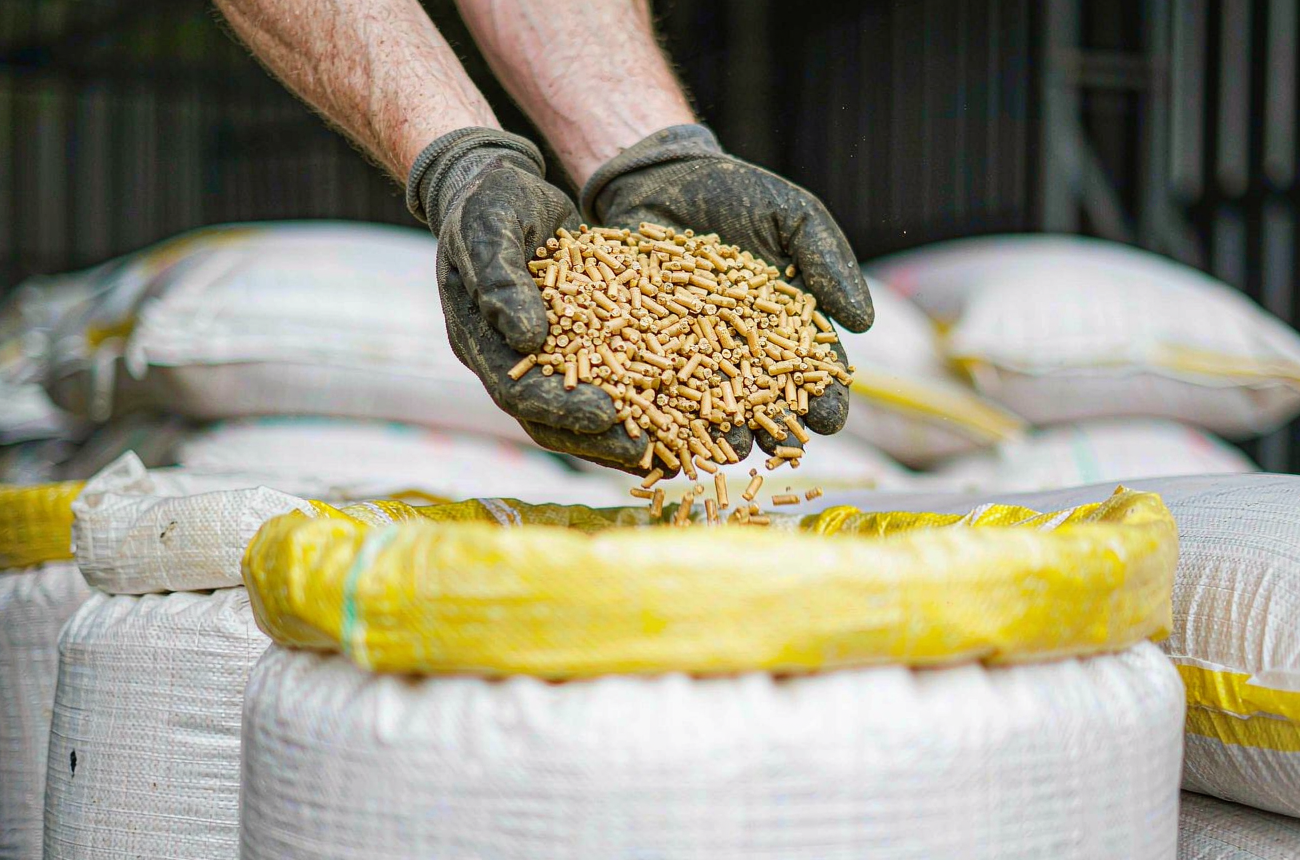
| 25 kg retail bags on pallets | Palletised, stretch-wrapped, stuffed into dry containers | Highest cost per tonne; bag scuffing and rupture at each rehandle | Branded residential fuel for the ENplus bagged market |
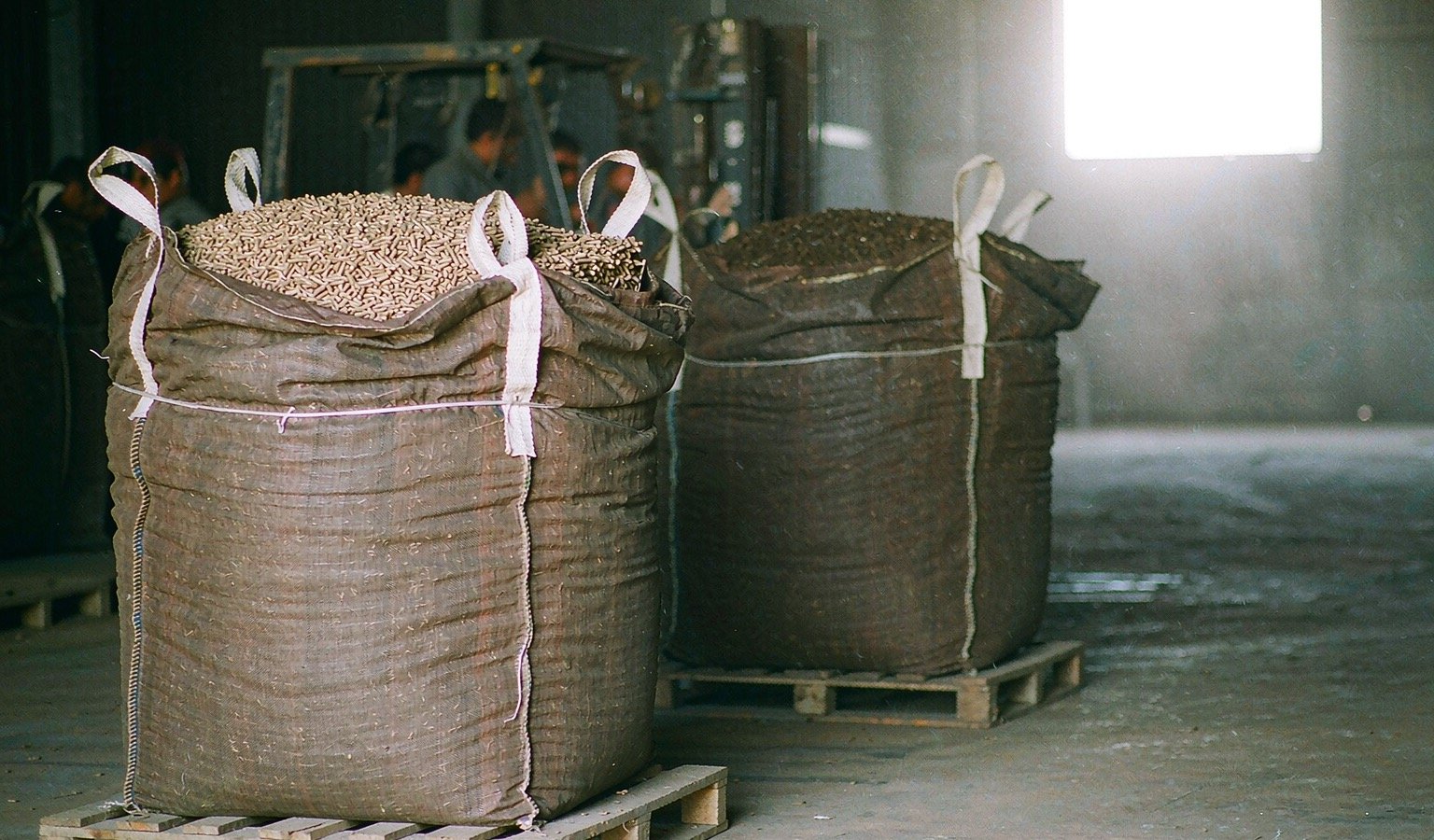
| 1 tonne jumbo bags (FIBC) | Palletised or loose, forklift handling, containerised | Bag corners chafe and spill; stacking voids waste container volume | Industrial buyers without silo intake |
| Bulk in a lined container | Blown or belt-fed into the box through a liner bag | Fines generated at filling; condensation if the liner is skipped | Flexible 20–28 t parcels to mixed destinations |
| Bulk in a vessel hold | Conveyor or shiploader, trimmed level | Gas rules, rain exposure, discharge breakage | 20,000–75,000 t parcels to power plants and ports |
One warning about the bagged rows: ENplus applies a stricter fines limit to bagged product (0.5%) than to bulk (1.0%). If your line struggles to hold 1.0% in bulk, bagging will not hide the problem — it will surface faster, because the buyer opens bags that were filled weeks earlier.
How to choose among them, in plain terms. Retail bags are a brand business: you take on the bagging machine, the film supply, the print quality and the pallet discipline, and you get a consumer price in return. If your buyer is a retail distributor in Europe, this is the format, and the bagging bay belongs in your building from day one — our plant layout guide reserves space for it accordingly. Jumbo bags are the diplomat of the group: they protect pellets better than open bulk, load with a forklift, and suit buyers whose intake is a pile on a covered floor rather than a silo. Their cost is volume — bag walls and stacking voids mean you ship air, which is acceptable when freight per tonne is a rounding error and intolerable when it is not. Bulk in lined containers is the format most mid-size exporters grow into: it keeps the cargo sealed from plant to buyer’s intake, works at any port with container handling, and caps each parcel at container payload, which conveniently limits the size of any single claim. Bulk in a vessel hold is the cheapest per tonne at scale and the most demanding in every other respect — gas rules, weather windows, discharge discipline — and it only pays once your volumes justify a part cargo or a full ship.
What the discharge port does to your numbers
Shipping does not end when the hatch closes. At discharge, pellets go through a grab, a shiploader hopper, a conveyor and a stockpile before anyone weighs them, and each of those steps breaks a few percent of whatever you loaded carefully. The receiving buyer samples at intake — that is the sample your certificate will be measured against, not the one you sealed at the loadport. This is why the retained samples in the checklist below matter so much: when a discharge test comes back out of spec, the argument is settled between two sealed samples taken hours apart at loading, not between your lab and the receiver’s stockpile that sat in the rain for a week.
Plan the discharge conversation before the vessel sails, not after. Agree who samples, at which transfer point, by what method, and which laboratory arbitrates. Buyers respect exporters who raise the question first; they write contracts around exporters who raise it after a rejection.
What a container really carries
Container maths is where first-time exporters lose money, because the box that looks bigger is not the box that carries more. Published container data (checked October 2026 against 42 carrier and lessor specification sheets on Contsize) gives these figures:
| Container | Internal volume | Max payload | Bulk tonnage at 650 kg/m³ (arithmetic) | What binds first |
|---|---|---|---|---|
| 20 ft general purpose | 33.2 m³ | ≈28,250 kg | ≈21.6 t | Volume |
| 40 ft general purpose | 67.7 m³ | ≈28,800 kg | ≈44.0 t by volume | Weight |
| 40 ft high cube | 76.4 m³ | ≈28,670 kg | ≈49.7 t by volume | Weight |
Read the table carefully. In a 20 ft box, loose pellets at a typical bulk density of 650 kg/m³ run out of space at roughly 21–22 tonnes — the volume limit arrives first, and the payload cap never matters. In a 40 ft box it is the opposite: the cube would swallow 44–50 tonnes, but the payload cap of roughly 28 tonnes binds long before the box fills. That is why a 40 ft bulk load ships with permanent headspace, and why stuffing a second 40 ft “because it is taller” gains you almost nothing in bulk. For bagged cargo the same logic applies: a 40 ft container takes 20–24 standard pallets per layer depending on type (NSL), and palletisation voids mean the weight cap still lands first with a cargo as dense as pellets.
Three practical notes. First, payload figures vary slightly by carrier and by the rating printed on each box’s CSC plate — the lower of the plate rating and your carrier’s booking limit governs. Second, since 2016 the SOLAS convention requires a Verified Gross Mass declaration for every packed container before it can be loaded onto a vessel (NSL). Third, bulk-in-container needs a liner bag and cannot be filled to the roof: leave headspace so the cargo can be discharged, and seal the liner properly, because condensation on a bare container roof drips straight into the pellets.
Bulk vessels cube out before they deadweight
The same physics scales up on the ocean. The IMSBC Code schedule for wood pellets lists bulk density of 600–750 kg/m³ and a stowage factor of 1.33–1.67 m³/t, with an angle of repose of about 30° (Resolution MSC.393(95), which inserted the current WOOD PELLETS schedules into the Code — the text is reproduced in the Finnish Transport Safety Agency’s copy of the amendment). At a stowage factor of 1.5 m³/t, one tonne of pellets occupies one and a half cubic metres of hold. Compare that with coal at roughly a third of that, and it is obvious why pellet cargoes are volume cargoes: a vessel carrying pellets usually fills its hold cube well before it reaches its load line.
That shapes chartering. Typical biomass parcels run from 20,000–35,000 t on Handysize vessels up to 60,000–75,000 t on Panamax tonnage, with Supramax and Ultramax ships (40,000–60,000 t) doing most of the flexible mid-size flows (Bulkargo). Small parcels sail on smaller ships and pay more freight per tonne, which is why a 12,000 t lot often makes more sense shipped as containers than as a part cargo.
Arithmetic you can use before you even call a broker: at a stowage factor of 1.5 m³/t, a 30,000 t cargo needs about 45,000 m³ of hold cube. Ask the owner for grain cubic capacity, not deadweight, when you check whether a nominated vessel can actually lift your parcel.
In a hold, pellets are Group B cargo
This is the section most first-time exporters skip — and the one that ends up in a master’s protest letter. Under the IMSBC Code, wood pellets are a Group B cargo: a chemical hazard, not a simple dry bulk commodity. The schedule states the hazards plainly. Shipment subjects the cargo to oxidation, which depletes oxygen and raises carbon monoxide and carbon dioxide in the cargo space and in communicating spaces. Handling can raise explosive dust. Wetted pellets swell; pellets over 15% moisture may ferment, generating asphyxiating and flammable gases with a risk of spontaneous combustion (MSC.393(95), WOOD PELLETS schedules).
The operational consequences are specific, and they belong in your voyage planning, not just the ship’s files:
- Nobody enters the hold or adjacent enclosed spaces until testing confirms oxygen at 21% and carbon monoxide below 100 ppm; the ship must carry self-contained breathing apparatus and combined oxygen/CO meters.
- Cargo is not handled during precipitation, and all non-working hatches into spaces being loaded must stay closed.
- Spaces that were ventilated and closed can re-deplete, because a previously ventilated adjacent space faces renewed oxygen depletion and CO formation after the hatch covers close again.
- The cargo is stowed and segregated as for class 4.1 materials.
What does this mean on your side of the fence? Declare the cargo correctly on the shipper’s declaration, keep the load dry from plant to port, and expect the discharge port to run gas testing before any man enters the hold. If your cargo arrives wet, you have not just a quality claim — you have handed the receiver a cargo with documented self-heating and fermentation behaviour.
How freight gets priced on a volume cargo
You do not need a freight market feed to negotiate sensibly — you need to know which variable the shipowner is watching. For a volume cargo like pellets, hold cube is the scarce resource, so vessel owners quote with the stowage factor in mind, and small parcels sail on smaller vessels that pay more per tonne (Bulkargo). A cargo quoted “lump sum” for a parcel of 15,000 t at a stowage factor of 1.4 is a different negotiation from the same tonnage at 1.65 — the second cargo eats a fifth more of the ship’s cube for the same freight.
Three consequences for your side of the table. First, density sells: a mill that consistently ships at the top of the bulk density band occupies less hold per tonne, and that is a point in every freight conversation. Second, format changes the cube: bagged and jumbo-bagged cargo carries packaging voids, so expect the shipper’s declared stowage factor to rise against the bulk schedule’s 1.33–1.67 m³/t band once bags enter the hold. Third, container freight is priced per box, not per tonne — which is why the payload arithmetic in the table above, not the freight rate, decides your cost per tonne shipped in containers.
Moisture: the number that decides the voyage
The IMSBC schedule itself notes that finished wood pellets typically carry 4–8% moisture, and the ENplus cap is 10%. The fermentation threshold in the schedule sits at 15%. Everything you do between cooler and hold should keep the product inside that window, because moisture moves in one direction at sea: into the cargo.
Three habits protect it. Store under cover until loading — our article on pellet storage and silos covers why open piles both reabsorb moisture and off-gas carbon monoxide in ways that surprise people. Refuse to load in rain, which the Code requires anyway, and put the requirement in your own load plan so nobody argues about drizzle. And in containers, always line the box; a wet container floor has ruined more than one “premium” cargo.
Fines compound in one direction
Fines behave differently from moisture: they are created, not absorbed. A service-oriented industry analysis of the problem lists the four places fines are born — at the die, at the cooler, at the screen, and in handling — and makes a point worth printing above your loadout conveyor: a pellet that was acceptable at the screen can still break in the conveyor, the silo, the truck or the bag, and the first symptom the exporter hears is the buyer’s complaint (Changsheng Machinery service notes).
The fix is procedural. Screen as the last step before the cargo leaves, not as a step somewhere upstream. Sample the loading stream per shift and sieve it at 3.15 mm — the ISO 18846 method — so you know your shipment’s fines number before the buyer does. And walk your transfer points once: every unnecessary drop, every auger where a belt would do, is a fines generator you are paying for twice, once in product and once in claims.
Papers and third-party checks
Export paperwork for pellets is lighter than for many commodities, but three items deserve care.
First, classification. Wood pellets enter under HS subheading 4401.31 — “sawdust and wood waste and scrap, agglomerated in logs, briquettes, pellets or similar forms”. The World Customs Organization definition, reproduced in the FAO’s note on HS nomenclature changes, is worth knowing because customs officers use it: wood pellets means by-products such as cutter shavings, sawdust or chips that have been agglomerated directly by compression or with a binder not exceeding 3% by weight, and the pellets are cylindrical, with a diameter not exceeding 25 mm and a length not exceeding 100 mm. If your product falls outside that description, classification questions are coming.
Second, certificates. Ship ENplus or SBP documentation only if the certificate actually covers your plant and the lot — claiming certified quality on an uncertified cargo is the fastest way to lose a Japanese buyer permanently. Where your contract references a sustainability scheme, our SBP certification guide explains what the scheme asks of producers.
Third, independent inspection. For bulk lots, a third-party pre-shipment inspection — sampling and sealing at the loadport — protects both sides of the deal, and firms like SGS offer exactly this service. The cost is trivial against the value of one rejected hold.
Keep the weight trail consistent, too. The net weights on your packing list, the tonnage in the shipper’s declaration and the Verified Gross Mass submitted to the carrier must reconcile with each other, because discharge weighbridges are where mismatches surface — and a cargo that disagrees with its own paperwork invites a quality argument it does not deserve. If your bagging line fills by weight, log the scale checks; if you ship bulk, weigh the loading conveyor against the hold figure and keep both numbers with the retained samples. The paperwork that survives a claim is the paperwork that agrees with itself.
Loading day rules that protect the cargo
Most cargo claims trace back to a handful of loading-day decisions. Keep the product temperature at ambient before loading, so you are not loading self-heating material. Minimise drop heights from loader to hold and keep the trim level rather than building steep piles. Close non-working hatches. Keep the pellet temperature and the weather under continuous watch — precipitation stops loading, full stop. And after the hold is sealed, nobody opens it for a “quick look” without gas testing, because the atmosphere you sealed is not the atmosphere that will be there next week.
None of this is complicated. All of it is discipline, and the plants that treat loading as part of quality control — not as logistics — are the plants whose discharge samples match their certificates.
48-hour pre-shipment release checklist
Run this list in the two days before any export lot leaves the plant. Every line has a pass criterion; if one fails, the cargo waits.
| # | Check | Pass criterion |
|---|---|---|
| 1 | Loading sample sieved at 3.15 mm | Fines inside the contract limit (0.5% bagged / 1.0% bulk, ENplus A1) |
| 2 | Moisture on the loading sample | ≤10% (ENplus A1), no visible wet or discoloured pellets |
| 3 | Pellet temperature at loading | Within ~5 °C of ambient, no self-heating material loaded |
| 4 | Hold, container or liner condition | Clean, dry, free of previous cargo residues; liner sealed for container bulk |
| 5 | Weather window | No precipitation during loading; non-working hatches closed |
| 6 | Declaration | Cargo declared under the IMSBC WOOD PELLETS schedule, Group B |
| 7 | VGM | Verified Gross Mass submitted before the carrier’s cut-off |
| 8 | Gas readiness | O₂/CO meters and ventilation plan agreed for the discharge port |
| 9 | Retained samples | Sealed samples from every loading shift, held until the discharge test is settled |
| 10 | Certificate match | ENplus/SBP documents cover the exact plant and lot being shipped |
If you are still choosing the equipment upstream of all this — the line that decides your durability and fines numbers in the first place — our complete pellet production lines are specified with export markets in mind, and our plant layout guide shows where the bagging and loadout bays belong in the building. Get those right, and shipping becomes the easy part.